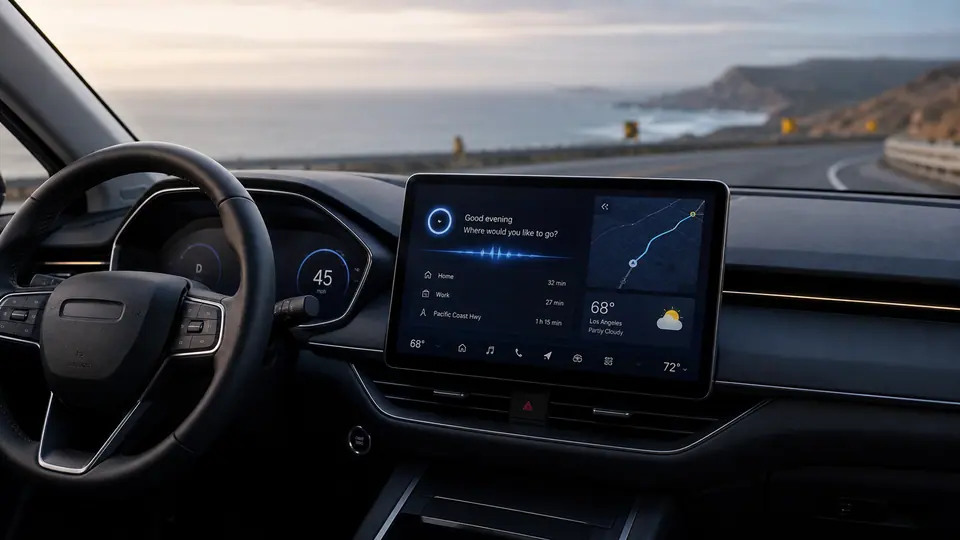
Vehicle AI assistants are starting to look less like a novelty demo and more like a potential cockpit layer. That does not mean drivers need a chatbot in the dashboard for its own sake. It means the car is one of the few places where voice control has a natural reason to exist. Hands are busy, eyes should stay on the road, and the useful request is often tied to the vehicle itself: navigation, climate, charging, entertainment, maintenance, alerts, and route context.
The car is not a smart speaker
In-car assistants have to meet a higher bar than home assistants. A wrong answer in a kitchen is annoying. A confusing answer while driving can become distracting. The assistant cannot behave like a general chat window pasted into the infotainment system. It needs to understand vehicle context, use short responses, avoid unnecessary conversation, and know when not to engage. The best interaction may be a quick command, a confirmation tone, and a visible change on the screen.
Context is what separates a useful cockpit assistant from a gimmick. If the driver says it is cold, the car should know that climate settings are relevant. If the route includes a long drive, an electric vehicle assistant should understand charging stops. If a warning light appears, the assistant should explain it in calm, simple language and suggest safe next steps without pretending to be a mechanic. If passengers ask for music or a nearby restaurant, the system should handle that without burying important driving information.
Reliability matters more than personality
Consumer AI often rewards charm. Cars reward reliability. Drivers need commands to work the first time, especially for common functions like temperature, defrosting, volume, calls, directions, and seat controls. If the assistant frequently misunderstands, people will stop using it and return to buttons or touchscreens. That is not a failure of voice as an idea. It is a reminder that driving leaves little patience for experimental interfaces.
Distraction control is equally important. A vehicle assistant should not deliver long speeches, ask too many follow-up questions, or place complex menus behind voice prompts. It should be designed around short tasks and safe defaults. When a request is too complicated, the assistant should defer, simplify, or suggest handling it when parked. That restraint may be less impressive in a demo, but it is exactly what makes the feature trustworthy.
The dashboard is becoming a software surface
Automakers are interested in AI assistants because the dashboard is now a major software surface. Navigation, media, driver profiles, subscriptions, charging networks, service reminders, and phone integration all compete for space. Voice and context could reduce that complexity if implemented well. Instead of hunting through layers of menus, a driver could ask for a function in natural language and receive a focused result.
There is also a business incentive. A smarter assistant can make the car feel more connected to the automaker's services after purchase. That could include maintenance scheduling, feature education, route planning, or subscription features. This is where user trust becomes important. Drivers may welcome help that makes ownership easier. They may reject an assistant that feels like a sales channel in the middle of the cockpit.
Privacy also deserves attention. Cars can reveal where people go, when they travel, who they call, and what they ask inside the cabin. If voice assistants become more capable, automakers need clear settings for data collection, retention, personalization, and account linking. The driver should not need to decode a long policy to understand whether voice recordings or route-related requests are stored.
The opportunity is real because the car is one of the few environments where a good assistant can reduce screen use instead of adding to it. But the product has to be boring in the right ways: dependable, brief, context-aware, and easy to silence. The future cockpit assistant should not try to become the main character of the drive. It should help the driver do the next safe thing with less effort.