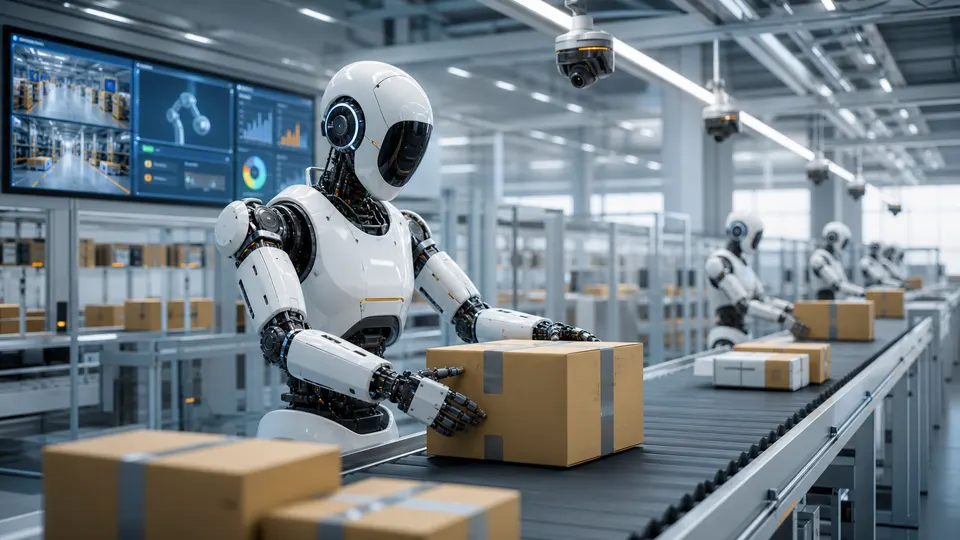
Figure's package-sorting milestone is the kind of robotics claim that gets attention for a good reason. Humanoid robots have lived for years in a fog of demo videos, investor decks, staged tasks, and ambitious timelines. A package count gives the story a harder edge. It suggests work was done repeatedly, not merely performed once for a camera.
That does not mean the claim should be accepted without questions. In robotics, the number is the start of the story, not the end. How many packages were handled? Over what period? In what environment? With what error rate? How much human intervention was required? Were the packages varied, awkward, heavy, damaged, reflective, or partially occluded? Did the system recover when something went wrong? Those details decide whether a milestone is a demo, a pilot, or an early sign of deployable labor.
Warehouse work is a serious test
Package handling is a useful robotics test because warehouses are structured but not perfectly predictable. Objects move. Labels vary. Lighting changes. Packages deform. Conveyors create timing pressure. A useful system has to perceive, decide, grip, place, and repeat without turning every edge case into a human rescue.
Humanoid robots face an extra burden because they are often judged against the promise of generality. A fixed industrial robot can be excellent at one constrained motion. A humanoid form is sold on flexibility: reaching different surfaces, navigating human-designed spaces, and adapting to tasks that were not rebuilt around a machine. That promise is attractive, but it also raises the standard of proof.
If a humanoid robot sorts packages reliably in a realistic setting, that matters. It could show that the form factor is moving from theatrical to operational. But the useful reader question is not whether the robot looks human. It is whether the system completes valuable work at an acceptable cost, speed, safety level, and reliability.
The missing numbers matter
Robotics companies understandably highlight big milestones. A large package count is easier to understand than a table of failure modes. But buyers will care about the boring metrics. Error rate. Damage rate. Human takeover frequency. Maintenance time. Battery life. Throughput. Safety incidents. Training time for a new site. Integration cost. Total cost compared with human labor, fixed automation, or a redesigned workflow.
The difference between 95 percent and 99.5 percent reliability can decide whether a system is useful. A robot that needs frequent intervention may still be impressive, but it can create a different kind of labor instead of removing work. Someone has to monitor it, reset it, clear jams, handle exceptions, and maintain the equipment.
That does not make the milestone meaningless. It means the milestone should invite sharper follow-up questions. Robotics progress often arrives in uneven steps. A system may first prove it can do a task under controlled conditions, then improve reliability, then expand object variety, then reduce cost, then scale across sites. Each step is real, but each step is different.
Robots need operational credibility
The broader robotics market is hungry for proof because labor shortages, warehouse pressure, and automation budgets are real. Companies want systems that can work in spaces built for people without requiring a complete rebuild. Humanoid robots are one possible answer, but they compete with many others: conveyors, sorters, autonomous mobile robots, robotic arms, better software, and changes to facility design.
For Figure, the strongest version of the story will be operational credibility. That means showing not only that robots can handle packages, but that they can do it safely, repeatedly, economically, and with enough context for customers to evaluate the claim. The more transparent the metrics, the more serious the milestone becomes.
The robotics hype cycle rewards dramatic visuals. Warehouses reward uptime. If Figure can keep moving from impressive package counts to clear deployment data, the story becomes much bigger than a demo. It becomes evidence that humanoid robots may finally be finding work where the shape of the machine has practical value. Until then, the right reaction is interest with a checklist nearby.