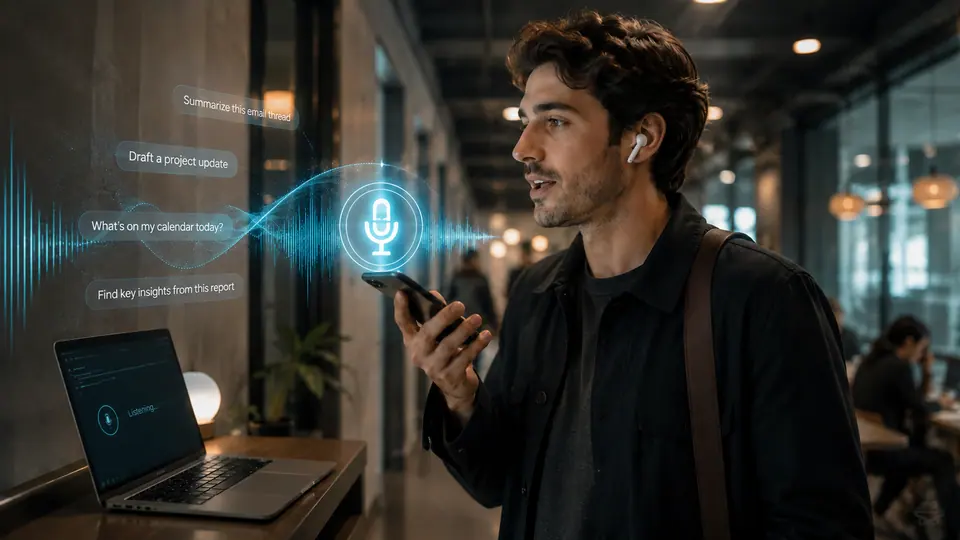
Voice-first AI is trying to challenge one of the most durable habits in computing: reaching for the keyboard. Recent funding and product attention around voice interfaces suggests that the next interface fight is not only about smarter assistants. It is about whether speaking can become the fastest way to capture ideas, edit text, and control lightweight workflows throughout the day.
The promise is easy to understand. People often think faster than they type. They remember tasks while walking, driving, cooking, or moving between meetings. They want to turn a rough thought into a note, message, reminder, outline, or search without stopping to open the right app and arrange the right words. A voice-first AI layer says: speak naturally, and let the system shape the result.
Voice is not just another assistant mode
The strongest voice AI products are not trying to recreate the old smart speaker experience. They are competing with typing. That means the useful use cases are practical and frequent: dictating a message, cleaning up a paragraph, capturing meeting follow-ups, creating a task, navigating an app, or making a quick edit without touching a keyboard.
This framing matters because many assistant products have struggled when they depend on users asking broad questions. Voice becomes more valuable when it is attached to immediate work. A person does not need a grand conversation with a machine to benefit from saying, turn this into a polite reply, add this to my project list, or summarize what I just said into three bullets.
AI also changes the expectations around dictation. Traditional speech-to-text tools treated the spoken words as the product. Voice-first AI can treat speech as raw material. It can remove filler, infer structure, adjust tone, and produce something closer to what the user meant to write. That makes voice useful even for people who do not speak in polished sentences.
The adoption barrier is comfort
Accuracy remains the first test. If a voice tool misunderstands names, terms, or context too often, users will return to typing. The cost of correction can quickly become greater than the benefit of speaking. The best products will need to handle messy audio, interruptions, accents, specialized vocabulary, and the difference between casual thought and final text.
Privacy comfort may be just as important. Speaking to an AI system feels more intimate than typing into a box. It can happen in shared spaces, near coworkers, or around family members. Users need confidence about when the microphone is active, where audio is processed, what is stored, and how easily they can delete or restrict recordings. A voice layer that feels always present can be useful, but it can also feel intrusive.
There is also a social dimension. People are not always comfortable talking to computers in public or professional settings. Voice-first tools may gain traction first in private contexts, mobile use, accessibility workflows, and jobs where hands-free capture is already natural. From there, the interface can expand as the behavior becomes less awkward and more clearly productive.
The keyboard will not disappear
The more realistic outcome is not that voice replaces typing everywhere. It is that voice becomes a parallel input layer for moments when typing is too slow, too formal, or physically inconvenient. The keyboard remains better for precise editing, coding, dense formatting, and quiet environments. Voice is better for capture, first drafts, quick commands, and turning thought into editable material.
That division could still be a major change. Many AI products today begin with a text box, which assumes the user is seated, focused, and ready to type. A voice-first layer opens different moments: the hallway thought, the commute note, the post-meeting recap, the quick instruction while another app is open. If AI is going to become more ambient, voice is one of the clearest paths.
The product challenge is to make speaking feel controlled rather than exposed. Users need accuracy, privacy, and fast correction. If voice AI can deliver those basics, it may not replace the keyboard, but it can claim many of the moments that typing currently makes people postpone or forget.