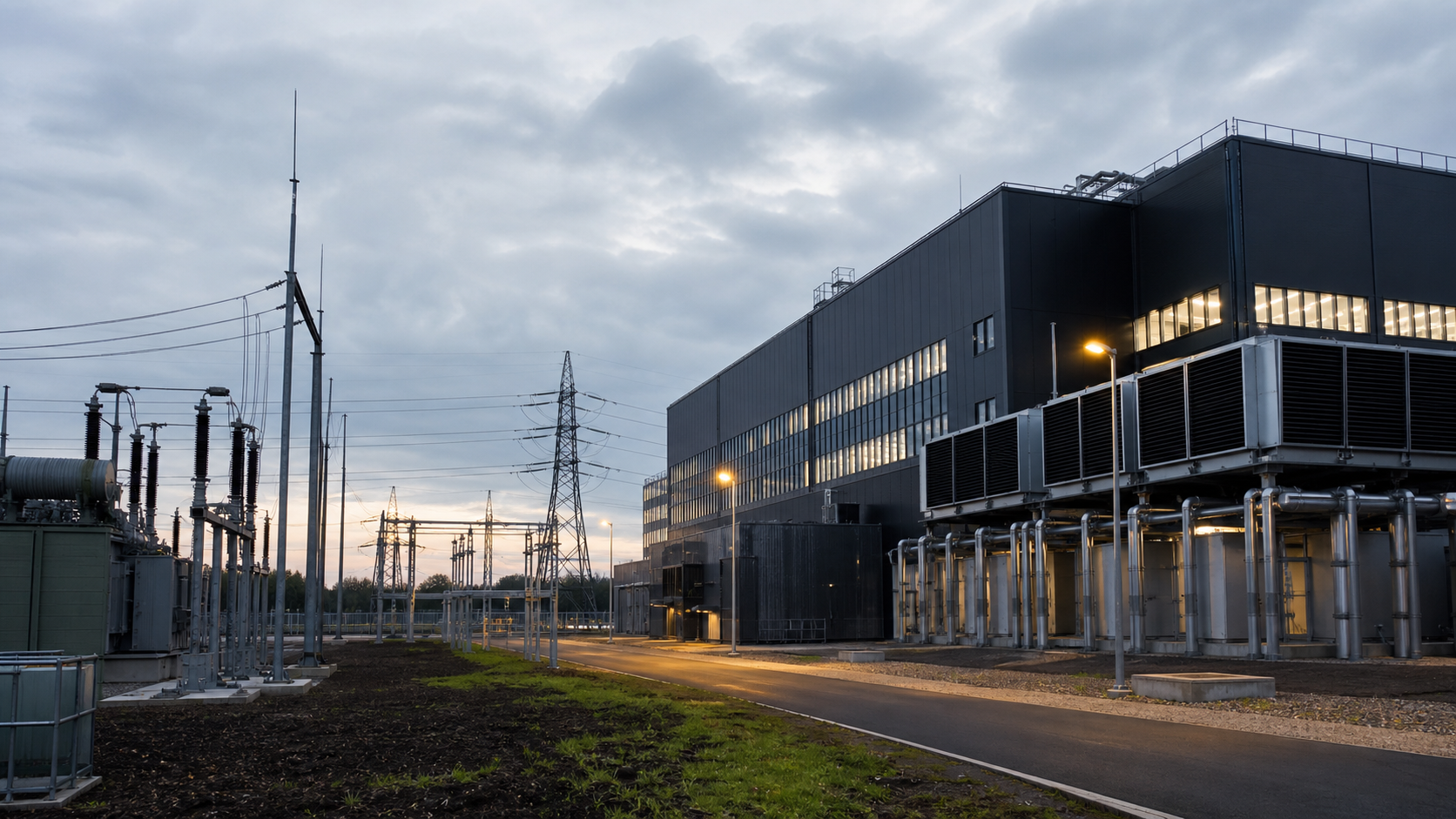
Europe has spent the past two years trying to prove it can be more than a regulatory superpower in artificial intelligence. The pitch is familiar: sovereign AI, trusted cloud, industrial data, strong universities, and a policy environment that can make enterprise buyers feel safer. But the AI race is now colliding with a less glamorous constraint. The next wave of AI needs power, and lots of it.
Data centers were already a difficult fit for European energy systems before the latest AI acceleration. Training clusters and heavy inference workloads change the math. AI facilities can draw the kind of load once associated with industrial sites, but they want to land quickly, scale fast, and sit close enough to fiber, customers, and renewable power contracts to make the economics work. That combination puts pressure on grids already managing electrification, heat pumps, EV charging, and the move away from fossil generation.
The bottleneck is physical
The bottleneck is no longer just chips or GPUs. It is grid access, permitting, cooling, power purchase agreements, and local consent. Ireland remains the cautionary example for many planners: data center growth brought investment and cloud capacity, then ran into concerns over electricity demand and grid stability. Other European markets are trying to attract AI infrastructure without repeating the same political fight.
The conflict is easy to understand. Governments want AI investment because it brings jobs, cloud capacity, and strategic relevance. Utilities want predictable demand and someone to pay for grid upgrades. Local communities want lower bills, cleaner air, and credible answers about water use, land use, and noise. Hyperscalers want fast interconnection and enough clean energy to defend their climate targets. Those goals can coexist, but not automatically.
AI sovereignty now includes substations
The bigger shift is that data center planning is becoming industrial policy. Europe cannot talk seriously about AI sovereignty while outsourcing the physical layer of AI to whichever region can plug in fastest. If local model training, secure public-sector AI, and enterprise inference are strategic priorities, then substations, transmission lines, battery storage, and clean firm power become strategic assets too.
That will force harder choices. Some projects may move toward Nordic markets with abundant low-carbon electricity and cooler climates. Others may cluster around regions with nuclear capacity or major offshore wind development. A few may be delayed because the economics no longer work once grid reinforcement costs are included. The most sensitive question is who pays. If consumers see bills rise while large AI campuses receive priority connections, the backlash will be swift.
There is also a timing mismatch. AI infrastructure demand can appear almost overnight by energy-sector standards. Grid upgrades move through planning processes measured in years. That gap favors companies that can bring an energy strategy, not just a site plan. Expect more deals involving dedicated renewable generation, long-term power contracts, batteries, and partnerships with utilities. Expect fewer credible claims that AI capacity can simply be dropped into existing grids without tradeoffs.
What buyers should ask now
Europe’s regulatory instincts may become an advantage if they move from paperwork to coordination. Transparent queue rules, clearer data center siting criteria, faster permitting for grid upgrades, and realistic reporting on power and water use would make the market less chaotic. The worst outcome would be a shadow race in which countries quietly compete on exemptions, subsidies, and grid priority while publicly promising sustainable AI.
The AI industry also needs to be more honest about efficiency. Better chips, model compression, caching, and workload scheduling can reduce the energy intensity of AI services, but efficiency gains can also increase total usage by making AI cheaper and more available. Europe should welcome efficiency, but not treat it as a substitute for infrastructure planning.
The message for enterprise buyers is practical. AI roadmaps now have an energy dependency. If a vendor promises massive private model capacity in Europe, ask where it runs, how it is powered, and whether that capacity is contracted or merely announced. Compute availability may become a procurement risk, not just a technical detail.
Europe can still win meaningful parts of the AI infrastructure race. It has dense enterprise demand, strong clean-energy ambitions, and a policy environment that could reward responsible buildout. But the next phase will be less about speeches and more about transformers, interconnects, and megawatts. The AI boom has reached the grid connection office.