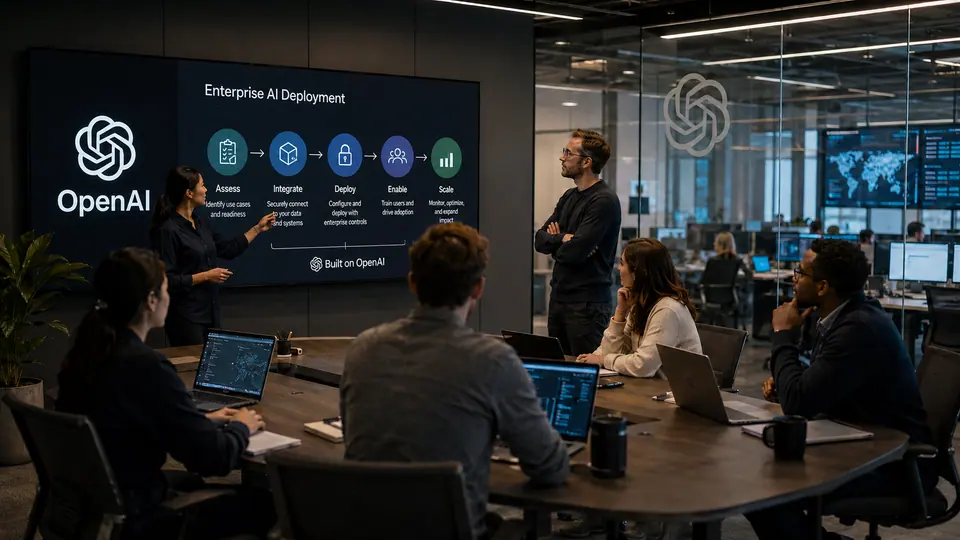
OpenAI's deployment-focused moves point to a larger shift in the AI market. The center of gravity is moving from model access toward implementation. For many customers, the important question is no longer whether a powerful model exists. It is who can turn that model into a working system, connect it to business processes, support it after launch, and help organizations manage the change.
That is a different contest from the early race to publish model improvements. Model quality still matters, and every major upgrade can reset expectations. But businesses do not buy capability in the abstract. They buy outcomes. A company considering AI for customer support, internal search, coding, analysis, or operations needs more than an API key. It needs integration, governance, training, measurement, and a path from pilot to production.
From access to adoption
The first phase of enterprise AI adoption was often experimental. Teams tested assistants, built prototypes, and looked for quick productivity gains. That stage rewarded novelty. The next phase rewards reliability. A working deployment has to fit existing systems, permissions, records, workflows, and compliance expectations. It also has to survive everyday usage by people who are not AI specialists.
This is where services and deployment muscle become strategic. A provider that can help a customer identify the right use case, configure the product, measure performance, and refine the workflow has an advantage over one that only offers raw capability. The market is asking who can carry the messy middle between an impressive demo and a durable business tool.
That messy middle includes decisions that rarely appear in launch headlines. Which employees should have access? Which data sources are safe to connect? How should the system handle uncertainty? What should be logged? Who reviews failures? How do teams measure whether the tool is improving work rather than just adding another interface?
The model is only one layer
AI services are becoming layered products. The model is the engine, but the surrounding system determines whether it is useful. Connectors bring in company data. Admin tools define permissions. Evaluation systems check performance. Human review processes catch mistakes. Training and support help employees understand where the tool belongs in their day.
This broader stack is why deployment may matter more than a single model announcement. A better model can improve the experience, but a poorly deployed system can still fail. It can answer the wrong question, expose the wrong data, or sit unused because employees do not trust it. Conversely, a carefully deployed system with a clear scope can create value even if the underlying model is not always the most advanced available.
The shift also changes the competitive landscape. AI companies are not only competing with one another on benchmarks. They are competing with consultancies, software platforms, cloud providers, and internal engineering teams that know how organizations actually operate. In that environment, the ability to package expertise becomes as important as the ability to ship features.
Rollout is now a product feature
For customers, this creates a more practical way to evaluate AI vendors. Ask less about the most spectacular demonstration and more about the deployment path. How long does it take to connect the system to real data? What controls are available? How are errors surfaced? Can the vendor support a narrow pilot and then expand without rebuilding everything?
Those questions may sound less exciting than model comparisons, but they are where adoption is decided. AI is moving into budgets, departments, and operational plans. Once that happens, the winner is not simply the company with the flashiest capability. It is the company that can help customers use the capability safely, repeatedly, and at scale.
OpenAI's deployment push is best understood in that context. It reflects a market that is maturing from fascination to implementation. The next phase of AI services will be measured by working systems, not isolated announcements.