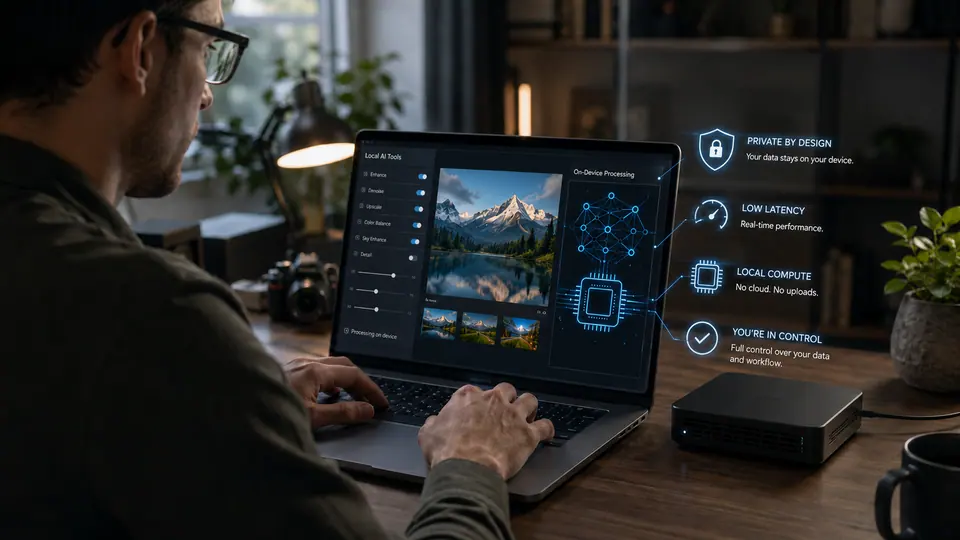
Local AI tools are finding their clearest argument in a familiar place: privacy. After a period when cloud assistants defined the category, a growing set of local and hybrid apps is trying to win users by keeping more work on the device. The pitch is not only that local execution can be faster. It is that sensitive documents, personal notes, internal drafts, and private files should not always have to leave the machine before AI can be useful.
That argument lands because many of the best AI use cases involve information people are careful about. A user may want help summarizing a contract, sorting medical notes, reviewing financial records, or searching a personal archive. A company may want employees to use AI with customer data or internal strategy documents. In both cases, the question is not whether AI can help. It is where the data goes and who controls the path.
The privacy pitch is becoming practical
Local AI once sounded like a niche concern for developers and privacy enthusiasts. Now it is becoming part of mainstream product positioning. A local app can say that it handles files on the user's device. A hybrid app can say that it keeps some operations nearby while sending harder tasks to stronger cloud models. That distinction gives buyers a clearer way to think about risk.
The strongest privacy case for local AI is not absolute secrecy. It is control. Users can decide which files are indexed, which features run offline, and which requests require a cloud model. For sensitive documents, even partial local processing can reduce anxiety. It can also make AI feel less like a distant service and more like a tool installed alongside the user's existing work.
Latency is part of the appeal too. Local execution can make small interactions feel immediate: rewriting a sentence, finding a note, extracting a task, or answering a question about a document already on the device. The more AI becomes a background layer for everyday work, the more those small delays matter. A tool that responds quickly and privately has an advantage for routine tasks.
Cloud models still have the edge
The case for local AI has limits. Cloud models continue to offer strong capability, broad integrations, and simple access across devices. For many users, convenience will beat architecture. They will choose the assistant that produces the best answer with the least setup. If the local option feels weaker, harder to configure, or cut off from the services people use, its privacy argument may not be enough.
This is why the likely future is not a clean split between local and cloud AI. It is a hybrid model. The practical middle ground is to run sensitive, repetitive, or latency-sensitive tasks locally while reserving complex reasoning, large context, or specialized tools for cloud services. That arrangement matches how users actually think. They do not want to study infrastructure. They want the right level of protection for the task in front of them.
Hybrid AI also gives product teams more room to explain tradeoffs. A document search feature might run locally. A deep analysis feature might ask permission to use a cloud model. A business app might let administrators set rules about which data can leave a device or workspace. Those controls are less dramatic than a pure privacy promise, but they are more likely to survive contact with real use.
The new trust interface
As local AI becomes more visible, privacy will need to be expressed in product design, not just marketing language. Users should be able to see when a task is local, when it is cloud-based, and what changes if they switch modes. Vague reassurance will not be enough for people working with sensitive material.
The broader shift is that AI tools are being judged not only by how clever they are, but by how they fit into personal and organizational boundaries. Local execution gives developers a powerful answer to that concern. Cloud capability gives them another. The products that combine the two honestly, with clear controls and plain explanations, may define the most durable version of everyday AI.