Agents Are Leaving The Experiment Folder
AI agents are starting to look less like clever demos and more like production services that happen to use language models. That shift changes the job for cloud teams. A chatbot that drafts a note can fail quietly. An agent that opens tickets, calls tools, changes configuration, queries data, or triggers a deployment needs the same operational discipline that teams already apply to APIs, workers, queues, and background jobs.
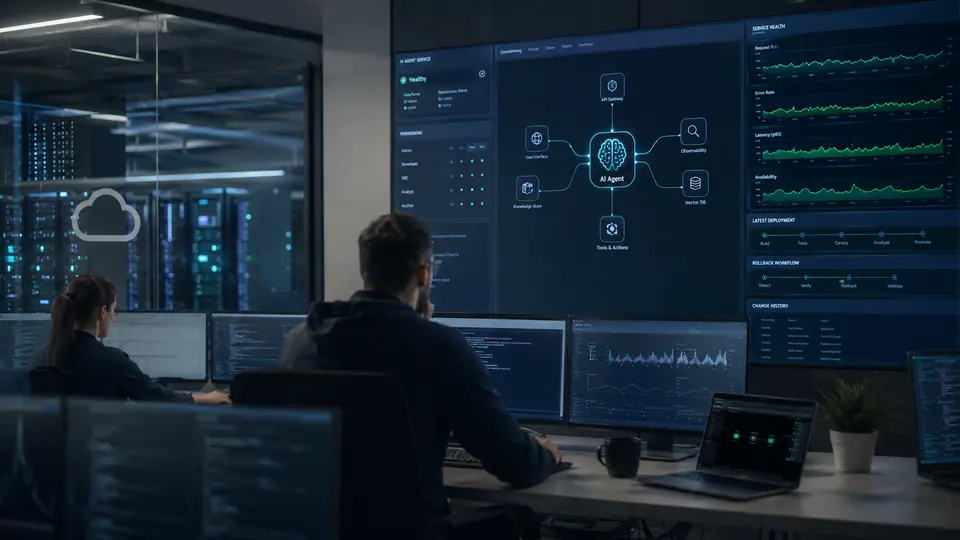
The important move is not just putting an agent behind an endpoint. It is wrapping the workflow in production controls. Teams need to know what the agent attempted, which tool it called, what permission it used, how long it took, what changed, and whether the result matched the expected path. Without that visibility, an agent becomes a black box with credentials, which is exactly the combination operators try to avoid.
Observability Has To Include Intent
Traditional monitoring can tell a team that a service returned errors, consumed memory, or crossed a latency threshold. Agents add a different layer. They make decisions through prompts, retrieved context, model responses, and tool calls. Observability needs to capture that chain in a form engineers can debug without exposing sensitive data everywhere.
For a production agent, logs should answer practical questions. What instruction did the system provide? What user request started the run? Which data sources were consulted? Which action was selected, and which alternatives were skipped? Did the agent retry because the model response was unclear, because a tool failed, or because a policy blocked the call? These details matter during incidents because the failure may not be a crashed process. It may be a plausible but wrong path through a workflow.
Metrics also need to become more task aware. Success rate, escalation rate, tool failure rate, policy denial rate, and manual override frequency can be more useful than raw model latency alone. If an agent is helping with cloud operations, the team should be able to tell whether it is reducing toil or creating review queues that humans must untangle later.
Permissions Are The New Blast Radius
The riskiest part of an agent is often not the model. It is the tool permission attached to the model. A read-only assistant can be useful with limited danger. An agent that can rotate secrets, modify infrastructure, change access policies, or approve workflow steps needs tight boundaries. Cloud teams already know how to think about identity and access management, but agents make the permission model feel more dynamic because the same credential may be used across many natural language requests.
A sensible design treats the agent as a service identity with narrowly scoped permissions. It should not inherit broad human administrator access just because it is acting on behalf of a trusted user. It should have explicit tool allowlists, environment boundaries, and approval gates for sensitive actions. For example, reading deployment status may be automatic, while rolling back production may require human confirmation or a signed workflow event.
Rollback paths matter because agents will make mistakes, and so will the systems around them. A production-ready agent workflow should leave behind enough state to reverse or compensate for changes. If it edits configuration, there should be a previous version. If it opens a pull request, there should be review context. If it triggers a job, there should be a clear cancellation path. The agent should not be treated as magic. It should be treated as automation that needs guardrails.
Cloud Platforms Are Packaging The Controls
Cloud platforms have a natural incentive to package these controls because customers do not want to assemble every piece from scratch. Monitoring, identity, policy, evaluation, audit logs, and deployment workflows are already part of the cloud operations surface. AI agents pull those features into a new shape. The platform that makes agent runs observable, permissioned, and recoverable will feel safer to teams that are ready to move beyond experiments.
That packaging is useful, but it also deserves scrutiny. Teams should ask whether they can export traces, route events into their existing incident process, define policies outside a single vendor console, and test behavior before a workflow reaches production. Agent controls should fit the operating model the organization already uses, not create a parallel universe where only the AI team can see what happened.
The practical takeaway is simple: if an agent can affect production, it belongs in production engineering. It needs owners, service level expectations, incident playbooks, change history, least privilege, and rollback plans. The more cloud teams treat agents like services, the less surprising their failures become. That does not make agentic systems easy, but it makes them operable, which is the real threshold between a demo and infrastructure.