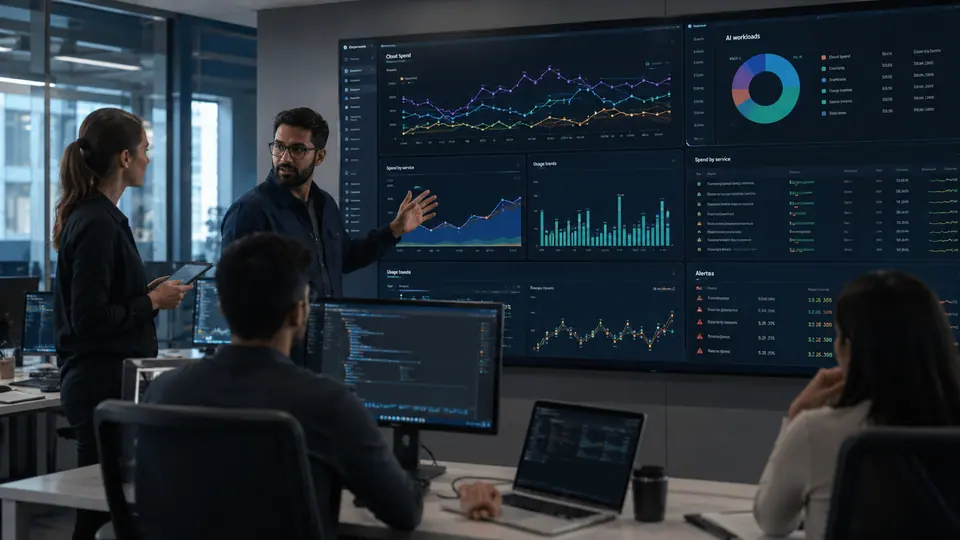
The Bill Is Now An Engineering Signal
The next cloud contest is cost visibility because modern workloads are becoming harder to predict. AI makes that more obvious. A feature can look small in the user interface while triggering model calls, embeddings, retrieval, batch processing, storage growth, and accelerator usage behind the scenes. If teams only understand the cost after deployment, they learn too late.
Cost visibility used to be treated mainly as a finance concern. Engineers built systems, cloud bills arrived, and finance teams asked questions. That loop is too slow for bursty AI workloads. FinOps has moved into the engineering workflow because architecture decisions now shape spend minute by minute. Model choice, caching, batching, prompt size, context retrieval, retry behavior, and traffic patterns all affect cost.
AI Makes Usage Less Intuitive
Traditional web services are not always cheap, but many teams have developed intuition around them. They understand instance counts, database load, storage growth, and network traffic. AI workloads are less intuitive because cost can be tied to tokens, accelerator time, model size, queue depth, indexing jobs, or background evaluations. A small product change can increase usage in several layers at once.
For example, adding richer context to a generated answer may improve quality but increase per-request cost. Running evaluation jobs more often may improve reliability but consume more compute. Allowing users to upload larger documents may increase storage, parsing, embeddings, and retrieval work. None of these choices is automatically wrong. The problem is making them without feedback.
Teams need cost signals before deployment. A pull request that changes an AI workflow should be able to show expected cost impact in the same way performance-sensitive systems show benchmark changes or test results. A staging environment should expose usage patterns before production traffic arrives. Product managers and engineers should be able to discuss tradeoffs with numbers instead of guesses.
Visibility Has To Be Granular Enough To Act On
A monthly cloud bill is too blunt for engineering decisions. Teams need to connect spend to services, features, environments, models, customers, and workflow steps. If an AI assistant becomes expensive, the team should know whether the driver is long prompts, repeated retries, inefficient retrieval, a costly model choice, or a batch job running too often.
Good cost visibility is actionable. It does not only say that spend increased. It points to the part of the system that changed and gives developers a path to improve it. That may mean recommending a smaller model for certain requests, caching repeated outputs, reducing context size, moving work to asynchronous jobs, or setting limits on high-cost operations.
Alerting also needs to become more intelligent. A sudden spike in AI usage may be legitimate if a product launch succeeded, or it may be a bug, abuse pattern, retry storm, or misconfigured job. Cost tools should help teams distinguish growth from waste. The best systems will combine usage metrics, deployment history, and service ownership so the right team sees the problem quickly.
Cloud Platforms Will Compete On Clarity
Cloud providers and developer platforms have an opportunity to compete on clarity. Pricing pages are not enough. Teams need estimates inside design tools, dashboards that match engineering ownership, policy controls before deployment, and reporting that explains cost in workload terms. For AI, that means showing cost by model, task, token pattern, endpoint, and environment where possible.
This is also where platform engineering becomes important. An internal platform can define approved AI services, standard observability, budget guardrails, and deployment checks. Instead of asking every product team to invent its own cost model, the platform can provide shared patterns. That makes experimentation safer because teams can see the economic shape of a feature early.
Cost visibility should not be used only as a brake. If handled well, it helps teams move faster. Engineers can choose an efficient design with confidence. Product teams can price features more intelligently. Finance teams can forecast without blocking every experiment. Leadership can understand which AI investments are creating value and which are simply consuming capacity.
The next cloud contest will not be won only by offering more services. It will be won by helping customers understand what those services are doing to their systems and budgets. As AI workloads make usage more variable, cost visibility becomes a developer experience feature. The teams that see cost before it surprises them will make better architecture decisions, and the platforms that provide that visibility will become easier to trust.