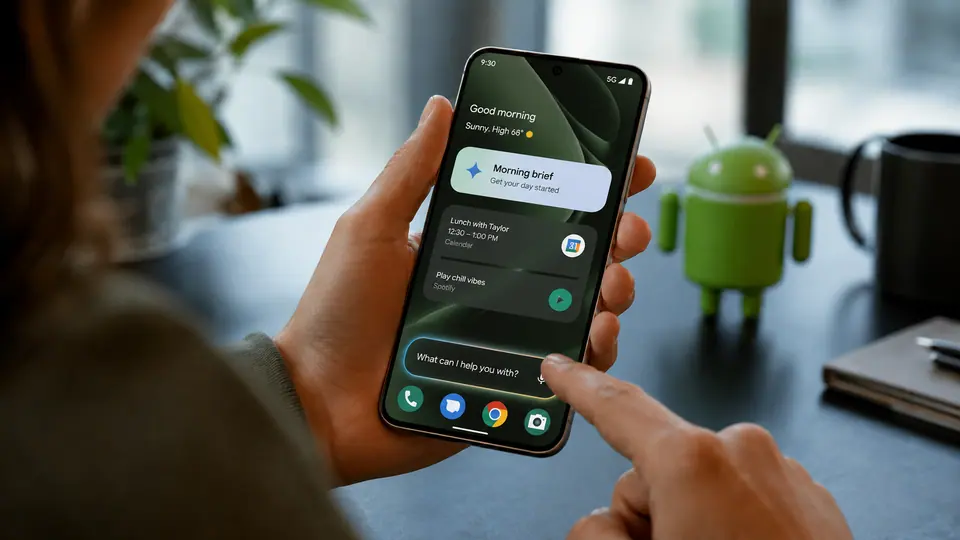
Android's AI overhaul points to a more aggressive phase for mobile assistants. The important shift is not simply that phones will have more AI features. It is that assistants are moving closer to the system surfaces people touch every day: search, messages, photos, notifications, settings, apps, and the home screen. Mobile AI is becoming a distribution problem.
That matters because most people do not want to manage another standalone AI app. They want help at the moment they are already doing something. On a phone, that moment can be short and fragmented. A user might need to summarize a message, find a photo, reply while walking, translate text, organize a reminder, or act on information inside another app. System-level access can make those tasks feel natural.
The assistant moves into the phone's rhythm
Mobile use is different from desktop use. It is more interrupted, more personal, and more context-heavy. The phone knows about location, contacts, calendars, media, recent activity, and app state. An assistant that can work across those surfaces may be far more useful than one confined to a chat window.
That is the opportunity behind deeper Android AI integration. If the assistant can understand what is on screen, help inside apps, or connect one small action to another, it becomes less like a destination and more like a layer. The user does not have to copy text into an AI tool. The AI tool is already near the text.
This could improve everyday tasks that are too small to justify opening a separate assistant. A long message can become a short summary. A photo search can use natural language. A notification can turn into a reminder. A draft can be rewritten before sending. The value is not one spectacular feature. It is a collection of tiny frictions removed from phone use.
Usefulness comes with sensitivity
The closer an assistant gets to the operating system, the more sensitive the privacy tradeoff becomes. A phone is not just another device. It holds conversations, photos, health-related information, financial apps, location history, and intimate routines. System-level AI may need broader context to be useful, but broader context also demands clearer boundaries.
Users deserve plain-language controls. They should know what an assistant can see, when it can act, what stays on the device, what goes to the cloud, and how to turn off access. If a feature uses screen context, that should be understandable. If a task requires cloud processing, the product should not bury that fact behind vague language.
The trust issue is not theoretical. Mobile assistants will be judged by whether they feel helpful without feeling nosy. A tool that interrupts too often, guesses too aggressively, or exposes private context in the wrong place can lose trust quickly. The phone is powerful because it is personal. That is also why mistakes feel personal.
The platform advantage
Android's AI direction also shows why mobile AI is a platform contest. The operating system has distribution that individual apps cannot easily match. It can place AI in default surfaces, connect permissions, and make features available across device categories. That gives system-level assistants a major advantage over standalone tools.
App developers still matter. Many useful actions happen inside third-party services, and the assistant's value will depend on how well it works with them. But the platform sets the rules of access and visibility. If AI becomes part of the phone's core interaction model, the operating system becomes the gatekeeper for how people encounter it.
For users, the best outcome is not an assistant that tries to take over the phone. It is one that reduces small burdens while giving clear control. Mobile AI will succeed when it respects the pace and privacy of daily phone use. Android's overhaul is significant because it moves that question from optional app behavior into the center of the mobile experience.