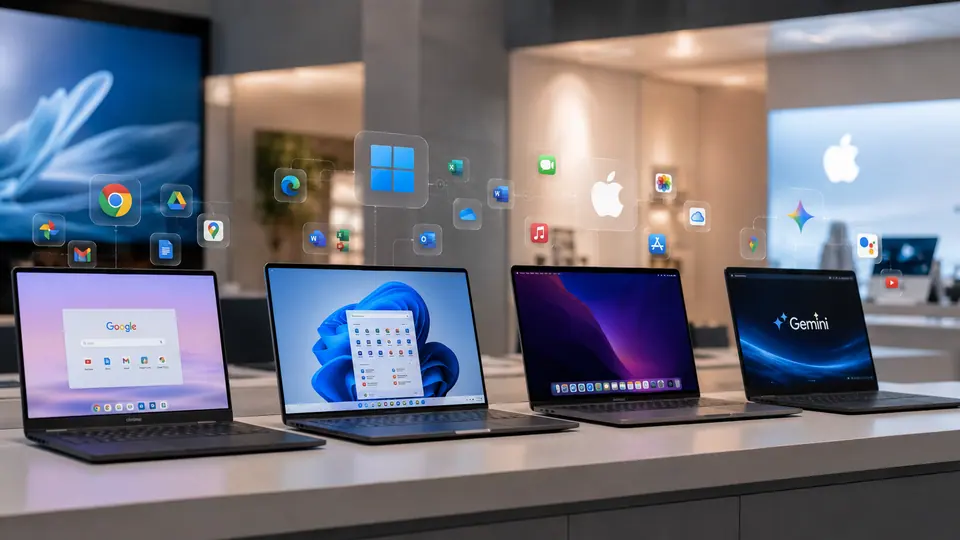
AI laptops are increasingly being marketed through chips, performance numbers, and new hardware labels. But the more important battle is moving above the spec sheet. Device makers want AI to feel native, persistent, and useful across the operating system, browser, and everyday apps. That makes the AI laptop less a hardware category than a platform contest.
The shift is easy to miss because hardware launches naturally lead with processors and battery claims. Those details matter. Local AI features need enough compute to run efficiently, and consumers will care if AI drains the device or slows other work. Still, most buyers will not judge an AI laptop by theoretical model performance. They will judge it by whether the assistant helps them do something they already care about.
Workflows beat labels
The marketing around AI PCs is moving from raw capability toward workflows: summarizing meetings, finding files, rewriting text, editing photos, searching across local content, and assisting inside apps. These features depend on more than silicon. They require operating system access, app integration, privacy controls, and design choices about when an assistant should appear.
That is why the platform layer matters. The company that controls the system surface can make an assistant feel like part of the machine rather than another app to open. A browser can do something similar by placing AI close to search, tabs, writing, and web workflows. Device makers, operating system vendors, and browser companies all see the same opportunity: distribution for assistants is becoming a strategic asset.
For users, native placement can be genuinely useful. An assistant that understands the current document, open page, or recent file can reduce friction. It can turn AI from a separate destination into a tool available at the moment of need. But native placement also raises the stakes. The closer an assistant sits to daily computing, the more carefully it must handle permissions, context, and mistakes.
The consumer test is practical
Consumers are unlikely to reward AI laptops for vague intelligence. They will ask ordinary questions. Does the battery still last? Does the feature work offline when needed? Does it respect private files? Can it save time without requiring a tutorial? Does it make the laptop feel faster, clearer, or more capable?
Those questions should worry any company relying too heavily on branding. AI features that are hard to find, inconsistent across apps, or only useful in demos will not define the category. People already have cloud assistants, mobile apps, and browser tools. A laptop needs to justify why local or native AI is better in the context of the device itself.
Privacy is one possible advantage. If a laptop can process sensitive documents locally, summarize personal files without uploading them, or offer clear controls over what leaves the device, that becomes a meaningful distinction. But the privacy story has to be understandable. Users should not need to parse model architecture to know whether a feature is local, cloud-based, or hybrid.
A platform fight hiding inside a purchase decision
The AI laptop battle is also about who gets to shape user habits. If an operating system assistant becomes the default way to search files or write messages, it gains a powerful position. If a browser assistant becomes the default layer for web tasks, it can steer attention and workflow. If device makers build their own AI experiences, they can differentiate hardware beyond price and design.
This is why the category should be watched less as a parade of laptop launches and more as a distribution fight. The hardware enables the experience, but the software decides whether the experience matters. A fast chip with weak workflows will feel like unused potential. A well-integrated assistant with clear limits may become a reason to choose one device ecosystem over another.
The winner will not simply be the laptop with the loudest AI branding. It will be the one where AI feels useful, controlled, and worth the battery it consumes.