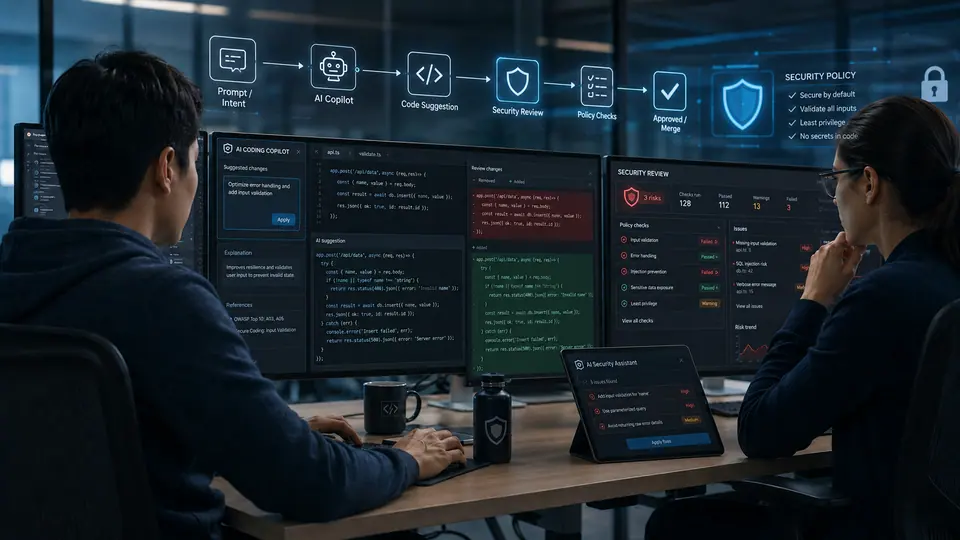
AI coding copilots have changed the speed of software work, but their next collision is with security review. Companies want the productivity gains of code generation, autocomplete, and automated refactoring. They also want evidence that AI-generated changes are not quietly widening risk through subtle logic errors, unsafe dependencies, or insecure patterns that look plausible in a pull request.
This tension is creating room for a category beside code generation: AI code review and AI security review. The appeal is straightforward. If one set of tools can help developers write code faster, another set of tools needs to help teams understand what changed and whether it is safe to ship. Speed alone is not the buyer's question anymore.
The risk is often invisible
Security teams are not only worried about obviously broken code. They are worried about changes that appear reasonable while altering behavior in risky ways. A generated patch might add a dependency with a weak maintenance history. It might skip an edge case in authentication. It might handle errors too broadly, expose more data than intended, or introduce a logic path that is hard to spot during a quick review.
These are not problems unique to AI. Human developers make similar mistakes. The difference is volume and confidence. AI tools can produce more code, faster, with a tone that makes the output feel complete. That can increase review pressure. If teams accept generated changes too casually, they may accumulate risk in places that are not obvious until later.
There is also a documentation problem. A human reviewer needs to know not just what lines changed, but why. Generated code can arrive without a clear trail of assumptions. If the developer using the copilot does not fully understand the suggestion, the review process becomes weaker. The team may be approving code that nobody has properly owned.
Review tools are becoming part of the AI stack
The natural response is to add more automation to the review side. AI security platforms can help flag suspicious diffs, summarize behavioral changes, identify risky dependencies, and point reviewers toward areas that deserve attention. Used well, these tools can reduce noise and help teams focus on the parts of a change that matter most.
But review automation has to be handled carefully. A tool that produces too many generic warnings will be ignored. A tool that misses important issues while sounding authoritative can create false confidence. The best role for AI review is not to replace security judgment. It is to make review work more targeted, explainable, and consistent.
This also changes how companies evaluate copilots. A code assistant should not be judged only by how much code it can produce. Buyers should ask how it fits into the development lifecycle. Does it support tests? Does it make generated changes easy to inspect? Does it preserve context for reviewers? Can the organization set policies around dependency changes, secrets, access control, and high-risk files?
The governance layer is coming
As AI coding becomes normal, companies will likely treat it less like an individual productivity perk and more like a managed engineering system. That means policies, logs, review requirements, and security checks. Developers may still use copilots freely, but generated changes will need to move through controls that match the risk of the codebase.
The goal should not be to slow every AI-assisted change. That would defeat much of the benefit. The goal is to separate low-risk help from changes that require scrutiny. A generated test, a small refactor, and an authentication change should not be treated the same way. Security review tools can help make those distinctions visible.
The broader lesson is that AI coding is not just a writing problem. It is a trust problem across the software delivery chain. Companies want faster development, but they also need confidence that faster code is not quietly becoming fragile code. The most durable products in this space will connect generation, review, and evidence into one workflow.