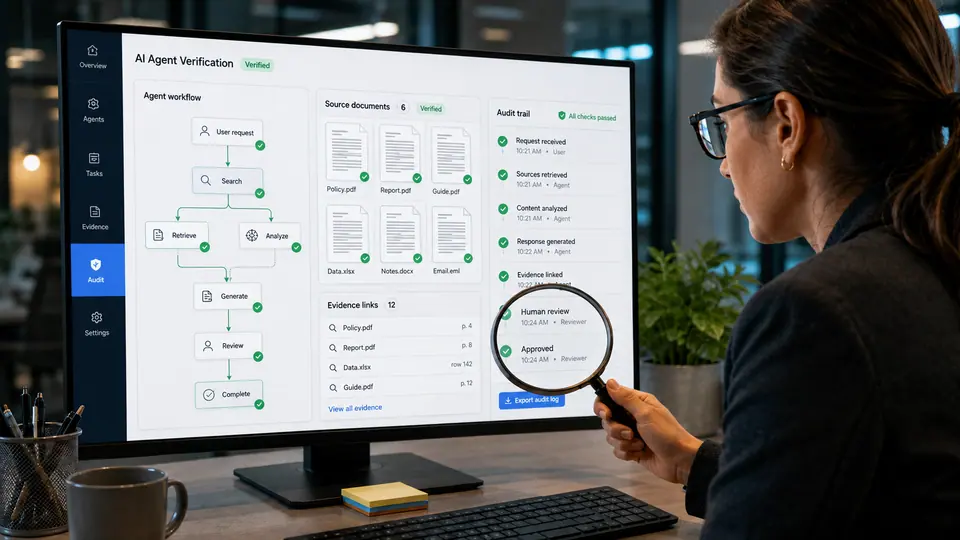
The next test for AI agents is not whether they can produce a polished demo. It is whether a user can calmly inspect what happened after the demo ends. As agent tools are increasingly described as workflow replacements, the gap between impressive movement on screen and dependable operational value is becoming harder to ignore. The central question is simple: can the person responsible for the work verify the agent's actions without replaying the entire task from scratch?
That question matters because agent products are being sold on delegation. They promise to search, summarize, draft, schedule, compare, update, file, and sometimes decide. In that framing, the agent is not just a faster chatbot. It becomes a temporary worker inside a process. The more a system claims to complete a workflow, the more it needs to show its work in a way that is useful to the human who owns the outcome.
The audit trail is the product
A credible agent experience needs more than a final answer. It needs a clear trail of inputs, tool calls, assumptions, rejected options, edits, and handoff points. If an agent compares vendors, the user should know which sources it considered and what it ignored. If it prepares a customer response, the user should be able to see which account details shaped the draft. If it updates a system, the change should be easy to review before it becomes permanent.
This does not mean every user wants a wall of logs. Most people do not want to inspect raw traces or internal reasoning. They want a readable record that supports confidence. The design challenge is to compress activity into a reviewable form: what was attempted, what changed, what remains uncertain, and where human approval is needed. That is a product problem, not just a model problem.
The handoff is equally important. Many agent demos show a tool moving from step to step as if every step is equally safe. Real workflows are messier. Some actions are reversible, some are sensitive, and some require judgment that belongs with a person or team. A useful agent should understand when to pause. It should make escalation feel normal rather than like a failure.
Demos reward motion, operations reward trust
The market has been trained to notice agents that look busy. A browser opens, forms fill, files appear, and the system reports completion. That visual rhythm is powerful because it makes automation feel tangible. But motion is not the same as reliability. A tool that moves quickly in the wrong direction can create more review work than it saves.
For teams, the cost of an unreliable agent is not only the original mistake. It is the uncertainty afterward. If people cannot tell whether an agent skipped a step, misunderstood a policy, or used stale information, they have to investigate. That investigation can erase the productivity gain. In some cases, it can make teams less willing to delegate future work.
This is why verification should be treated as a first-class feature. The winning products will not simply claim to automate longer tasks. They will make the work legible. They will give users confidence that an agent did the narrow job it was asked to do, within clear boundaries, with a visible path for review.
A calmer filter for the agent wave
Readers do not need to dismiss agent progress. The category is clearly moving beyond chat-style assistance, and some workflows will benefit from tools that can coordinate multiple steps. But it is worth applying a practical filter to every new claim. What exactly was delegated? What evidence is available afterward? Where does the human approve, correct, or stop the process?
Those questions cut through the theater of agent demos. They also help separate useful automation from risky abstraction. An agent that cannot be audited may still be entertaining, but it is not ready to replace important work. The real milestone is not when an AI can act on a user's behalf. It is when the user can verify those actions quickly enough to trust the delegation.