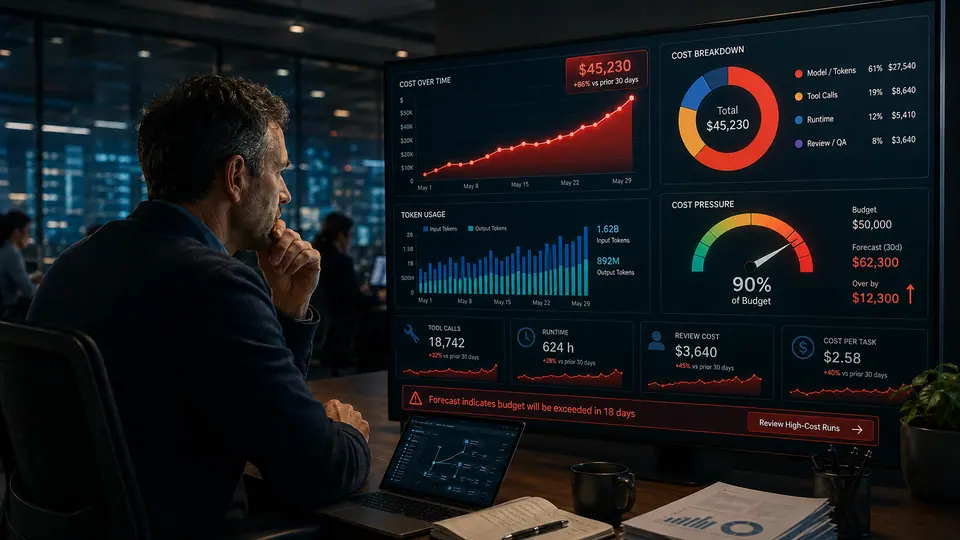
The cost problem for AI agents is becoming harder to hide. Early agent demos often focused on what a system could accomplish if allowed to run through a task. In real adoption, the question is more grounded: how much did that task cost, how many times did the agent loop, which tools did it call, and how much human review was still required at the end?
That matters because agent workflows can be open-ended. A simple assistant exchange usually has a visible boundary. A user asks, the model answers, and the cost is relatively easy to estimate. An agent, by contrast, may search, plan, call tools, inspect results, revise its plan, call more tools, and ask for confirmation. Each step can consume tokens, trigger paid services, and create review work.
Autonomy changes the budget
The promise of agents is that they can handle longer tasks with less supervision. The financial risk comes from the same feature. If a task is not tightly bounded, the agent may spend more than expected before producing a useful result. It may loop on a failed action, gather more context than needed, or keep refining an output that a human would have stopped earlier.
For individual users, this can turn into surprise usage. For companies, it becomes a planning problem. Enterprise buyers need to know whether a deployed agent can stay within a budget across hundreds or thousands of runs. They need cost ceilings, audit logs, and controls that prevent a routine task from becoming an expensive background process.
The issue is not only model usage. Tool calls can carry their own costs. Human review has a cost too. If an agent saves thirty minutes of drafting but creates twenty-five minutes of verification, the economic case is weaker than the automation story suggests. If it requires a specialist to clean up errors, the cost may simply move to a different line item.
Predictability becomes a feature
Agent products that want enterprise trust will need to make spending understandable. That means showing expected cost before a task starts, live usage during execution, and a clear summary afterward. It also means letting administrators set limits: maximum steps, maximum tool calls, approval gates for expensive actions, and automatic stops when confidence is low.
These controls may sound unglamorous, but they are central to adoption. Businesses are used to paying for software seats, cloud usage, and support. They can handle variable costs when the variables are visible. What they dislike is uncertainty. An agent that acts like a black box with a meter attached will be difficult to scale responsibly.
Cost visibility also improves product quality. If users can see that an agent spent most of its effort searching irrelevant material or retrying a failed action, that becomes feedback. Developers can tighten workflows, improve prompts, adjust tools, or redesign the task. Without cost traces, inefficient behavior stays hidden until the bill arrives.
The useful agent is a bounded agent
The future of agents is likely to be less autonomous than the most dramatic marketing suggests, at least in business settings. The strongest products may be those that define narrow jobs, clear stopping points, and explicit handoffs. They will not ask users to trust unlimited exploration. They will say what the agent is allowed to do, how much it may spend, and when a person takes over.
This does not make agents less interesting. It makes them more usable. A bounded agent can still save time by handling repetitive research, drafting, comparison, or system updates. The difference is that the user and the organization can understand the tradeoff before deploying it widely.
The cost conversation is a sign of maturity. It means buyers are moving from curiosity to operations. Once agents are treated as real workflow tools, budgets, logs, and limits become part of the product. The winners will not be the agents that run the longest. They will be the ones that make useful work predictable.