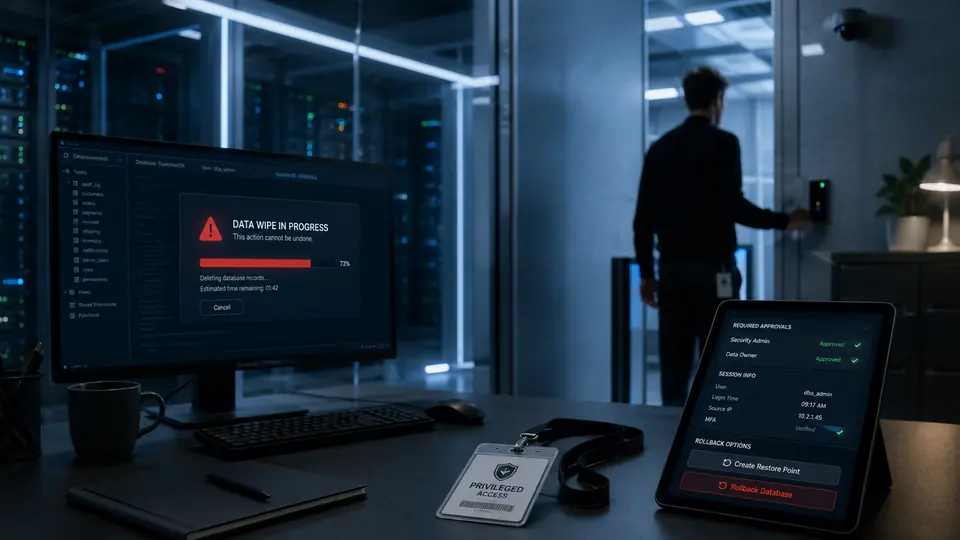
Backups are not a full access strategy
Destructive database incidents highlight a lesson that many organizations learn too late: backups matter, but they are not enough. If a privileged user or process can wipe data without friction, the organization is relying on recovery after the damage rather than prevention before it. That may work in some cases, but it can still mean downtime, data loss, customer impact, investigation cost, and a painful scramble to understand what happened. Insider access does not always mean a malicious employee. It can also mean a compromised account, a mistaken command, or an automation path with too much power.
The safer approach is to treat destructive access as exceptional. Deleting production data, dropping tables, disabling audit logs, or changing backup policies should not feel like ordinary maintenance. Those actions deserve approvals, alerts, and records that survive the incident. If one account can both destroy data and hide the trail, the organization has a serious control problem.
Friction should appear at the dangerous moment
Security friction is often unpopular because it can slow people down. The trick is to place it where it matters most. Routine read access and low-risk changes do not need the same controls as irreversible operations. Destructive database actions should trigger extra checks because the potential damage is high. That might mean requiring a second approval, using just-in-time elevation, limiting access windows, or forcing commands through a controlled administrative path.
Alerts are also essential. A destructive action should not be discovered only when an application fails or a customer complains. Security and operations teams should know quickly when unusual deletion, privilege escalation, backup modification, or bulk export behavior occurs. The alert does not have to assume bad intent. It simply recognizes that certain actions are important enough to verify immediately.
Small teams need guardrails too
Large organizations may have formal identity systems, database activity monitoring, and separation of duties. Smaller organizations often do not. A founder, lead developer, or operations generalist may hold broad access because there are not enough people to divide responsibilities cleanly. That reality is understandable, but it does not remove the risk. In a small team, one compromised admin account can be enough to create a crisis.
There are practical steps that fit smaller environments. Use separate accounts for daily work and privileged administration. Require multifactor authentication for database consoles and cloud accounts. Keep backups in a location that the same production admin account cannot easily delete. Test restores, not just backup creation. Log administrative actions and send important events to a place that is harder for a single user to erase. For the most dangerous operations, create a habit of peer confirmation, even if the peer is another founder or trusted contractor.
Reversibility should be designed, not assumed. Point-in-time recovery, protected backups, soft delete patterns, and staged deletion workflows can reduce the finality of mistakes or abuse. If a system supports retention locks or delayed deletion for backups, those controls can create valuable breathing room. The goal is to make the first destructive command less final and the second suspicious step more visible.
The human side matters as well. Teams should avoid creating a culture where all access is permanent because trust is high. Trust and controls are not opposites. Good controls protect trusted people from mistakes, protect the business if an account is stolen, and create evidence if something malicious occurs. Database wipes are dramatic, but the lesson is ordinary: privileged access needs limits, logs, approvals, and recovery paths. Without that friction, one bad moment can become the whole incident.