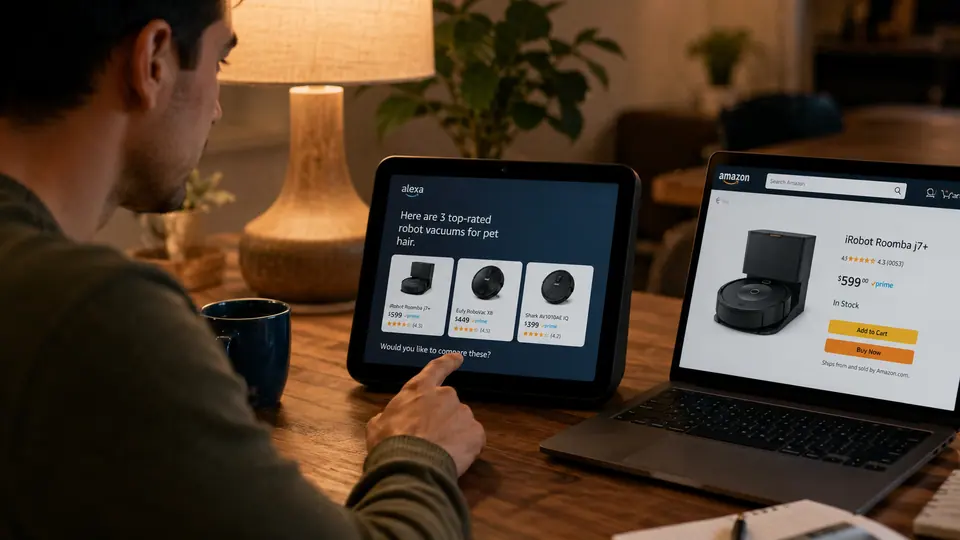
Shopping Assistants Sit Near The Sale
Amazon's assistant strategy is especially important because shopping is a decision environment. An AI feature inside a general productivity tool may help users think, write, or summarize. An AI feature inside a shopping journey can directly influence what someone buys. That makes the assistant both useful and commercially sensitive.
Online shopping already involves ranking, reviews, recommendations, sponsored placements, filters, and comparison tools. AI adds a conversational layer on top of that system. It can explain differences between products, summarize reviews, suggest tradeoffs, answer practical questions, and narrow a crowded category. For shoppers, that can reduce fatigue. For the platform, it creates a new surface close to revenue.
The Ranking Question
Trust depends on how recommendations are ranked. If an assistant suggests a product, users will wonder whether the answer reflects their needs, product quality, availability, price, sponsorship, margin, delivery speed, or some combination. Traditional shopping pages already blend many signals, but AI responses can feel more authoritative because they sound like advice.
That tone changes the responsibility. A list of search results invites comparison. A conversational recommendation can feel like a conclusion. If the assistant does not explain why it prefers one option, the user may either overtrust it or distrust it completely. Neither outcome is ideal.
The best shopping assistants will show reasoning in practical terms. They can say a product appears relevant because of size, compatibility, review themes, price range, or delivery need. They should also make uncertainty visible. If reviews are mixed, if specifications are unclear, or if a recommendation depends on a user's preference, the assistant should say so.
Summaries Can Shift Buyer Behavior
Review summaries and comparison prompts can strongly influence purchases. Many shoppers do not read hundreds of reviews. They look for patterns: battery life, durability, fit, setup, noise, comfort, customer support. AI can extract those patterns quickly. That is useful, but it also means the summary becomes a gatekeeper for user perception.
A balanced summary matters. Overemphasizing positives can make weak products look safer than they are. Overemphasizing negatives can punish products unfairly. The assistant needs to preserve tradeoffs rather than flatten them into a single recommendation. Shopping decisions are often contextual. The best product for one user may be wrong for another.
Comparison tools create another layer of influence. When an assistant chooses which products to compare, it defines the consideration set. Products left out may never be evaluated. That makes disclosure and control important. Users should be able to adjust criteria, ask for cheaper options, request non-sponsored alternatives where applicable, or compare by specific needs.
Disclosure Is Product Design
Disclosure matters when AI changes buying paths. If a recommendation is affected by advertising, paid placement, platform preference, or availability constraints, users need clear signals. Disclosure should not be buried in a policy page. It should appear near the decision point, in language ordinary shoppers understand.
This is not only about compliance. It is about preserving confidence in the assistant. Once users suspect that every answer is just a sales tactic, the assistant becomes less useful. The commercial value of the tool depends on the belief that it helps the shopper, not only the marketplace.
Amazon also has to manage the relationship between sellers and AI surfaces. Sellers may care how their products are summarized, whether review themes are accurate, and how recommendation prompts affect visibility. As AI becomes a shopping layer, marketplace optimization may shift from search keywords and images toward assistant-readable product information.
A Shorter Path From Question To Purchase
The strategic opportunity is a shorter path from need to purchase. Instead of typing a broad query, scanning pages of results, opening tabs, and reading reviews, a shopper can describe the problem. The assistant can narrow the field and explain options. That is a powerful experience when it works.
But the closer the assistant gets to the buy button, the more important its product ethics become. It should help users make better decisions, not simply faster ones. It should reduce confusion without hiding tradeoffs. It should be clear when it is summarizing evidence and when it is recommending an action.
Amazon's advantage is that it already owns much of the shopping context: listings, reviews, pricing, logistics, and account history. That context can make an assistant highly useful. It can also make the assistant highly influential. The platform challenge is to turn that influence into trust rather than suspicion.
Shopping AI will not be judged only by whether it answers questions. It will be judged by whether buyers feel respected after the purchase. If recommendations prove helpful, users will return. If they feel steered, the assistant may become another layer to second-guess. In commerce, trust is not a soft feature. It is part of the conversion engine.