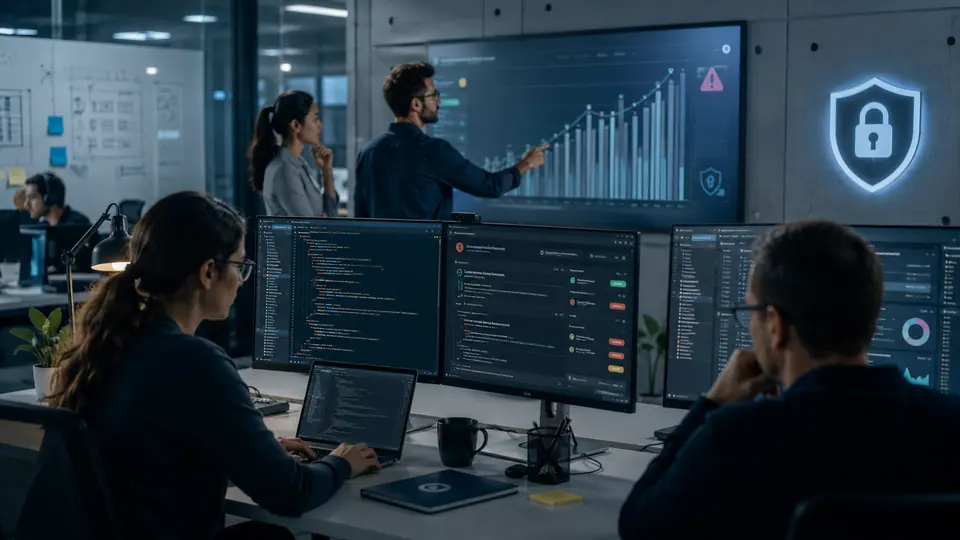
AI security startups are raising money around a simple market thesis: if AI helps teams produce more software, then review, monitoring, and governance have to scale as well. More code can mean faster shipping, but it can also mean more surface area, more dependencies, more configuration, and more chances for mistakes to reach production.
This does not mean AI-generated code is automatically unsafe. The issue is volume and velocity. When development accelerates, existing security processes can become strained. Human reviewers may face larger pull requests, more frequent changes, and less time to understand context. Security teams need tools that help them keep up without blocking every release.
Scanning Is Not Enough
Traditional security tools often focus on detection. They scan code, dependencies, containers, or infrastructure and produce alerts. That remains useful, but buyers are increasingly sensitive to alert fatigue. A tool that finds many possible issues but cannot prioritize them may create more work than it removes.
AI-era security startups are trying to move from scanning toward workflow control. That means helping teams understand which issues matter, who should fix them, whether a generated change violates policy, and how risk moves through the development process. The goal is not only to find problems. It is to keep software delivery safe while the pace increases.
False positives are a major buying concern. Security teams already struggle with noisy systems. If AI increases the number of findings without improving relevance, developers may ignore the tool. Startups that can reduce noise, explain risk clearly, and integrate into existing developer workflows will have a stronger case.
Governance Moves Into Development
AI coding tools also create governance questions. Which code was generated? Which model or assistant was used? Did the output include insecure patterns? Was sensitive information exposed in a prompt? Did the team rely on a dependency with licensing or maintenance concerns? These questions sit at the intersection of security, compliance, and engineering management.
That intersection is creating room for new products. A company may want policy controls around AI coding assistants, review systems that understand generated changes, or monitoring that connects code output to production behavior. The buyer may be the security leader, but the product has to work for developers too.
This is where many security startups fail or succeed. If a tool slows engineers down without a clear payoff, adoption suffers. If it fits naturally into code review, issue tracking, continuous integration, and deployment systems, it can become part of the normal workflow. AI security is not only about catching threats. It is about shaping how teams build software when generation becomes routine.
The Market Thesis Is Practical
The funding interest in AI security is not based only on fear. It is based on a practical scaling problem. Software organizations want the productivity benefits of AI, but they cannot allow review quality to collapse. The more code enters the system, the more important prioritization, context, and automation become.
There is also a broader trust issue. Enterprises may hesitate to expand AI coding if they cannot measure and control the risk. Security startups that provide visibility can help unlock adoption. In that sense, they are not only selling protection. They are selling confidence that AI-assisted development can be managed responsibly.
The category will likely become competitive quickly. Large security vendors, developer platforms, and AI coding tools all have reasons to add protective features. Startups need a precise wedge, such as better review intelligence, stronger policy enforcement, cleaner developer experience, or deeper understanding of AI-generated patterns.
As code volume rises, the security bottleneck becomes more visible. The winners will not be the tools that shout the loudest about risk. They will be the ones that help teams ship more software without losing control of quality, accountability, and trust.