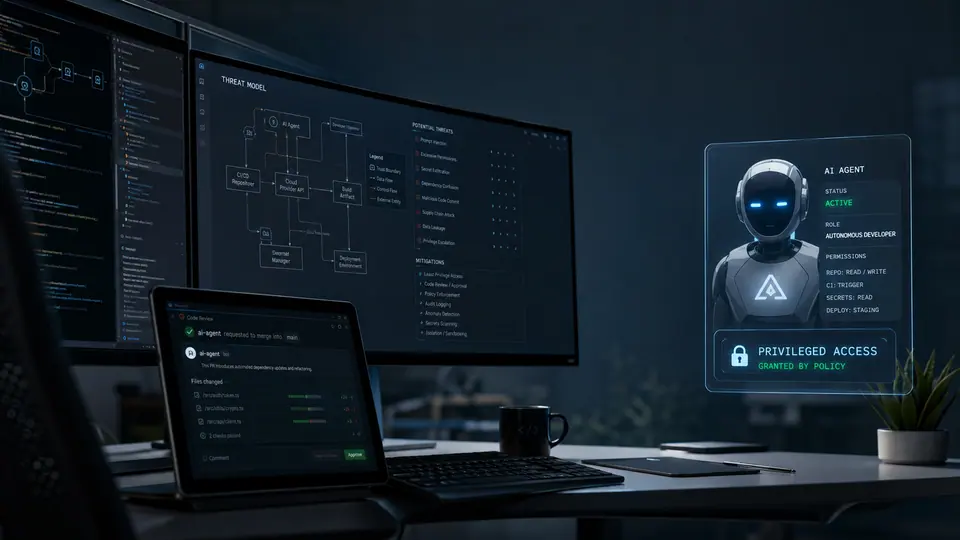
A helper with permissions is still a privileged actor
AI coding agents are often introduced as productivity tools, but once they can read repositories, write files, run commands, or open pull requests, they become part of the security model. That shift is easy to miss because the interface feels conversational. A developer asks for a fix, the agent suggests a patch, and the workflow looks like assistance. Underneath, however, the agent may be operating with access that would normally belong to a trusted engineer or automation system. It can see context-rich code, configuration, tests, comments, secrets if they are present, and sometimes the surrounding command output that explains how the project works.
That does not mean teams should avoid coding agents. It means they need threat models before broad permissions are granted. The question is not whether an agent is useful. The question is what it can observe, what it can change, what it can execute, and how a team would notice if something went wrong. A tool that can make sweeping edits at speed needs more than enthusiasm around it. It needs boundaries.
Prompt risk is only one piece
Many discussions about AI security focus on prompt manipulation, but coding workflows add project manipulation as well. A repository is full of instructions, examples, scripts, issue text, generated files, comments, and documentation. Some of that material may influence what an agent decides to do. If the agent treats project content as guidance, then malicious or simply careless text inside the workspace can become part of the workflow. The risk is practical rather than theoretical: the agent is being asked to transform code based on local context.
The agent also changes the pace of review. A human developer may produce a small patch after reading a few files. An agent can touch many areas quickly, sometimes with confidence that hides uncertainty. That speed is valuable, but it raises the cost of weak review habits. Teams need to know whether the agent only proposes changes, whether it can apply them, whether it can run commands, and whether it can reach the network. Each added permission changes the risk profile.
Permission boundaries should be boring and clear
A practical model starts with least privilege. Agents should get the minimum access needed for the task at hand, not a standing invitation to the whole environment. Read access, write access, command execution, dependency installation, and deployment rights should be treated as separate decisions. Sensitive repositories may need stricter modes than documentation sites or internal prototypes. The goal is not to slow every task. It is to avoid giving one conversational interface a bundle of privileges that nobody would grant to a new script without review.
Logging matters just as much. Teams should be able to answer basic questions: which agent changed which files, what command did it run, what input did it receive, and who approved the result. Without logs, an agent-assisted change can blur accountability. With logs, it becomes another auditable development tool. That is especially important when multiple people and automated systems share the same repository.
Review remains the final guardrail. Agent output should be reviewed as code, not as advice from a clever assistant. Generated changes can compile and still introduce unsafe behavior, weak validation, excessive permissions, or fragile assumptions. The safer habit is to pair agents with branch protection, tests, code owners, secret scanning, and human approval for risky operations. AI coding agents can improve throughput, but throughput without boundaries creates a new class of privileged activity. Treating the agent as a real actor in the system is the first step toward using it safely.