


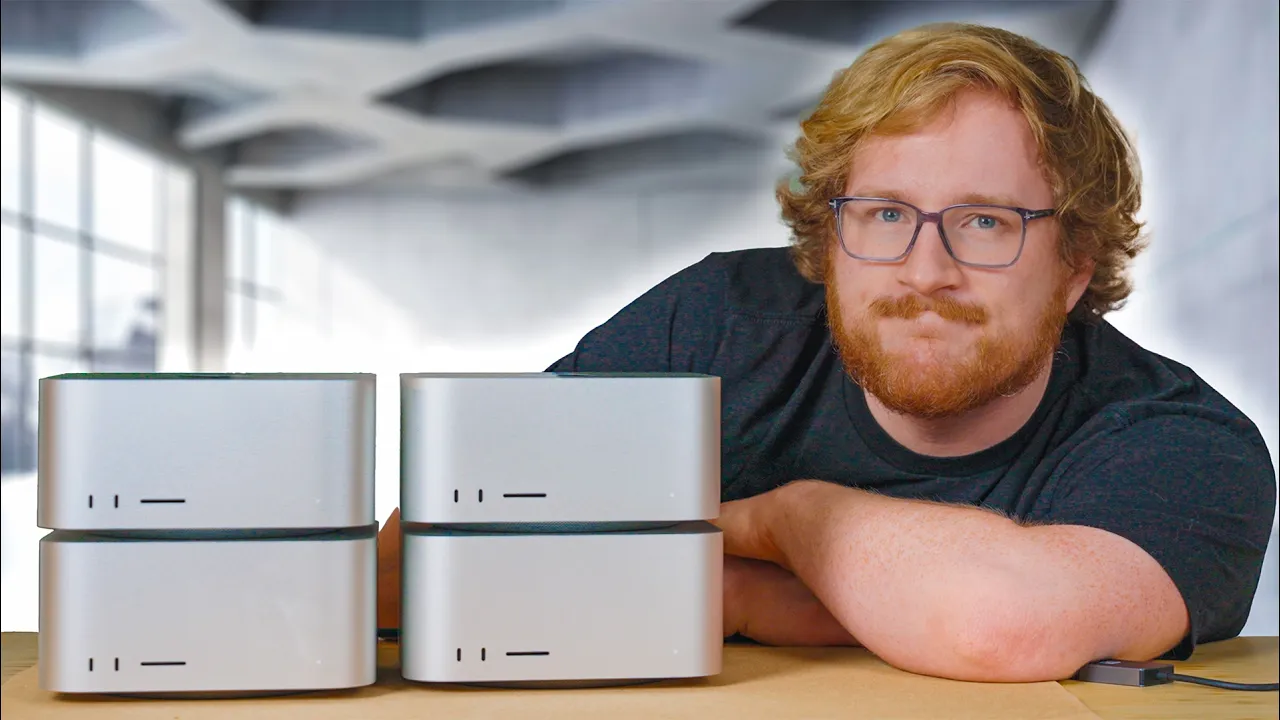
Running large language models (LLMs) has traditionally been a choice between expensive cloud subscriptions like OpenAI and Google Gemini or high-end NVIDIA consumer GPUs. However, a new frontier in local AI is emerging through the clustering of Apple Mac Studios. By combining multiple units, users can access massive amounts of unified memory that rival enterprise-grade supercomputers at a fraction of the cost.
The Power of Unified Memory
The core advantage of Apple’s M-series silicon, including the M1 Max and M3 Ultra, lies in its unified memory architecture. Unlike traditional PC setups where memory is split between the CPU and a dedicated GPU, Apple’s design allows the graphics cores to access the entire system RAM. When four Mac Studios are clustered together, they provide a combined total of 1.5 terabytes of unified memory. This capacity is essential for running “beefy” models like Llama 3.3 70B in full precision (FP16), which simply cannot fit on standard consumer hardware.
Breaking the Networking Bottleneck
Historically, clustering multiple computers for AI inference faced a major hurdle: networking latency. Standard 10 Gigabit Ethernet acts as a severe bottleneck. In testing, running Llama 3.3 70B on a single Mac Studio yielded approximately 5 tokens per second. Adding more Macs over an Ethernet connection using Pipeline Sharding failed to increase this speed, as the latency of moving data between machines was akin to a relay race held up by airport security.
The breakthrough arrived with the macOS Tahoe 26.2 beta, which introduced RDMA (Remote Direct Memory Access) over Thunderbolt. By using Thunderbolt cables to connect the Macs directly, users can bypass the traditional networking stack. This update reduces network latency by 99%, enabling low-latency communication for distributed AI inference using Apple’s MLX framework.
Performance Benchmarks: Llama and Kimi
With the release of EXO 1.0 software, users can now easily cluster Mac Studios to run models locally. The performance gains with RDMA and Tensor Sharding are substantial:
- Llama 3.3 70B (FP16): A 4x Mac Studio cluster achieved 15.3 tokens per second. This is 3.25 times faster than a single machine and features an initial response time of just 1.129 seconds.
- Kimi K2 Instruct (4-bit): This Mixture of Experts (MoE) model reached 34.3 tokens per second on the 4x cluster using RDMA Tensor Sharding, compared to 22 tokens per second over standard Ethernet.
- DeepSeek V3.1 (8-bit): The cluster achieved approximately 24 tokens per second, demonstrating its capability with the latest high-demand models.
Efficiency and Cost Comparison
The Mac Studio cluster is not just about raw speed; it is about efficiency. While an NVIDIA H200 GPU can run Llama 3.3 70B (FP8) at roughly 51.14 tokens per second, the power draw and cost are significantly higher. A 4x Mac Studio cluster running DeepSeek V3.1 consumes only 480W, less power than a single NVIDIA H200 GPU.
From a financial perspective, the gap is even wider. A cluster of four Mac Studios costs significantly less than comparable enterprise solutions, such as the 8x NVIDIA DGX Spark units which retail for approximately $32,000. For researchers and developers who need to keep their data local and avoid subscription fees, the Mac Studio cluster offers a viable path to supercomputing performance on a desk.
Current Limitations
While the hardware is ready, the software is still evolving. The EXO 1.0 software currently has some limitations, including specific naming conventions required for Mac devices within the cluster and restricted support for certain custom models. Additionally, Mixture of Experts (MoE) models still face some software overhead that prevents them from reaching their theoretical maximum speeds in a distributed setup.
Despite these early-stage hurdles, the combination of M3 Ultra hardware and the “sneaky” release of RDMA over Thunderbolt 5 marks a significant shift. Performance that was once restricted to billion-dollar data centers is now becoming accessible through personal hardware.
