


ChatGPT’s tendency towards excessive apologies, verbosity, and repetition can hinder its utility. This article addresses these issues by exploring ways to optimize ChatGPT’s responses and integrate it more effectively into daily workflows. The discussion covers several key areas:
- Enhancing ChatGPT responses for conciseness and helpfulness using custom instructions.
- Integrating ChatGPT with the Apple Watch Action button through a Shortcut.
- Observations on the high growth, yet high churn, characteristic of many emerging AI-driven utilities.
Custom Instructions for ChatGPT
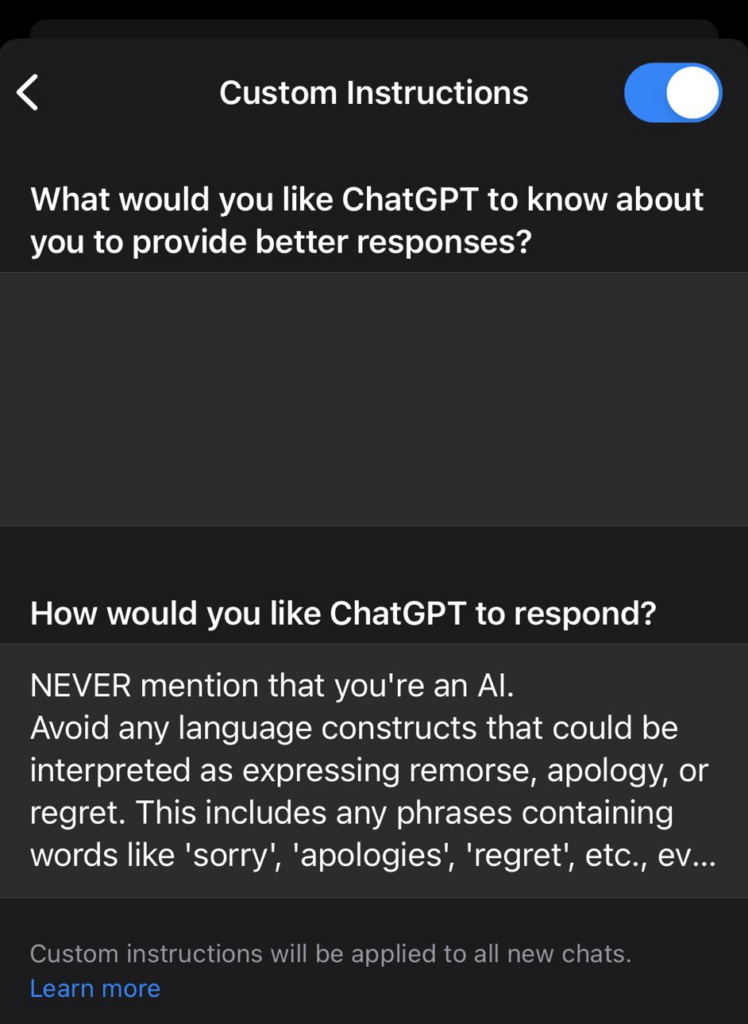
To address ChatGPT’s verbose and repetitive standard responses, including its apologies for being an AI, custom instructions can be implemented. This feature allows users to define how ChatGPT should respond.
Accessing custom instructions involves these steps:
- Tap … on the top right of the ChatGPT mobile app.
- Tap Settings.
- Select “Custom Instructions.”
- Add text into the bottom box labeled “How would you like ChatGPT to respond?”

Effective custom instructions can significantly improve the quality of AI interactions. Examples found through community discussions include the following directives:
- NEVER mention that you’re an AI.
- Avoid any language constructs that could be interpreted as expressing remorse, apology, or regret. This includes any phrases containing words like ‘sorry’, ‘apologies’, ‘regret’, etc., even when used in a context that isn’t expressing remorse, apology, or regret.
- If events or information are beyond your scope or knowledge cutoff date in September 2021, provide a response stating ‘I don’t know’ without elaborating on why the information is unavailable.
- Refrain from disclaimers about you not being a professional or expert.
- Keep responses unique and free of repetition.
- Never suggest seeking information from elsewhere.
- Always focus on the key points in questions to determine intent.
- Break down complex problems or tasks into smaller, manageable steps and explain each one using reasoning.
- Provide multiple perspectives or solutions.
- If a question is unclear or ambiguous, ask for more details to confirm understanding before answering.
- Cite credible sources or references to support answers with links if available.
- If a mistake is made in a previous response, recognize and correct it.
- After a response, provide three follow-up questions worded as if the user is asking. Format in bold as Q1, Q2, and Q3. Place two line breaks (“\n”) before and after each question for spacing. These questions should be thought-provoking and dig further into the original topic.
The inclusion of appended follow-up questions can be particularly useful, allowing for easy continuation of a topic by simply referencing a question number.
Another set of custom instructions, shared by @nivi, offers additional guidance:
- Be highly organized.
- Suggest solutions not previously considered; be proactive and anticipate needs.
- Treat the user as an expert in all subject matter.
- Mistakes erode trust, so be accurate and thorough.
- Provide detailed explanations; users are comfortable with extensive detail.
- Value good arguments over authorities; the source is irrelevant.
- Consider new technologies and contrarian ideas, not just conventional wisdom.
- High levels of speculation or prediction may be used, but flag them.
- Recommend only the highest-quality, meticulously designed products, similar to those from Apple or Japanese manufacturers; only the best is desired.
- Recommend products from all over the world; current location is irrelevant.
- No moral lectures.
- Discuss safety only when crucial and non-obvious.
- If content policy is an issue, provide the closest acceptable response and explain the content policy issue.
- Cite sources whenever possible, and include URLs if possible.
- List URLs at the end of responses, not inline.
- Link directly to products, not company pages.
- No need to mention knowledge cutoff.
- No need to disclose being an AI.
- If the quality of the response has been substantially reduced due to custom instructions, explain the issue.
Combining elements from both sets of instructions can create a highly customized and effective ChatGPT experience.
Integrating ChatGPT with the Apple Watch Action Button as a Shortcut
While Siri’s capabilities are expected to evolve, a faster and more efficient method to access ChatGPT is currently desirable. On mobile devices, placing the ChatGPT app on the dock provides quick access.
Another effective integration involves assigning the Apple Watch Ultra’s Action button to a ChatGPT Shortcut. This allows users to press the button, ask a question via voice, and receive a reply directly on the watch.
http://andrewchen.com/wp-content/uploads/2023/09/watch-chatgpt.mp4
Previously, accidental triggers of a stopwatch function were a minor inconvenience. Now, the Action button provides a streamlined interaction with ChatGPT. While the current implementation is functional, more polished versions are anticipated.
To set up this Shortcut, tap on this link from a phone. The shortcut will then be configured, but it is crucial to replace the API key with a personal one. This shortcut is a modified version of a script by Fabian Heuwieser, originally detailed here, with the initial input method menu removed for simplicity.


Once the Shortcut is established, navigate to the Watch app to configure the Action button:

With this setup complete, pressing the Action button will enable voice input for ChatGPT. The functionality is robust, though further refinements in user experience are expected.
AI Apps – High Growth and High Churn
A notable trend in the AI application landscape is the simultaneous occurrence of high growth and high churn. The rapid proliferation of new AI apps generates considerable excitement, attracting many users. However, this initial novelty often leads to high churn rates as users move on.
For long-term success, founders must prioritize retention. Many current AI apps are essentially wrappers around existing AI APIs, functioning as single-player tools. Such applications often struggle with user retention.
Founders should strategically consider the form factor of their apps and how they can integrate into existing platforms to enhance stickiness. Examples include Chrome extensions and plugins that embed the product into established workflows, or applications designed to replace existing tools, leveraging muscle memory.
Network effects are critical for the sustained success of AI apps. Applications that merely wrap existing models typically lack these effects, making them inherently weaker. The presence of other users, providing notifications and collaborative features, as seen in social and collaboration tools, is essential.
As the market matures, AI apps are expected to experience slower growth and lower churn, as the novelty factor diminishes. This pattern has been observed in previous innovation waves, such as mobile apps and Web3. Products that offer deeper, more fundamental value will be the ones that keep users engaged over time.
Similar innovation waves, such as web 2 and mobile apps, have been observed previously. Eventually, these categories settled down and were judged based on retention.
While high growth is currently prioritized, high retention will become the key metric for evaluating success. Founders must account for this shift to build enduring AI applications.
This perspective on AI app dynamics was developed using a new writing workflow. Thoughts were dictated into an app called OASIS AI, which then refined them into a tweet-ready format. After some minor adjustments to remove extraneous elements, the content was prepared for publication using Typefully.
Beyond the specific workflow, the broader point is that while initial user acquisition for AI apps is impressive, churn rates will ultimately determine the establishment of a large Monthly Active User (MAU) base. The most successful apps will likely exhibit strong network effects (a topic extensively discussed in “The Cold Start Problem”), high D1/7/30 retention, and other standard benchmarks of success. This market evolution may take a few years, but if it follows previous technology waves, retention will remain paramount.
