


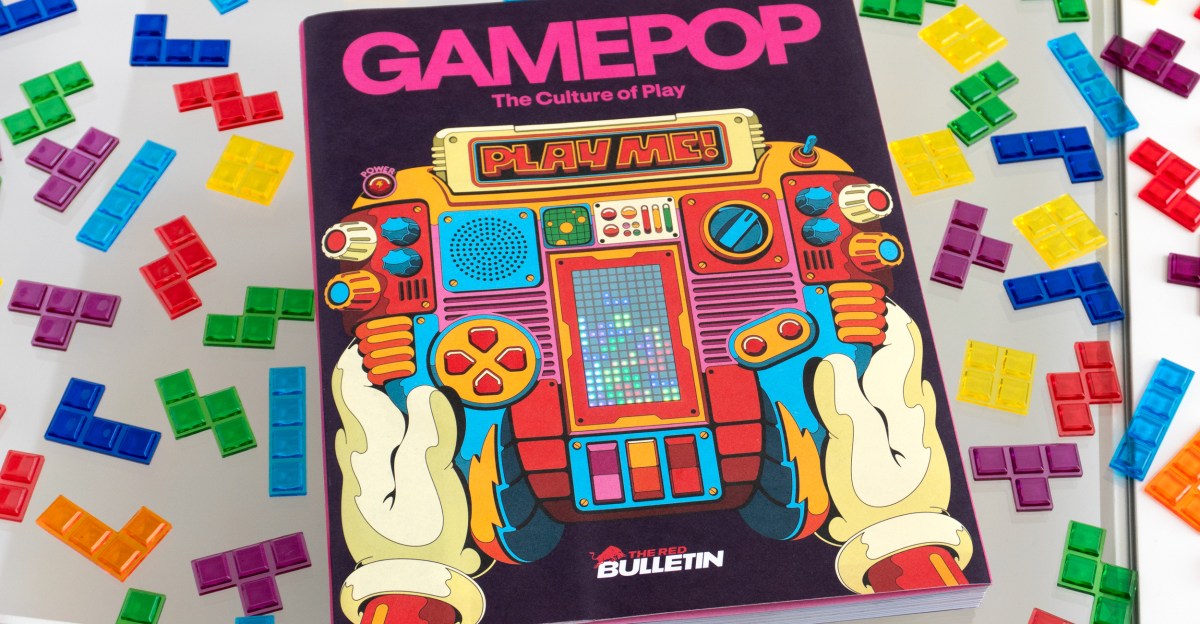
Tetris has appeared in various playable forms, from a McDonald’s chicken nugget to a 7-Eleven Slurpee cup and even a wristwatch. However, one of the most unique iterations of the classic puzzle game is now found within the pages of a magazine.
The Tetris Company previously collaborated with Red Bull for a gaming tournament, which famously transformed the Dubai Frame into the world’s largest playable Tetris installation using over 2,000 drones. Coincidentally, Red Bull Media House also released a special gaming edition of its The Red Bulletin magazine. A limited number of these 180-page magazines featured a playable Tetris game on the cover, a less massive but equally impressive technical feat.
Red Bull Media House partnered with Kevin Bates to develop this playable magazine. Bates gained recognition in 2014 for his ultra-thin Tetris business card. In 2015, he launched the Arduboy, a $39 credit card-sized, open-source handheld that fostered a developer community. Over ten years, Bates also produced two pocketable
devices under $30, and the compact USB-C Arduboy Mini.
The GamePop GP-1 Playable Magazine System represents Bates’ ongoing effort to redefine portable gaming using accessible and affordable technology. Its development spanned “most of last year,” according to Bates in an interview with The Verge. While specific collaboration details with Red Bull remain undisclosed, Bates’ expertise in creating flexible, officially licensed Tetris devices was crucial for this project. He provided insights into the technical aspects of its creation.

Despite advancements in OLED technology, which allows for folding tablet-sized devices, these displays remain costly and delicate. To embed a durable display into a flexible magazine cover, Bates engineered a custom matrix of 180 tiny 2mm RGB LEDs on a flexible circuit board, only 0.1mm thick. Although the display and coin-cell batteries increase the thickness to almost 5mm in certain areas, the device still feels remarkably like a paper-based handheld. The flexible circuits are laminated between two sheets of paper, forming a thin, pliable sleeve around the magazine.

Flexible circuits have been a staple in electronics for decades, found in devices ranging from vintage flip phones to modern laptops, often used for miniaturization. However, this technology has only recently become accessible to independent creators. Bates, who has experimented with flexible circuits for years, saw this collaboration as a chance to apply his knowledge to a real-world product.
While the GamePop GP-1’s display resolution is not comparable to OLED screens in folding phones, its durability is significantly higher. Beyond standard safety tests, Bates personally subjected the game to impact tests, including hitting it with a hammer, which the display successfully withstood. This contrasts sharply with folding phones, which are considerably less robust.

To maintain its thin profile, the game incorporates seven capacitive touch sensors directly “printed in the copper layer of the board,” as explained by Bates. Although there is no mechanical click, the paper’s slight flex provides a tactile sensation when pressed. Bates fine-tuned the sensors’ responsiveness to compensate for the paper thickness and adhesives used. While not designed for competitive Tetris play, the controls are surprisingly responsive and offer a more user-friendly experience compared to other Tetris devices.

The manufacturing cost of the flexible Tetris game remains undisclosed by both Bates and Red Bull. To manage expenses, not all components are flexible. A thin, rigid PCB, housing an ARM-based 32-bit microprocessor and four rechargeable LIR2016 3V coin cell batteries, is discreetly placed along the magazine’s spine within the cover.

The game supports USB-C charging, though the port is subtly integrated. A deconstructed USB-C port, featuring a small paper pocket with a pin-covered head instead of a metal ring, is located along the bottom edge of the magazine’s cover. While it may not offer the same durability as a typical phone charging port, it provides a valuable rechargeable solution, preventing the device from being disposable.
Some compromises were made in the GamePop GP-1’s design. While high scores are saved, modern Tetris features such as piece previews or the ability to hold tetrominoes are absent. Sound effects are present, but the iconic Tetris theme only plays a brief snippet at the start of a game. Bates explained that the piezo speaker consumes significant power, so limiting its use helps extend the small rechargeable batteries’ life. A single charge allows for one to two hours of gameplay, and the battery can last for several months in standby.
Approximately 1,000 copies of the magazine were produced by Red Bull. While available online in Europe and at select newsstands like Iconic Magazines in New York and Rare Mags in the UK, only 150 copies featured the playable cover. These special editions were not sold to the public but were distributed to Tetris competitors, featured individuals, influencers, and specific media outlets.
This playable cover is unlikely to revolutionize the print industry or lead to rollable smartphones. Instead, its purpose was to showcase existing technology in an innovative and novel way for gamers.
Photography by Andrew Liszewski / The Verge
