


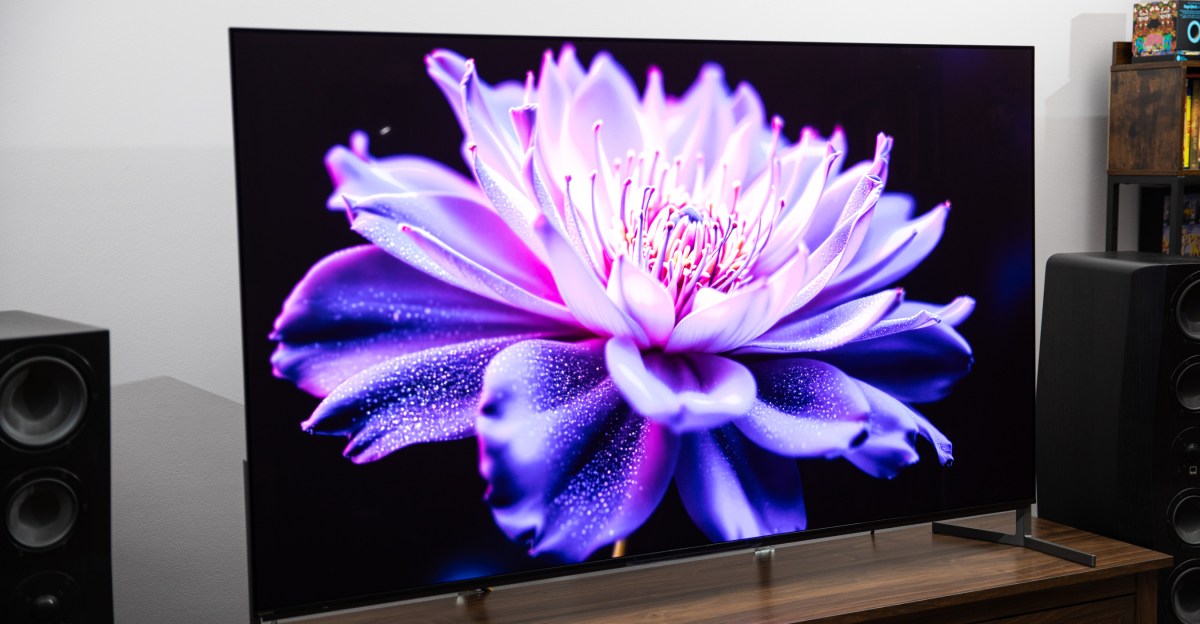

 The Bravia 8 II draws you in.
Sony has a history of making excellent TVs, from the Trinitron CRTs of last century to the world’s first OLED nearly 20 years ago to 2016’s ZD9 mini-LED that delivered exceptional brightness and dimming control for the time. While Samsung beat Sony to the market with the S95B, in 2022 Sony was the first company to announce a QD-OLED TV. That TV, the A95K, was considered the best TV by the reviewer — until the A95L in 2023. The next in the series is now available. The naming convention has changed, but with the Bravia 8 II, Sony once again aims to create the best-ever QD-OLED TV.
Since its release in June 2025, the Bravia 8 II has received praise for its deep blacks and shadow detail, excellent processing, and realistic picture quality. Like the A95K in 2022, and the A95L in 2023 and 2024, the Sony Bravia 8 II was named the King of TV by the judges of the Value Electronics’ 2025 TV Shootout (including Verge editor-in-chief Nilay Patel). It is a bit brighter than the A95L, its processing is stellar — especially the way it elevates the look of lower-quality content — and it runs on Google OS, which is a great benefit over its QD-OLED and OLED competitors from Samsung, LG, and Panasonic, which rely on either their own, clunkier interfaces or on Amazon Fire TV. Since it is an OLED, its blacks are deep and inky, and better when the lights are on than the Samsung S95F QD-OLED, which uses a matte finish. However, it is not quite as accurate out of the box as the A95L, which measured virtually perfect. Because of those sky-high expectations, some reviewers and enthusiasts have rated the Bravia 8 II lower than it deserves.
There is no such thing as a perfect TV. Each one has something it does not do quite right. But while the Bravia 8 II does have some minor issues, they are the kind that only TV enthusiasts are likely to notice. And those enthusiasts are the same people that will get the Bravia 8 II calibrated, eliminating most of the issues. Even though the reviewer is exceedingly particular about TV performance, none of the issues were deal-breakers, because with actual content they were either fleeting or not visible from a normal viewing distance. The reviewer rarely enjoyed watching a TV more than this one.
At a Sony Electronics event at Sony Pictures in Los Angeles a couple years ago, company reps boasted that Sony products are used in every level of cinema production, from the cameras and lenses to the $40,000 display used to master the final product. Sony’s tagline for its Bravia TVs and speakers is “
,” and the Bravia 8 II is its top-end OLED, designed to deliver as close to a theater-level performance in a living room as possible. It is what cinephiles chase: a TV that accurately displays the creators’ intent. And it is for that reason the assessment is a bit picky.
Sony Bravia 8 II specs
Display type: QD-OLED
Sizes available (inches): 55, 65
Backlight: N/A
HDR formats: Dolby Vision, HDR10, HLG
OS: Google TV
HDMI inputs: 2 x HDMI 2.0, 2 x HDMI 2.1 (one with eARC/ARC)
Gaming features: 4K/120Hz, VRR, ALLM
The Bravia 8 II is only available in 55- and 65-inch sizes with MSRPs of $2,599.99 and $3,299.99, respectively. Only two of the four HDMI inputs are 2.1, allowing for 4K/120Hz signals with VRR, and one of those ports (HDMI 3) is the eARC connection. If a soundbar or receiver is connected and a game console is not routed through it, one of the HDMI 2.1 inputs is lost.
Like its predecessor, the A95L, the Bravia 8 II uses feet connected out near the screen edge that can be attached in two height positions — one with the bottom edge of the TV about half an inch from the surface it is resting on and the second elevating the TV 3 inches. That is enough to accommodate a soundbar right under the screen instead of in front of it, as with TVs like the TCL QM9K that have pedestal stands. However, it also means a media console wide enough to fit the TV is required.
OLED performance with Sony processing
Since it is a QD-OLED TV, the Bravia 8 II comes with the pure blacks and pixel-level control expected from an OLED, with the extra color vibrancy of quantum dots. Matched with Sony’s excellent image processing, which has been the best on the market for years, the Bravia 8 II delivers a fantastic 4K image. Stars sparkle, there is great detail in the shadows, and scenery looks realistic and inviting. The grittiness of future Los Angeles in Blade Runner 2049 is heightened by the details visible in the dark, rainy streets. The buildings among the trees of Rivendell look like a true solace from the evils creeping through Middle-earth. At numerous points during the review process, the reviewer was drawn into the content and momentarily forgot the evaluation task. Even a
winding its way through snow-covered villages in Switzerland was mesmerizing, and held attention while imagining a vacation in the Alps.
The TV’s processing and upscaling improves lower-quality content, causing it to look smoother and less pixelated, and better than what has been observed on competitors from LG, TCL, Samsung, and Hisense. Most of the content people watch is 1080p — be it from a streaming service, cable, or over the air — and there the Bravia 8 II achieves a cleaner and more detailed image than its competitors.
OLED brightness is not the problem it used to be
Brightness has always been the biggest factor limiting OLEDs, and while they still cannot compete with mini-LED TVs, they are now able to produce enough light to perform well in ambient lighting conditions. While the LG G5 is noted as a very bright OLED, the Bravia 8 II still achieves significant brightness. In HDR, the Sony measures 1,590 nits from a 10 percent window, and gets even brighter with smaller highlights (up to 1,884 nits). As the size of the bright area increases, the Sony is not able to maintain that level of brightness (a common characteristic for all TVs), and a full white screen measures only 239 nits. However, a full-field white screen is not typical viewing content. When watching movies and TV shows in a living room — which admittedly does not get direct sunlight — the Sony ably held up to ambient light. If a room has large picture windows with sunlight streaming through, the G5 might be considered; for most, Sony’s brightness should be plenty.
In SDR, if Peak Luminance (found under Brightness) is turned to High, the Sony hits 540 nits, which should be enough unless a living room is drenched in sunlight. For video purists watching SDR in a home theater, leaving Professional with its default SDR settings, the TV tracks between 107 and 100 nits from small highlights up to a full screen. This is spot-on reference-level brightness for SDR content in a dark room, demonstrating Sony’s commitment to delivering a reference-quality image with minimal settings adjustments.
 The Sony Bravia 8 II uses Google TV as its OS.
While the Bravia 8 II is incredibly accurate out of the box in Professional picture mode, there are a few minor issues. Most people will not be bothered by any of them. In HDR, the grayscale on the Bravia 8 II leans a little blue as it gets closer to white, in a way the LG G5 does not. It is most noticeable in things like white clouds or snow on mountain peaks. It is in no way unpleasant, just not quite as accurate and pure as it should be. Colors also pull a bit toward blue. It is not drastic — the red Corvette in The Big Lebowski is still red, just not quite as vibrant — but with a TV of this caliber, those minor details stand out more.
Calibration brings it from excellent to near perfect
How TVs are tested
Each TV is set up in a living room on a home theater credenza. Movies and shows are streamed through the TV’s apps, discs are played on an Oppo UDP-203 4K Blu-Ray player (including the Spears & Munsil Ultra HD Benchmark disc) and movies from a Kaleidescape Strato V player, and games are played on an Xbox Series X and PlayStation 5. This testing is conducted at different times of the day and under various lighting conditions, including with curtains open, with lamps and overhead lights on, or with blackout curtains to darken the room. While the reviewer is a certified ISF Level 3 calibrator, the TVs are not calibrated before measurement, as most TV owners do not perform this step. Therefore, it is important to assess how well the TVs perform out of the box, with only minor menu adjustments that anyone can make.
For measurement, Portrait Displays’ Calman color calibration software, a Murideo 8K Seven pattern generator, an X-rite i1 Pro 3 spectrophotometer, Portrait Displays’ C6 HDR5000 colorimeter, a Konica Minolta LS-100 luminance meter, and Leo Bodnar 4K lag tester are used.
Calibration is normally not recommended for most people or for most TVs. Out-of-the-box performance has improved significantly over the past few years across a broad range of prices and manufacturers, provided the default picture mode is switched to something like Movie, Cinema, or Professional. As mentioned, the Bravia 8 II looks great in Professional mode. However, it can still be improved. When a TV is marketed as bringing cinema home, buyers are often seeking the best possible image quality. For these individuals, a calibration is worthwhile. A quick 21-point calibration was performed on the Bravia 8 II, and afterward, the image appeared perfect. The blue tint in clouds was gone, and colors from skin tones to nature backdrops looked even more incredible.
If one were to be particular, the Bravia 8 II does have two issues specific to QD-OLED panels, but even those are less noticeable than on earlier models. One is the lack of a polarizing filter, which can lead to raised blacks with a slightly purplish color. While there was a little bit of this happening on the Bravia 8 II, it is better than what has been observed on Samsung QD-OLED TVs, and it was barely noticeable in regular use. Even with the lights on in the living room, the blacks felt deep and inky, giving the TV exceptional contrast. The triangular pixel structure of QD-OLEDs can also cause color fringing of either green or purple on the edges of bright images against dark backgrounds. Hints of this were observed, but from a normal viewing distance it is only noticeable if intently looking for it. This issue did not bother the reviewer’s family. This is also less noticeable than on early generation QD-OLEDs, though it likely will not go away entirely until Sony changes the pixel structure on QD-OLED panels.


 The Bravia 8 II has deep and inky blacks, giving great depth to space images.
If a TV were to be purchased today, the Sony Bravia 8 II would be a top choice. The picture it produces is incredibly engaging, and throughout the review process, the reviewer found a desire to watch it more and more, even without calibration. Certainly, there are minor issues with some dark scene color fringing, and it does not get as bright as other TVs. A case could be made for the older A95L if it is found discounted, as out of the box it will be a little more accurate than the Bravia 8 II. For a room that is absolutely bathed in light, the LG G5 offers very similar performance with a brighter image. However, during the time spent with the Sony Bravia 8 II, there was never a moment, be it with critical viewing or watching a movie with family, when the reviewer was not impressed. It served as a reminder of the appeal of movies. What more could be asked from a TV?
