


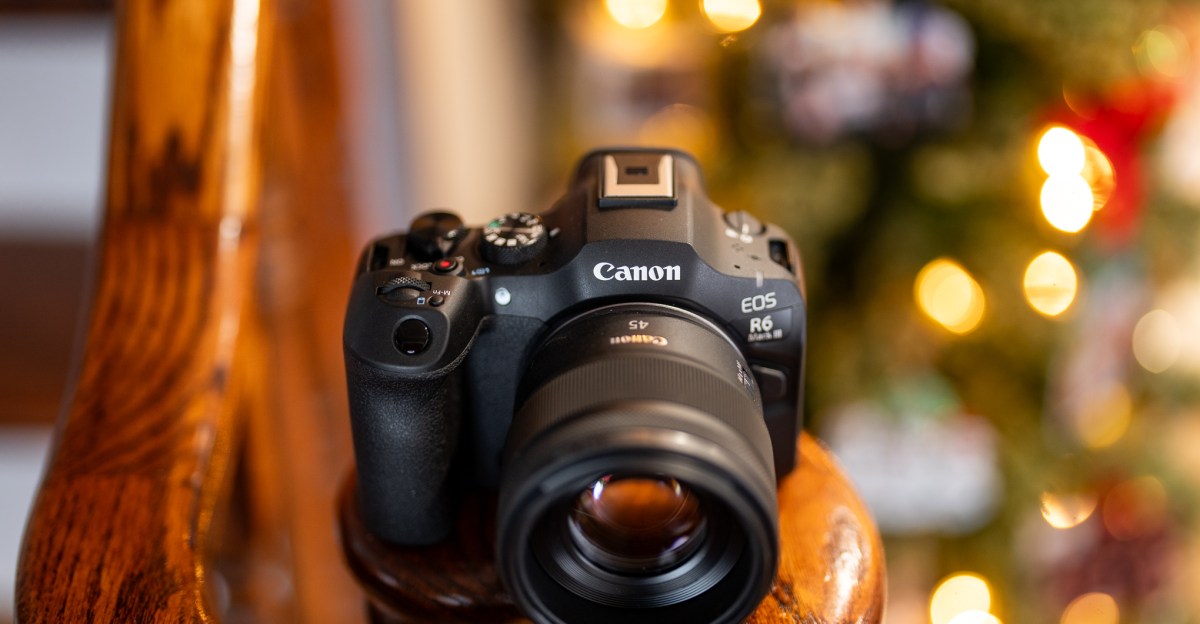
 An f/1.2 aperture is a beautiful thing.
Canon’s new EOS R6 Mark III is an excellent camera. While not a groundbreaking upgrade to the three-year-old R6 Mark II, it retains the same body with great ergonomics and introduces increased resolution, video capabilities up to 7K with open-gate filming, and enhanced autofocus performance. For those seeking a highly capable all-around camera for diverse applications, including wildlife photography, weddings, and videography, this model is a strong contender. It is a straightforward recommendation, particularly for existing Canon users looking to upgrade. (However, a used R6 Mark II remains an appealing option if the higher $2,799.99 price point is a concern.)
The lens Canon released alongside this camera, however, is truly exceptional. For enthusiasts of fast-aperture optics, it represents a highly desirable offering and exemplifies the direction many hope to see in future lens development.
Sub-$500 is “cheap”
The RF 45mm f/1.2 STM lens is a unique product. Priced at $469.99, this is an unprecedented cost in the photography and videography market for an f/1.2 maximum aperture. Lenses this fast are typically manual focus options from lesser-known third-party brands like Rokinon or Meike. Canon’s policy of restricting third-party manufacturers from producing lenses for its full-frame RF mount has created an artificial scarcity that further highlights the new 45mm. Canon’s own RF 50mm f/1.2 L USM lens, for example, costs a substantial $2,600. Even a more affordable Sigma 50mm f/1.2 DG DN lens for Sony and L-mount systems exceeds $1,500. Achieving a sub-$500 price point makes a fast-aperture lens like Canon’s 45mm accessible to a broader audience beyond professionals and affluent enthusiasts.


 1/3This thing is tiny. Here it is next to a workhorse 50mm f/1.2.
Beyond its affordability, the 45mm f/1.2 is a high-quality lens. Its compact size for a full-frame lens with such a wide aperture makes it an ideal everyday companion for an R6 or smaller R8 body. This is not a “pro” lens like Canon’s L series, so it does not feature weather sealing. A lens hood for added protection and flare reduction is available for an additional $59. However, weather resistance is not typically anticipated for full-frame lenses in this price range, and some users might prefer to forgo a hood to maintain the lens’s compact and portable nature. Compared to larger and heavier lenses, such as a Sony FE 50mm f/1.2 GM (weighing 778 grams / 1.72 pounds), this Canon lens is significantly lighter and less bulky, making it more convenient for various occasions.
Sample photos:


 1/29An f/1.2 lens is a great match for cozy holiday vibes.
The 45mm f/1.2 does have some limitations. Its most notable drawback is the presence of artifacting in high-contrast areas, manifesting as purple or green color fringing both in front of and behind the point of focus. This is a common characteristic in more affordable lenses with large apertures, known as longitudinal chromatic aberration (LoCa). The 45mm can exhibit a significant amount of this, particularly when photographing subjects like holiday string lights. While it can be distracting, especially when examining images closely, it is an acceptable compromise for an f/1.2 lens of this size and price.
Optically, the 45mm f/1.2 may not rival the performance of larger, professional-grade f/1.2 lenses. However, its image quality is sufficiently good, and the aesthetic it produces is highly pleasing, often overshadowing any technical imperfections. The RF 45mm excels in delivering a wide-aperture look, characterized by extremely shallow depth of field and substantial background blur (often referred to as “bokeh”) when subjects are close. It maintains good sharpness in the center of the frame at its wide-open f/1.2 aperture. While corners may show some softness, this is reasonable given the price point. Subjects are typically positioned near the lens’s sharpest central area, ensuring that the primary focus of the image remains crisp.
This lens is not considered “dreamy” or full of “character,” terms often used by photographers to describe softer lenses. When the aperture is set to f/1.2, the rendering of the 45mm consistently delivers satisfying results. For a Canon system owner, this lens could easily become a go-to choice for everyday photography. If Canon were to integrate this lens into a compact camera body, similar to a Fujifilm X100 or Leica Q, it would make for an excellent everyday carry camera.
Comparison photos with the Sony FE 50mm f/1.2 GM:


 1/14Canon RF 45mm f/1.2 STM wide open at f/1.2.
Many contemporary lenses from manufacturers like Canon, Sony, Nikon, and Fujifilm offer impressive image quality and autofocus performance, but their prices continue to rise. Lenses like the RF 45mm f/1.2, which are very fast, affordable primes, and compact enough for versatile use, are highly desirable. While it involves compromises in image quality, these are appropriate for achieving a distinctive look and feel that is otherwise unavailable at this price point.
Photography
