


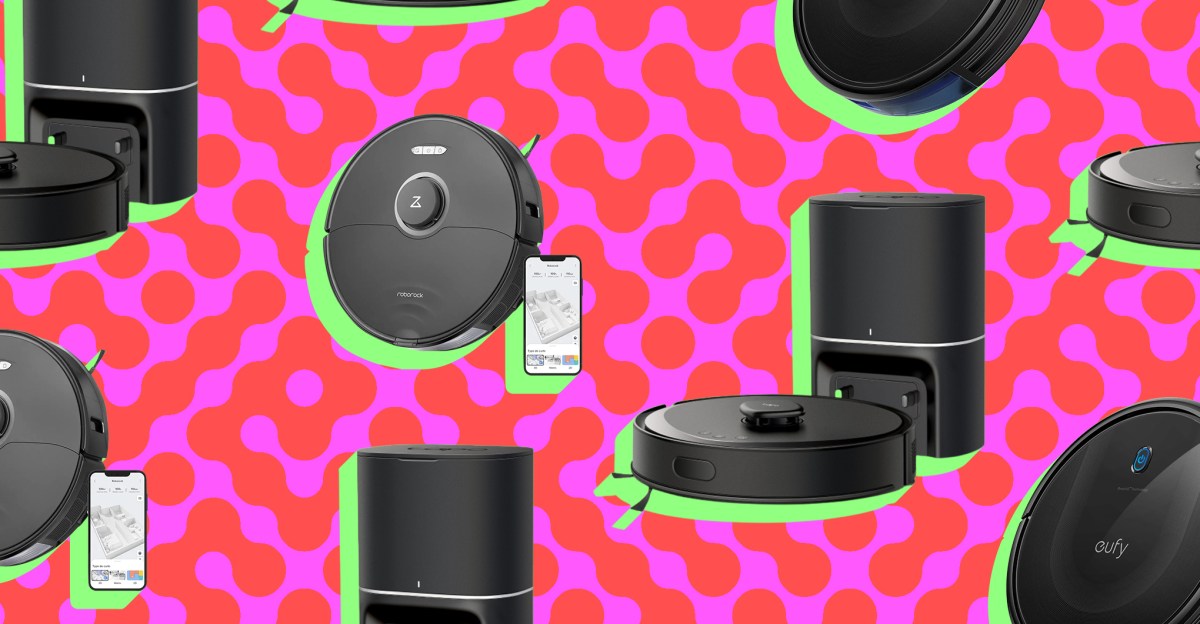
Today’s robot vacuums are becoming a bit like cars: with all the features, upgrades, and fancy trimmings available these days, it’s easy to forget that they can just be simple machines that get from point A to point B. Some bots blow hot air on their mop pads, deftly navigate dog poop, and have arms to pick up socks, but there are plenty of basic budget robot vacuums that just do a decent job of cleaning floors autonomously — as long as the area is tidied up first.
Fancier models have obstacle recognition, and some even use AI-powered cameras to tell popcorn from poop and avoid the latter. For those models, a best robot vacuum buying guide is available. However, if picking up after oneself (and pets) is manageable, a budget bot can save a lot of money and still perform well at cleaning floors.
Featured Products


Tapo RV30 Max Plus
$190 at TP-Link (with code WEEKLY60OFFRV)


Roborock Q10 S5


Shark Navigator RV2120


Eufy 11S Max
What to look for
How robot vacuums are tested
To judge its vacuuming power, every robot vacuum is run through a series of tests on hardwood and carpet, including flour, kitty litter, oatmeal, and pet and human hair. Obstacle avoidance is tested using cables, shoes, socks, and bed skirts. Mopping effectiveness is tested on hardwood and tile floors using dried and moist messes. If the robot has an auto-empty dock, its ability to empty the onboard bin, as well as any other dock features, are tested. Robot vacs are run around three different levels in a home to see how they handle different surfaces, room transitions, and edge sensing. Runtime before needing to recharge is evaluated, and each app is tested, focusing on its mapping functions to see how simple and reliable they are. Each robot’s build quality and parts availability are also examined, and they are judged based on how much a cat enjoys playing with them.
Price
While sub-$150 robots exist, they are generally not recommended. With many new models emerging daily, it is often better to seek sales on older models from reputable companies rather than purchasing no-name budget bots. A brand new Roborock with mapping and advanced navigation can sometimes be found for half its original price. These gadgets are designed to last for years. Sales can be hard to track, so some listed prices might seem high for a budget bot. If a model fits specific needs, monitoring a deals page for better sales is advisable.
Cleaning prowess
For cheaper bots, suction power becomes more critical as they tend to have fewer features that enhance cleaning. Higher-end robots offer features like improved brushes, carpet boost mode, and dirt detection. A minimum of 2,500Pa suction power is recommended (if the manufacturer provides this specification). Rubber roller brushes or a rubber/bristle hybrid are often preferred over purely bristle brushes, as rubber rollers tend to pick up more dirt and tangle less.
A mop (or not)
It is important to note that most budget mopping bots do not truly mop; they typically use a damp cloth to pick up fine dust left behind by the vacuum. This function is useful but not essential. Mop attachments with water reservoirs also occupy space on a robot, resulting in a smaller dustbin.
A big bin
A larger bin reduces the frequency of emptying. While 800 ml is the largest observed, anything over 450 ml is considered decent for a budget bot. With many bots now serving dual purposes as mopping robots and the prevalence of auto-empty docks, finding robots with large bins can be challenging. However, for those on a budget who prefer not to spend extra on a dock, a large bin will minimize hands-on vacuum maintenance.
Or an auto-empty option
If feasible, an auto-empty dock is strongly recommended, and more affordable versions are becoming available. While a convenience rather than a necessity, delegating the bin-emptying task to the robot ensures cleaner floors, as a vacuum with a full bin will not effectively pick up dirt.
Navigation / mapping
Opting for an older version of a high-end robot can provide superior navigation, but more budget bots now feature at least basic lidar-powered navigation and mapping. Investing in a bot that understands its path is worthwhile. Non-mapping bots may miss entire sections of a home and, after recharging, might restart cleaning areas already covered. However, mapping is less crucial for a bot intended for a single room or a small apartment. Most bump-and-roll bots do include a gyroscope function, which at least enables them to move in a straight line.
Good battery life / long runtime
While most bots can recharge and resume (return to their charging base and refuel before continuing), a bot capable of running for at least two hours on a single charge will complete tasks more quickly and be less disruptive. A runtime of at least 120 minutes is sought (180 minutes is ideal).
A decent app
Many budget bots come with barely usable apps, which is why choosing a lower-cost option from a company known for higher-end models often leads to a better app experience, as the app is typically more polished. A good basic app should allow for setting multiple cleaning schedules, offer a do-not-disturb period (to prevent unexpected startups after recharging), and provide connectivity to voice assistants and smart home platforms like Amazon Alexa, Google Home, and Apple’s Siri.
Repairability
Even at the budget end, a robot vacuum represents a $200 to $300 investment, making repairability and the availability of replacement parts a significant advantage.
Best budget robot vacuum and mop
Tapo RV30 Max Plus
The Good
- Cheap, even with the auto-empty dock
- A dual mop and dustbin means no swapping
- Room-specific cleaning
- Carpet boost
The Bad
- Short battery life
- Slow to recharge
- Docking can be spotty
- Basic obstacle detection
$190 at TP-Link (with code WEEKLY60OFFRV)
Suction power: 5,300Pa / Dustbin capacity: 300ml / Self-empty dock option: Yes / Mopping option: Yes / Mapping: Yes, lidar / Keep-out zones: Yes, virtual / Runtime: 100 mins, 2,600mAh battery/ Brush style: Single rubber bristle hybrid / Works with: Amazon Alexa, Google Home
 The Tapo RV30 Max Plus includes a compact auto-empty charging dock.
Thanks to lidar navigation, the RV30 performed excellently in navigating a house, cleaning room perimeters, and then using a mesh grid to clean inside rooms. Users may need to tidy up before it runs, as there is no onboard camera or AI-powered obstacle detection — so cables and socks could cause issues.
Its 5,200Pa suction power is impressive for a bot at this price, effectively picking up Cheerios and dry oatmeal on hard flooring. It was less effective on carpet, leaving some finer dust and debris due to its single bristle/rubber brush. However, the app allows setting it to clean a room three times per job, which generally results in picking up all visible debris.
Mopping performance was better than average for a mop without pressure or oscillation. It features a wide mop pad and a large 300ml tank (which also integrates a 300ml dustbin), ensuring sufficient water application for a good surface clean.
Another unique feature for a budget robot is the ability to set customized cleaning for each room, with options for five suction levels, three water levels, and three rotations.
The Tapo app is user-friendly, with an easy-to-edit map that allows adding virtual walls and no-go zones, designating carpet areas, and adding furniture. There is no carpet sensing, so users must specify carpet locations to prevent mopping. Cleaning direction can be set, and up to four maps can be built — features typically found on higher-end robots.
5,200Pa suction power is impressive on a bot at this price
It is also easy to start a clean from the app, and users can tap on the map to send the robot to a specific spot.
The biggest drawback of the Tapo is its small battery, only 2,600mAh. This is half the size of most vacuums, and it may not clean an entire 800-square-foot downstairs without needing to recharge. It also takes time to charge and occasionally struggles to reposition itself on its dock.
The RV30 can be purchased without the auto-empty dock for approximately $80 less, offering an even simpler robot vacuum setup. This option allows it to fit under couches or beds, but requires manual bin emptying.
Best upgrade budget vacuum
Roborock Q10 S5
The Good
- 10,000Pa suction
- Smarter obstacle avoidance
- Less prone to getting stuck
- Auto mop lift and auto carpet detection
The Bad
- Very large
- Auto-empty dock adds a lot to the cost
- Docking can be spotty
$400 at Roborock (w/auto-empty dock)
Suction power: 10,000Pa / Dustbin capacity: 600ml / Runtime: 150 mins, 5200 mAh / Brush style: single bristle / rubber hybrid / Auto-empty dock option: yes / Mapping: yes / Keep-out zones: yes / Works with: Amazon Alexa, Google Home, Siri Shortcuts
Roborock’s Q10 S5 represents an upgrade from the Tapo RV30, offering double the suction power, a significantly larger battery and longer runtime, AI-powered obstacle avoidance, and automatic carpet detection. It also features a vibrating mopping system that provides more effective floor scrubbing and can lift its mop up to 8mm to clear low-pile carpets.
 The Q10 S5 uses a wide, flat mopping pad with Roborock’s VibraRise mopping system that vibrates to scrub the floor.
It incorporates a more advanced lidar-based mapping and navigation system, which, similar to the Tapo, allows for cleaning specific rooms, creating no-go zones, and customizing cleaning schedules. However, unlike the Tapo, it navigates more intelligently and is less prone to getting stuck.
The robot vacuum alone costs more than the Tapo with its auto-empty base. Upgrading to the Q10 S5 Plus, which includes an auto-empty base, increases the cost to over $500. However, it is frequently on sale, making it a worthwhile consideration for those seeking a budget bot with enhanced vacuuming and mopping capabilities.
One drawback is that the bot is considerably larger and wider than the Tapo, potentially limiting its ability to fit into tighter spaces. The Roborock app is more feature-rich than Tapo’s, offering extensive customization options.
Best budget vacuum-only bot
Shark Navigator RV2120
The Good
- Big bin
- Easy to use
- Repairable
- Optional auto-empty dock doesn’t need bags
The Bad
- Loud and rattly
- App is very basic
Suction power: unknown / Dustbin capacity: 500ml / Runtime: 120 mins / Brush style: single bristle / rubber hybrid / Auto-empty dock option: yes / Mapping: yes / Keep-out zones: yes / Works with: Amazon Alexa, Google Home
The Shark Navigator RV2120 is a basic vacuum-only bot that improves upon a previous Shark pick, the Shark Ion, by incorporating lidar navigation. This allows it to map a home without blindly bumping and rolling like its predecessor. Mapping enables sending it to clean specific rooms and adding keep-out zones to restrict its movement.
While it lacks advanced features like AI-powered obstacle detection or room-specific cleaning settings, the RV2120 excels at basic functions. It features a generously sized bin, a straightforward app experience, decent battery life, and good repairability. It also demonstrates a robust ability to push through fabric skirting to clean under beds and sofas, a task many lidar bots struggle with. However, it operates quite loudly and with a rattling sound, even at its lowest power setting.
Unlike many budget bots, it utilizes a hybrid roller brush composed of both bristles and plastic, which tangles less than standard bristle brushes.


 The Shark uses a hybrid bristle roller brush and has big wheels with good suspension.
A notable advantage of this bot is its tank-like wheels, which effortlessly traverse various obstacles, including high room transitions, lounge chair legs, and other furniture traps that often impede other bots.
The Shark RV2120AE model includes an auto-empty dock. A significant benefit is that Shark’s auto-empty docks do not require replacement dust bags, offering long-term cost savings. However, the RV2120AE is more expensive than the Tapo RV30, even when accounting for the latter’s bag costs.
One advantage of Shark vacuums over the Tapo is their high repairability. Replacement parts for almost every component of the bot are available, unlike with the Tapo.
Best budget robot vacuum without Wi-Fi
Eufy 11S Max
The Good
- Big bin
- Slim profile
- Avoids obstacles
- Quiet
- Easily repairable
The Bad
- No mapping
- No keep-out zones
- Small battery
Suction power: 2,000Pa / Dustbin capacity: 600ml / Runtime: 100 mins / Brush style: single bristle / rubber hybrid / Auto-empty dock option: no / Mapping: no / Keep-out zones: no / Works with: n/a
The Eufy 11S Max is a unique robot vacuum that operates without Wi-Fi or an app. It starts with a simple button press and can also be programmed to clean at a specific time using an included remote control.
The 11S features a super slim profile, standing at 72.5mm high without a lidar tower, allowing it to fit under most couches. It has a large 600ml bin, and its performance in picking up debris from hardwood floors was impressive, despite its relatively modest 2,000Pa suction. It offers three cleaning levels, with the lowest registering around 55db, making it quiet enough for a home office.
It has a relatively small battery, providing only 100 minutes of runtime, but it will return to recharge. For $200, this is an ideal budget bot for those who prefer to avoid apps or Wi-Fi connectivity. As a bump-and-roll bot, it lacks advanced navigation skills. However, it boasts numerous replaceable parts, including the battery and wheels, ensuring a long operational lifespan.
Other budget robot vacuums to consider
- The $399.99 Switchbot K11 Plus is a great option for small spaces. Its tiny size lets it navigate around tight areas with ease, and it even comes with a pint-sized charging dock. It offers 6,000Pa suction and does a good job of cleaning up both carpets and hardwood floors. Just note that its mopping is more of a light wipe than a true scrub, and there’s no AI-powered obstacle avoidance.
- The $310 Dreame D20 Plus is an upgrade to a previous pick for best budget mopping robot, the $239.99 Dreame D10 Plus. It has not been tested yet, but it doubles the suction power to 13,000Pa, and its included auto-empty dock has a larger dust bag. The D20 also has a bigger water tank and adds the option to adjust the water flow and suction power.
