


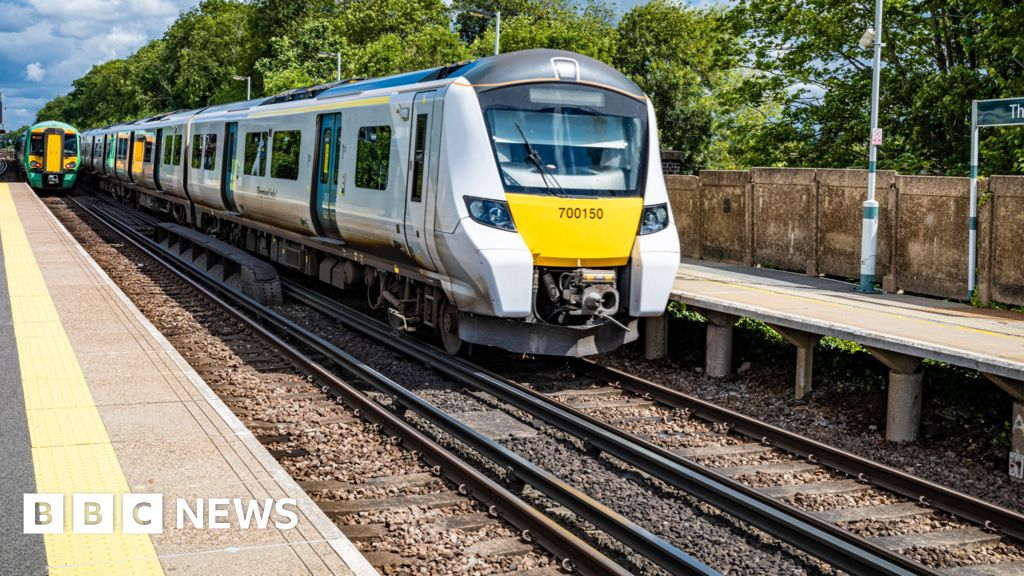

Thousands of passengers traveling southwest from Aldershot station daily might not notice the solar panels situated alongside the tracks, yet the trains they ride are powered by this very installation.
Leo Murray, co-founder and chief executive of Riding Sunbeams, a startup focused on integrating renewable energy into rail electrification, states that on a sunny afternoon, trains passing through Aldershot receive some energy from these solar panels.
The Aldershot array, built by Riding Sunbeams in 2019, is a modest 40-kilowatt installation, comparable to about ten residential rooftop solar systems in Britain. Despite its size, it effectively showcases how renewable energy can directly supply power to railways.
Murray highlights that this is currently the only solar array in the country directly powering trains. He suggests it offers the most affordable electricity for railway operations.
Globally, many trains continue to operate on diesel fuel. Historically, rail electrification has involved two primary methods: electrified third rails or overhead lines that trains connect to with
on their roofs. Both systems are typically costly and complex to install.
However, engineers are developing innovative approaches to implement these technologies, and entirely new alternatives are also emerging, potentially accelerating electrification efforts.
A significant obstacle to electrification often stems from local electricity grid limitations, making it difficult to secure substantial connections for powering trains. Murray notes that this issue has significantly worsened.
For this reason, solar panels are considered highly valuable for facilitating railway electrification projects.
Following the Aldershot project, Murray had intended for Riding Sunbeams to develop a full-scale commercial pilot, but funding challenges prevented this.
Currently, Network Rail, responsible for Great Britain’s railway infrastructure, is actively seeking suppliers for new rail-side renewable energy projects.
Murray describes this as a significant opportunity, confirming his business’s intention to bid for a contract.
New projects, however, introduce additional complexities. The Aldershot track was already electrified, simplifying the integration of solar panels into the existing system.
Integrating solar power becomes more challenging for trains transitioning from diesel to overhead lines, as solar panels generate direct current (DC) electricity while overhead lines utilize alternating current (AC).
Nevertheless, efforts are underway in England to develop a new converter device designed to address this compatibility issue.
In a separate development, Colton Junction, located between Leeds and York and known as the UK’s fastest railway junction with trains reaching 125mph, was recently electrified using software from the University of Huddersfield.
This software creates a 3D model of the overhead line system, enabling engineers to meticulously plan its construction. This approach reduces costs by eliminating the need for some traditional testing and evaluation methods.
João Pombo, associate director of the university’s Institute of Railway Research, stated that “Everything was specified in the software in terms of measurements,” and confirmed that “All the trains are running at maximum speed at that junction since August.”
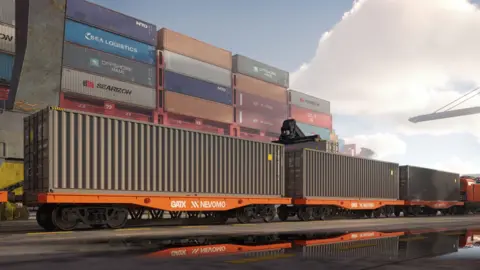
Beyond traditional methods, entirely different electrification concepts are emerging. Polish startup Nevomo has created an electromagnetic propulsion system.
This involves installing a thick aluminum cable within an enclosure between existing rails, which generates a magnetic field powerful enough to propel freight wagons equipped with magnets.
Ben Paczek, Nevomo’s founder and chief executive, explains that their system “eliminate[s] locomotives completely,” making “Each wagon… independent” and capable of operating in groups.
Paczek highlights a key advantage: the technology enables rapid stopping of freight wagons. This capability could, in theory, allow for safely positioning numerous independently moving wagons closer together on a single rail section, thereby increasing freight transportation density in a given area.
Nevomo plans to implement its technology at a steel plant in Bremen, Germany, and a port in India next year.
These initial installations will be small, covering less than 1km (0.6 miles) of track each. However, Paczek anticipates larger deployments in the future, noting that “In a quite conservative environment like rail, we need to demonstrate it properly first.”
He adds that while the motion of electromagnetically-propelled wagons could be automated, they will initially be controlled remotely by human operators.
In the US, Parallel Systems is also developing a distinct approach to electrifying individual freight wagons, enabling independent movement across a rail network using batteries. Co-founder and chief executive Matt Soule states that the firm’s wagons would achieve a range of 800km.
Soule likens this to “atomised freight,” where individual units move like packets in a distribution center, contrasting with traditional locomotive-pulled freight trains that can extend over 2km in length. He explains that the focus is on shorter routes not typically handled by current freight operations.
He clarifies that the goal is not to replace freight locomotives but to provide a rail-based delivery service competitive with trucking. Soule suggests that capturing “10% of the trucking market” could effectively double the rail industry.
Stuart Hillmansen from the University of Birmingham, a former collaborator with Riding Sunbeams, notes that coordinating the movement of individual freight trains on an existing rail network could be “quite challenging – certainly on [British] railways.”
However, he acknowledges that new technologies are aiding electrification, and electrified trains are increasingly becoming the preferred choice for new railway developments.
Hillmansen concludes that while “All of these technologies are physically feasible and can work,” the primary challenge lies in “managing the business case.”
