


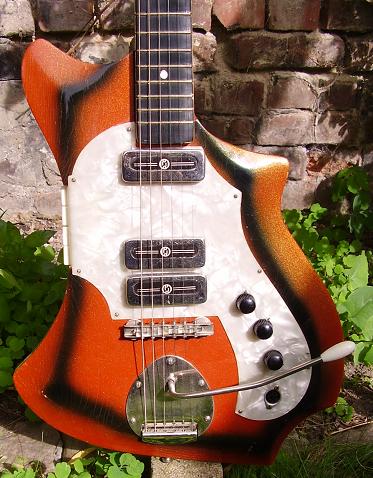

A journey into Eastern European guitars began with an “Orpheus” electric guitar discovered in Plovdiv, Bulgaria. Despite missing parts and being covered in dust, it was acquired for $20. This sparked a fascination with collecting and playing electric guitars from the Eastern Bloc. Other acquisitions include an 80s Tonika from St. Petersburg, a “Moni“-style Hungarian model from Budapest, and a Ural Tonika from Tbilisi.

The Tonika model holds particular historical significance regarding Soviet-produced electric guitars. Its unique shape, unlike any other guitar globally, was not a design choice but a directive from Central Planning. As the USSR’s first electric guitar, it needed to be distinctly Soviet, avoiding any resemblance to American models like the Strat or Gibson. The instruction for the first Leningrad Tonikas likely emphasized originality over conventional design.
The Tonika guitar embodied its Soviet origins: excessively heavy, constructed from inexpensive wood, and featuring a thick, baseball-bat-like neck. These guitars were challenging to play, with sharp frets and poor intonation that produced off-key sounds. Paradoxically, they often included sophisticated and well-crafted pickups. Fortunately for Soviet musicians, Czechoslovakian manufacturers produced quality, playable guitars that gained popularity across the Soviet Union. A comprehensive list of Czechoslovakian guitars, including some unusual models, is available on this site:

Jolana Big Beat, complete with short wave radio
Research into Azerbaijani music revealed exceptional guitarists performing modern interpretations of traditional Azeri styles. One notable artist is Remish. Limited information is available in English or comprehensible Azerbaijani translations, but it indicates he attended a music school and remains a renowned musician in Azerbaijan.
A compelling video features Remish’s performance, spanning over 90 minutes. Key moments from this extensive footage, which showcases remarkable guitar techniques, are highlighted below. Throughout the performance, Remish employs impressive trills and imitates vocal ornamentation using both left-hand bends and the whammy bar. His sound incorporates significant analog delay and overdrive. Notably, his pick grip mirrors that of a tar player, suggesting a background in that instrument:
- 5:20- some great slide guitar played with a glass bottle
- 10:40- back and forth with a clarinetist
- 11:30-13:12 ridiculous solo break
- 17:20- great melody and the tempo picks up
- 30:00-great one handed tapping and solo section, accordion exchange shortly after
- 34:00-ridiculous bends
- 42:40 some intentional bridge noise and another insane ornamentation
- 48:48-49:15* best part. just watch it.
- 53:28- nothing’s cooler than play and smoking st the same time
- 58:26- major and minor 3rd shifts
- 58:50- tempo change out of nowhere!
- 1:05:50- surf rock bend and neon sign
- 1:15:40- more smoking, eating, shredding, money being thrown in his face
These are particularly captivating segments, but the entire performance demonstrates relentless skill.
Another Azerbaijani guitarist, Elman Namazoglu, is featured in the video below. His guitar is a Jolana Special, a Czechoslovakian model that appears to be a preferred choice among prominent Azeri guitarists. Such virtuosic playing would be challenging on a Tonika or Orpheus guitar. Despite the availability of Western guitars like Strats and Les Pauls across the Caucasus, the Jolana Special remains a favored instrument. Schematics for the Jolana Tornado, a very similar guitar with minor variations, are also available:
https://www.youtube.com/watch?v=UZfZuyjzg8A


Further evidence of the Jolana’s popularity among Azerbaijani guitarists is a photograph showing a Jolana guitar painted with the national flag’s colors over its red finish. This model is ubiquitous:

An additional resource featuring more videos can be found in this post: http://moodorgan.wordpress.com/2010/02/09/monsters-of-azeri-guitar-ramish-rehman-memmedli-elman-namazoglu/.
UPDATE!
Significant developments have occurred since the initial publication of this article over a year ago. As part of the Sayat Nova Project, an opportunity arose to travel throughout the Caucasus, making field recordings. During a visit to Quba in north-eastern Azerbaijan, a Jolana Tornado was acquired. Photographs of this acquisition are provided below:


