


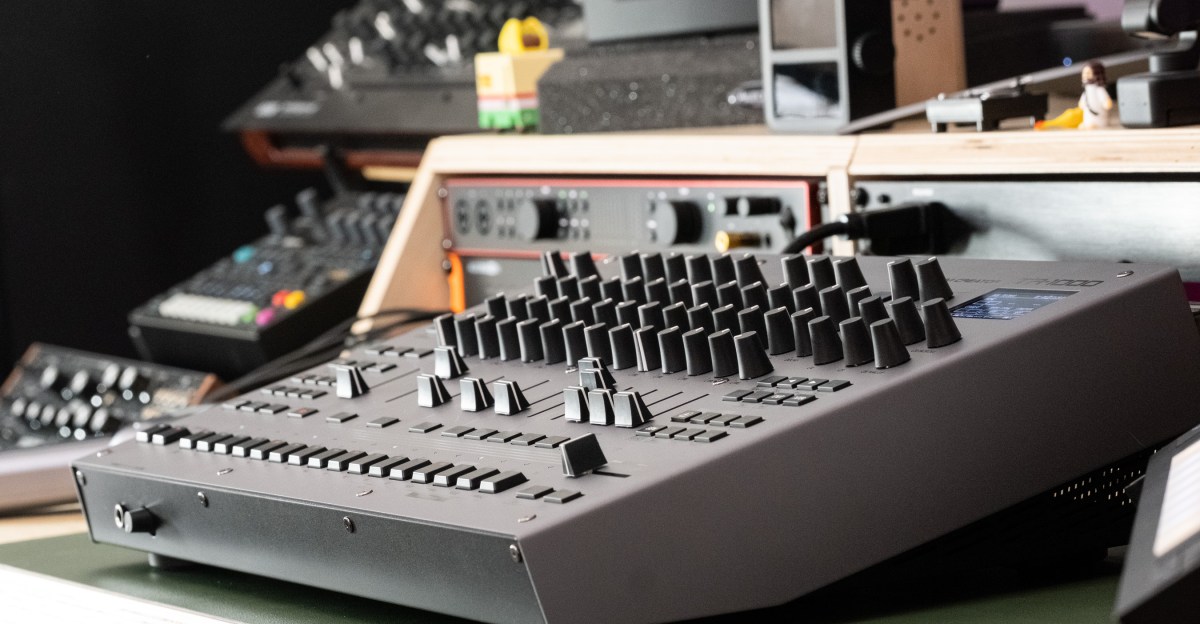

 This is actually tidier than my desk normally looks.
Roland has finally delivered a true analog successor to the legendary TR-808 drum machine, a long-awaited release for many enthusiasts. The influence of the 808 is so profound in music that it would be a challenge to list all the tracks and artists who have utilized its distinctive sounds.
,
the
, is
so
in the
of
that it
be a
to
and
its
to a
or a
of
. (Note: Not all linked songs necessarily feature an actual 808, but they showcase its samples or approximations.)
However, Roland did not stop at merely recreating classic analog circuits. The TR-1000 also incorporates digital emulations of other vintage Roland drum machines, FM synthesis, PCM samples, and an integrated sampler with looping and chopping capabilities. It boasts numerous effects, sound layering, and a contemporary sequencer featuring probability, automation, and microtiming. Essentially, the TR-1000 likely includes any desired drum machine feature. This extensive functionality, however, makes it a complex instrument with a substantial $2,699.99 price.
The TR-1000’s appearance can be somewhat intimidating. Roland has previously faced criticism for designs that leaned towards garish or toylike aesthetics. It seems the company has now shifted towards a more serious approach. While recent synthesizers like the Gaia 2 and SH-4d have a utilitarian, almost plain look, the TR-1000 maintains this trend but with a greater sense of importance. This flagship drum machine projects a professional and purposeful image.
Its striking gray-and-black color scheme evokes an industrial, almost brutalist aesthetic. The unit features 16 tactile keys for the step sequencer, robust sliders for each of its 10 audio channels, and an abundance of buttons and knobs. Roland appears to have responded to requests for more physical controls by integrating a comprehensive array of them.
 One of the TR-1000’s best features is its gritty analog filter.
Consequently, extensive functionality is accessible on the TR-1000 with minimal navigation through menus. Users familiar with step sequencers can quickly create basic beats. Dedicated knobs for tuning and decay allow for effortless creation of deep, modern 808 kick drones. Although other knobs have generic labels (CTRL 1, CTRL 2, CTRL 3), their functions are displayed on the top-right screen.
However, some menu navigation is still required, as is common with Roland devices. The company has improved its user interface recently, but it continues to integrate a vast number of features into each product. While sample chopping and resampling are available on the TR-1000, their implementation can be less intuitive, and the layout is not optimal for creative loop manipulation. The TR-1000 excels at sampling one-shots and drum hits, but certain advanced features appear to be added as an afterthought, hidden behind complex button combinations and awkward menus. This often leads users to utilize the TR-1000 primarily as a conventional drum machine, bypassing its more intricate sampling capabilities.
Viewed as a traditional drum machine, the TR-1000 is an undeniable, albeit costly, triumph. Its primary attraction lies in the 16 analog drum circuits that faithfully reproduce the legendary sounds of the TR-808 and TR-909. These circuits justify the TR-1000’s premium price. For individuals not seeking an authentic analog 808 snare recreation, numerous digital alternatives exist, such as the affordable T-8 from Roland, and countless free sample packs available online. However, for those desiring the genuine analog experience, this instrument fulfills that expectation.
For producers of old-school hip-hop, house, or classic techno, the TR-1000 offers an ideal sound palette. The 808 and 909 sounds are not merely retro; they are timeless. The TR-1000 reinforces this by integrating them into a modern sequencer alongside more contemporary digital sounds.
 The 808 bass drum is the most important development in pop music since the electric guitar.
The analog filter and drive effectively unify these diverse sounds while emphasizing the raw character of the analog drum circuits. Increasing the decay on an 808 kick and pushing the drive to approximately 75 percent produces a powerful, resonant sound. This setting creates a bass tone that begins to enter fuzz territory, delivering an impactful punch. This particular sound proved to be a frequent choice during creative sessions.
Here’s what the TR-1000’s analog drums sound like through its analog filter with the drive cranked
Roland could have simply reproduced the original 808 and 909 sounds. However, beyond these classic timbres, the TR-1000 offers expanded controls that provide significantly more sound sculpting possibilities than the original units. This includes the ability to tune the 808 kick, allowing it to be played as a bassline, a technique often requiring a sampler or synthesizer.
The TR-1000 also effectively showcases Roland’s digital emulations. Comparing the analog circuit behavior (ACB) emulation of an 808 kick with the actual analog version on the TR-1000 reveals only a very subtle difference. Even for an experienced listener, distinguishing between the two in a blind test proved challenging, with accuracy barely exceeding random chance.
The ACB models also contain some of Roland’s most appealing sounds. While the allure of the 808 and 909 is understood, a preference exists for the more lo-fi sounds of the
and the
. A genuine analog reissue of these sounds would be highly desirable.
 Okay, but seriously, give me an analog CR-78 reissue, please.
Despite the TR-1000’s extensive array of sounds and advanced features, a common starting point involved a slight variation of a consistent sound palette: an analog 808 kick, snare, hi-hat, and clap, an analog 909 snare, and a digital 808 kick layered with its analog counterpart. The remaining five tracks would then be populated with various digital percussion sounds chosen spontaneously.
Due to the unique characteristics of the TR-1000’s sequencer, shorter, simpler patterns were often favored. Instead of creating a single long 64- or 128-step sequence, the TR-1000 effectively operates with a 16-step sequencer, offering eight variations that can be modified, along with four “fill-in” versions for each variation. This encourages working with two- or even one-bar loops, then developing multiple subtle variations for dynamic switching.
This approach to workflow resulted in more diverse drum tracks, and the abundant hands-on controls encouraged treating the drum machine as a performance instrument, rather than merely a static accompaniment.
The Morph slider stands out as a particularly effective performance tool, drawing inspiration from Elektron’s Octatrack crossfader. It enables users to configure two distinct sets of parameters for all sounds and then smoothly transition between them. This feature is often employed to shift between a standard pattern and a more aggressive version with increased drive, extended kick decay, and harder-hitting snares.
 The Morph slider lets you seamlessly blend between two sets of sounds.
The Step Loop is another frequently utilized performance feature. While some drum machines offer the ability to repeat sections of a pattern, such as a half-bar or a single step, for on-the-fly fills and buildups, Roland uniquely allows users to repeat any desired steps in any combination. For instance, holding down steps one, five, and nine can create a snare-less looping fill for as long as needed. This transforms fill creation into an interactive process, moving beyond pre-programmed triggers. It is a distinctive Roland feature that could benefit other manufacturers.
The TR-1000 offers an enjoyable experience, surpassing many other drum machines in terms of engagement. However, its extensive capabilities suggest that only a fraction of its potential was explored over several months. Features like looping, time-stretching, and chopping were seldom used, as was the virtual analog synth engine, primarily due to the complexity of programming melodic sequences. While individual outputs for each track would be valuable in a professional studio, only the master out was utilized in a personal setup. Song Mode was also left untouched, a common practice with other equipment.
The sheer volume of features on the TR-1000 can be overwhelming. Roland has indeed created a comprehensive drum machine, but its complexity can sometimes be excessive, leading users to favor its fundamental functions. While utilizing an instrument in a personally intuitive manner is valid, the TR-1000’s $2,699.99 price point may be prohibitive if its full potential is not going to be explored.


 This is actually pretty neat for my desk.
