


In recent years, there has been a notable increase in interest in affordable digital cameras. Younger generations are acquiring older point-and-shoots, finding their aesthetic more authentic and appealing than images captured by smartphones. Some companies are even releasing older technology at new price points. This trend includes cameras like the original Camp Snap, a $70 single-button, screen-free digital camera designed to emulate a disposable film camera. Its affordability makes it suitable for children at summer camp, and its simple operation allows anyone to appreciate its lo-fi aesthetic.
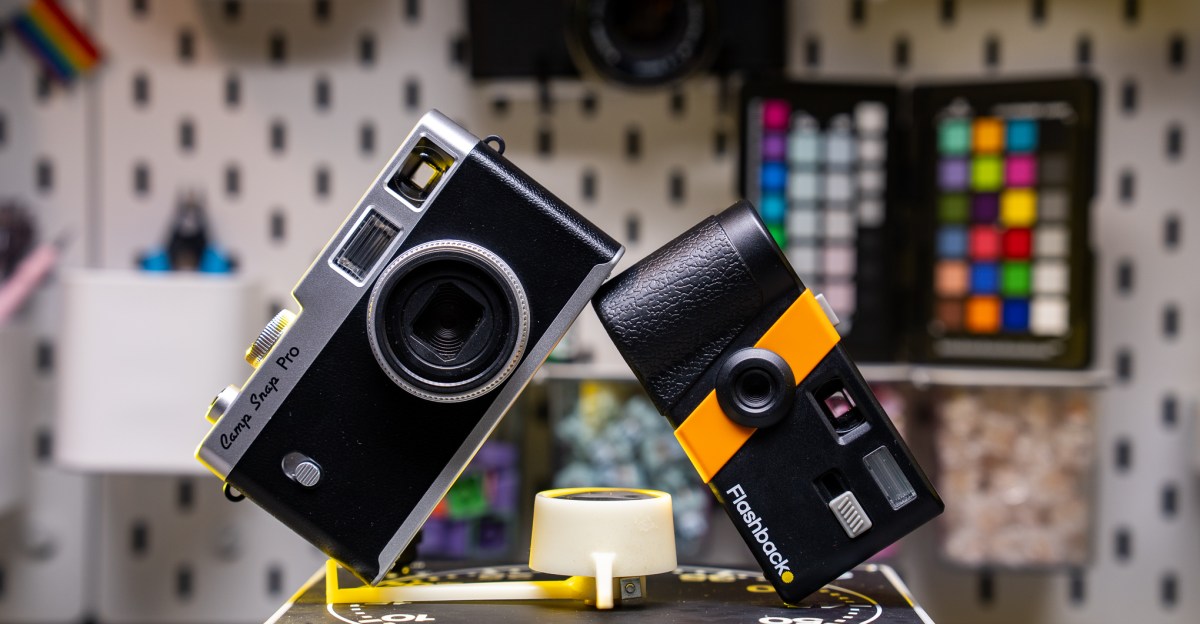
This article examines two compelling examples of this concept: the $99 Camp Snap Pro (CS-Pro), an enhanced version of the original Camp Snap with a design reminiscent of an all-plastic Fujifilm X100, and the $119 Flashback One35 V2, which closely resembles a traditional disposable camera.
Both cameras aim to deliver the aesthetic and screen-free experience of a disposable film camera combined with the advantages of digital technology. However, only one truly delivers on this promise.


Camp Snap Pro (CS-Pro)
The Good
- Simple dial for choosing four on-demand film profiles
- Xenon flash with two settings
- Has a tripod mount (rare for these kinds of cameras)
- No app, Wi-Fi, or Bluetooth connection needed
The Bad
- Setting date and time requires a screwdriver
- Silver-and-black styling is classic but a little boring
- Non-replaceable battery
$99 at Urban Outfitters$99 at Camp Snap$99 at Bespoke Post

Flashback One35 V2
The Good
- Compact size
- Fun and intuitive companion app
- Analog-like ritual of shooting with in-app “developing”
- RAW capture is possible (if desired)
The Bad
- Many missed shots due to slow-to-wake advance dial
- Lens is too close to grip, leading to fingers in shots
- Film styles sometimes failed to “load” in the camera
- Non-replaceable battery
$119 at Flashback$119 at B&H Photo
Both the Camp Snap Pro and Flashback One35 V2 are compact and constructed from lightweight, inexpensive plastic. The Flashback is noticeably smaller, approximately the size of a disposable film camera, making it easier to slip into a back pocket. However, both are best carried in a jacket pocket, small bag, or purse. They do not feel delicate like typical cameras. An original Camp Snap, for instance, can often be tossed into a diaper bag without concern.
Neither camera boasts impressive specifications. The Camp Snap Pro features a 22.5mm-equivalent lens and a 16-megapixel sensor, which are wider and higher resolution, respectively, than the standard Camp Snap (8-megapixel, 32mm equivalent). The Flashback V2 has a 13-megapixel sensor. These basic, smartphone-sized image sensors and small lenses produce image quality comparable to a disposable film camera or an older phone. Unlike film, there are no per-shot costs. Both cameras include proper xenon flashes for bright illumination in dark environments at close range, a desirable aesthetic that also compensates for their poor low-light performance. (The original Camp Snap’s LED flash is largely ineffective and less flattering.)


 The Flashback (right) is the cuter camera, but the Camp Snap Pro (left) is the better one.
The primary difference between these cameras lies in their operation. The Camp Snap Pro features a dial for selecting one of four filters: STD (standard), VTG1 (vintage 1, with a warm magenta tone), VTG2 (vintage 2, with a green tone and boosted blues), and B&W (black and white). Each preset is customizable, allowing users to create and apply their own looks using Camp Snap’s online Filter Builder. The original Camp Snap has a community that offers free and paid downloadable filters, although some are not yet available for the CS-Pro. The included 4GB microSD card can store over 1,000 photos, which can be downloaded via a USB-C cable or microSD card reader.
The Flashback also offers four preset filters: classic, mono (black and white), beta (a reddish tone), and cine (emphasizing a teal-and-orange aesthetic). However, these can only be changed within the camera’s companion app (iOS / iPad and Android), and they are applied as “rolls” for up to 27 shots at a time. This design is intended to mimic a disposable film camera. Once a filter is selected, it remains active for the entire “roll,” though a roll can be downloaded early to start a new one. The One35 V2 connects to a phone or tablet via Bluetooth, enabling users to check battery levels, activate a self-timer, or change film types. Downloading images to a device requires either Wi-Fi or a cable. By default, the app imposes a 24-hour waiting period to view images, but this can be bypassed by activating Digicam Mode for instant development.


 Camp Snap Pro sample photos.
While the app is well-designed, the virtual roll-by-roll shooting experience quickly becomes frustrating. There have been instances where the selected film type did not apply to the camera, resulting in rolls appearing with incorrect color tones or in black and white when color was expected. The anticipation of seeing photos and the occasional unexpected outcome are part of analog photography’s charm, but film development typically does not result in such discrepancies.
The One35’s commitment to replicating the disposable camera experience also introduces other drawbacks. After 27 shots, the camera becomes unusable until images are offloaded to the app or a computer. This negates a key advantage of digital cameras and the very purpose of a screen-free device. It prevents simply handing the camera to a child for unrestricted use. Furthermore, its reliance on a disposable-camera-style advance winder to activate the camera and re-cock the shutter frequently leads to missed shots. The advance dial requires only one turn to wake the camera but approximately eight turns to prime the shutter. It does not remain ready to shoot like a true film disposable camera, which is counterintuitive for a device designed for spontaneous photography.


 Flashback One35 V2 sample photos.
When questioned about this issue, Flashback’s external PR representative, Bethany Andros, confirmed to The Verge that it is a known problem currently being addressed. A firmware update is expected to help, but it will not resolve the Flashback’s other significant handling flaw: the lens placement. Wrapping a hand around the camera’s substantial grip often results in fingers obstructing the shot. This design choice undermines the benefit of a comfortable, contoured grip.
Regarding image quality, the Camp Snap Pro produces noticeably sharper and cleaner images than the Flashback. Even the standard Camp Snap, when used for comparison, exhibits slightly superior image quality. “Better” is, of course, subjective, as these cameras prioritize a specific aesthetic or “vibe.” They lack the technical sharpness and minimal noise typical of modern smartphones and full-sized cameras, but these aesthetic imperfections are central to their appeal. Some users within the Flashback subreddit have even expressed a preference for the One35 V1’s image quality over the V2, precisely because it appears worse.


 Click through this gallery for direct comparisons between the Camp Snap Pro, Flashback, and original Camp Snap.
The Camp Snap Pro is the recommended choice, a sentiment that cannot be extended to the Flashback. The One35’s concept is engaging and charming (and its transparent variants are visually striking), but its attempt to replicate the physical experience of a disposable camera introduces both old and new flaws.
The Camp Snap Pro focuses on the practical utility that disposable cameras offered before the widespread adoption of digital cameras and smartphones. It is more affordable than the Flashback, simpler to operate, more customizable, and delivers superior image quality—without being excessively high-fidelity. It is an ideal option for those seeking a slight upgrade from the basic Camp Snap, or at least a functional flash. When considering the Flashback’s nostalgic styling, the Camp Snap Pro offers a clear advantage.
Tech specs comparison
Camp Snap Pro
- Resolution: 16 megapixels
- Sensor Type: 1/3.06 CMOS
- ISO range: Not disclosed
- RAW support: No
- Focal length: 2.56mm (22.5mm equivalent)
- Aperture: f/2.2
- Focusing: Fixed
- Focus range: 3 ft / 0.9 m to infinity
- Lens filter thread: 37mm
- Shutter speed range: 1/30 to 1/1000
- Number of filter presets: 4
- Custom filter support: Yes
- Self-timer: No
- Storage: 4GB microSD, removable
- Tripod mount: Yes
- Connectivity: USB-C
- Battery: estimated 500 shots, USB-C rechargeable, non-removable
- Dimensions: 5 x 3 x 1 inches / 127 x 76.2 x 25.4 mm
- Weight: 7 oz / 198 g
Flashback One35 V2
- Resolution: 13 megapixels
- Sensor Type: 1/3.06 CMOS
- ISO range: 100 to 1000
- RAW support: Yes, DNG format
- Focal length: 4.15mm
- Aperture: f/2.2
- Focusing: Fixed
- Focus range: Not disclosed
- Lens filter thread: None
- Shutter speed range: 1/6 to 1/5000
- Number of filter presets: 4
- Custom filter support: No
- Self-timer: Yes
- Storage: “Sufficient for 27 photos in DNG+JPG format,” non-removable
- Tripod mount: No
- Connectivity: USB-C, Bluetooth, Wi-Fi
- Battery: estimated 15 rolls / 405 shots, USB-C charging, non-removable
- Dimensions: 4.4 x 2.3 x 1.3 inches / 112 x 59 x 32 mm
- Weight: Not disclosed
