
Close Menu
    Latest Post

    Verifying 5G Standalone Activation on Your iPhone

    March 1, 2026

    Hands on: the Galaxy S26 and S26 Plus are more of the same for more money

    March 1, 2026

    IronCurtain: A Secure AI Agent Designed to Prevent Rogue Actions

    March 1, 2026
    Facebook X (Twitter) Instagram
    Trending
    • Verifying 5G Standalone Activation on Your iPhone
    • Hands on: the Galaxy S26 and S26 Plus are more of the same for more money
    • IronCurtain: A Secure AI Agent Designed to Prevent Rogue Actions
    • Kwasi Asare’s Entrepreneurial Journey: Risk, Reputation, and Resilience
    • The Rubin Observatory’s alert system sent 800,000 pings on its first night
    • GitHub Actions Now Supports Unzipped Artifact Uploads and Downloads
    • Project Genie: Experimenting with Infinite, Interactive Worlds
    • Text Generation Using Diffusion Models and ROI with LLMs
    Facebook X (Twitter) Instagram Pinterest Vimeo
    NodeTodayNodeToday
    • Home
    • AI
    • Dev
    • Guides
    • Products
    • Security
    • Startups
    • Tech
    • Tools
    NodeTodayNodeToday
    Home»Dev»ReliCSS
    Dev

    ReliCSS

    Samuel AlejandroBy Samuel AlejandroFebruary 12, 2026No Comments2 Mins Read
    Share Facebook Twitter Pinterest LinkedIn Tumblr Reddit Telegram Email
    src cvu649 featured
    Share
    Facebook Twitter LinkedIn Pinterest Email

    Many CSS codebases contain outdated practices. This might include one-off !important declarations that could now be managed with cascade layers, or a dated Checkbox Hack that :has() has since resolved. Older sites might also be full of vendor-prefixed properties from years past. These elements can be considered “demons” in the codebase.

    Stu Robson’s ReliCSS tool can identify outdated CSS in a codebase that now have modern solutions.

    Each identified relic is assigned a level of severity:

    • High Severity: True “fossils” such as hacks for unsupported browsers (like IE6/7) or “dangerous” techniques. These are high-risk, obsolete, and should be primary targets for removal.
    • Medium Severity: The middle ground, including hacks for older unsupported browsers (IE8-10). These work but are fragile. They are hacks to review for continued relevance to actual users.
    • Low Severity: Modern artifacts, typically vendor prefixes (-webkit-, -moz-). These are generally safe but are better handled by automated tools like Autoprefixer. They present an opportunity to improve the build process.

    Consider a site that has not received an overhaul in some time.

    Screenshot of a CSS audit using Stu Robson's ReliCSS tool. No issues are found.

    Such a site might contain elements that are no longer ideal.

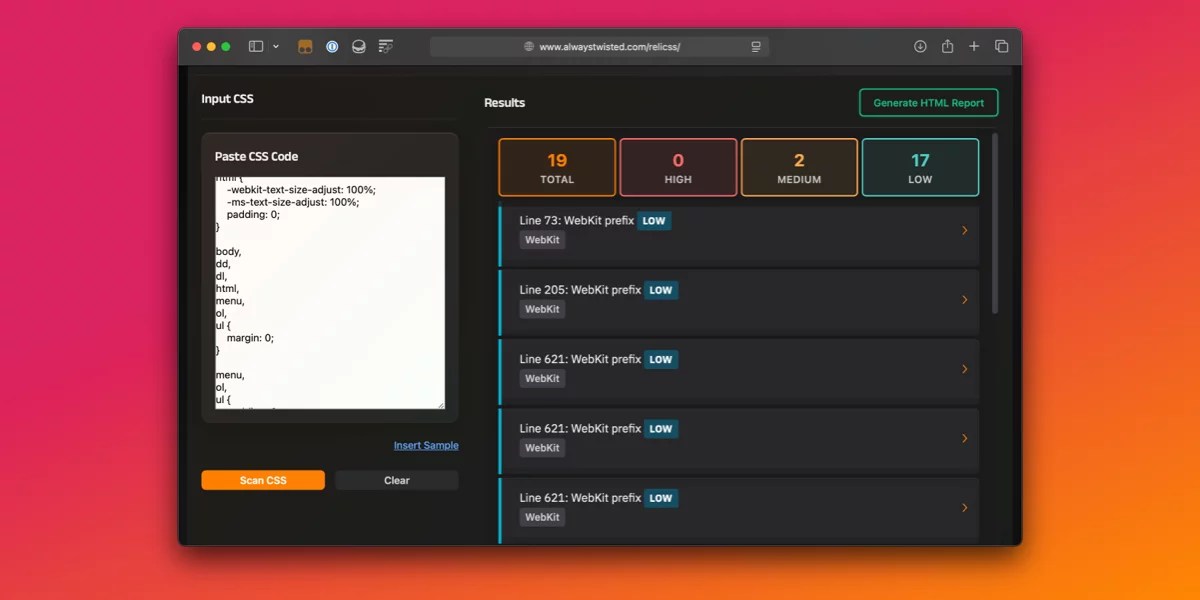
    An archaeological dig on a large, established site, perhaps one that has not been updated in several years, might reveal interesting findings.

    Screenshot auditing CSS-Tricks CSS stylesheet in Stu Robson's ReliCSS tool. Out shows 19 total relics.🫣

    Often, findings are largely vendor prefixing, which could be a result of an older Autoprefixer configuration.

    Share. Facebook Twitter Pinterest LinkedIn Tumblr Email
    Previous ArticleProtecting Your Privacy: How to Disable AI Training for Gemini Conversations
    Next Article Deploy LLMs with Hugging Face Inference Endpoints
    Samuel Alejandro

    Related Posts

    Dev

    Text Generation Using Diffusion Models and ROI with LLMs

    March 1, 2026
    Dev

    RCCLX: Innovating GPU Communications on AMD Platforms

    February 28, 2026
    Dev

    RSC for LISP Developers

    February 26, 2026
    Add A Comment
    Leave A Reply Cancel Reply

    Latest Post

    ChatGPT Mobile App Surpasses $3 Billion in Consumer Spending

    December 21, 202517 Views

    Automate Your iPhone’s Always-On Display for Better Battery Life and Privacy

    December 21, 202515 Views

    Creator Tayla Cannon Lands $1.1M Investment for Rebuildr PT Software

    December 21, 202514 Views
    Stay In Touch
    • Facebook
    • YouTube
    • TikTok
    • WhatsApp
    • Twitter
    • Instagram
    About

    Welcome to NodeToday, your trusted source for the latest updates in Technology, Artificial Intelligence, and Innovation. We are dedicated to delivering accurate, timely, and insightful content that helps readers stay ahead in a fast-evolving digital world.

    At NodeToday, we cover everything from AI breakthroughs and emerging technologies to product launches, software tools, developer news, and practical guides. Our goal is to simplify complex topics and present them in a clear, engaging, and easy-to-understand way for tech enthusiasts, professionals, and beginners alike.

    Latest Post

    Verifying 5G Standalone Activation on Your iPhone

    March 1, 20264 Views

    Hands on: the Galaxy S26 and S26 Plus are more of the same for more money

    March 1, 20265 Views

    IronCurtain: A Secure AI Agent Designed to Prevent Rogue Actions

    March 1, 20264 Views
    Recent Posts
    • Verifying 5G Standalone Activation on Your iPhone
    • Hands on: the Galaxy S26 and S26 Plus are more of the same for more money
    • IronCurtain: A Secure AI Agent Designed to Prevent Rogue Actions
    • Kwasi Asare’s Entrepreneurial Journey: Risk, Reputation, and Resilience
    • The Rubin Observatory’s alert system sent 800,000 pings on its first night
    Facebook X (Twitter) Instagram Pinterest
    • About Us
    • Contact Us
    • Privacy Policy
    • Terms & Conditions
    • Disclaimer
    • Cookie Policy
    © 2026 NodeToday.

    Type above and press Enter to search. Press Esc to cancel.