





Pornhub’s parent company, Aylo, announced upcoming restrictions for its website in the UK, attributing the decision to the nation’s stringent age verification requirements for explicit content platforms.
Beginning February 2, only individuals with pre-existing Pornhub accounts will be able to access the site’s content.
Aylo stated that updates to the UK’s Online Safety Act (OSA), which mandate age verification, have not achieved their intended goal of safeguarding minors. Instead, the company claims the legislation has redirected users to less regulated areas of the internet.
In October, Aylo reported a 77% drop in website traffic following the implementation of the law.
Ofcom, the UK’s regulatory body, previously indicated that the stricter age checks were effectively preventing children from encountering inappropriate material.
An Ofcom spokesperson commented that adult content services have the option to either implement age verification as required by the Act or block access to their sites within the UK.
The regulator also mentioned its ongoing discussions with Aylo to understand the company’s revised stance.
Alex Kekesi, head of community and brand at Aylo, described the decision to limit UK access to Pornhub as challenging.
“Its sites, which host legal and regulated porn, will no longer be available in the UK to new users, but thousands of irresponsible porn sites will still be easy to access,” Kekesi stated.
Kekesi explained that the platform initially complied with OSA obligations, having hoped that Ofcom, as a determined regulator, could effectively enforce the legislation. However, six months after the introduction of age verification, Kekesi suggested that the company’s experience indicates the OSA has not met its objective.
A spokesperson for the Department for Science, Innovation and Technology affirmed that the Online Safety Act mandates online pornographic services to implement robust age assurance to prevent child access. The spokesperson clarified that the Act does not prohibit adults from viewing legal content, and services are not required to exit the UK; they simply need to ensure minors cannot access their material, with various methods available to achieve this.
Pornhub remains the largest porn platform in the UK, according to web analytics firm Similarweb.
It was among numerous sites that introduced age verification methods for UK visitors when the requirements became effective last summer.
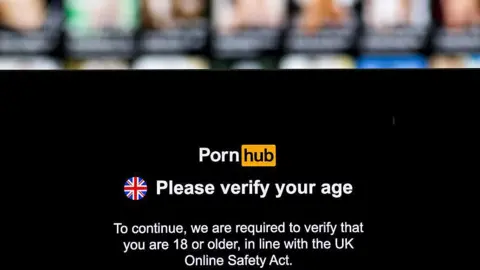
Individuals attempting to access Pornhub in the UK after February 2 will encounter a barrier instead of site content, according to Kekesi. Similar restrictions will also apply to other Aylo-owned porn sites, including YouPorn and Redtube.
No silver bullet
Solomon Friedman of Ethical Capital Partners (ECP), Aylo’s owner, expressed belief that Ofcom was making good faith efforts to enforce age verification. However, Friedman argued that the issue lies with the law itself, stating that even a dedicated regulator cannot succeed under flawed legislation.
Friedman noted that six months after the age verification requirement for sexually explicit content sites took effect in the UK, individuals could still easily find such content through online searches.
Emma Drake, a partner specializing in online safety and privacy at Bird and Bird law firm, pointed out that while Aylo’s research suggested adults were seeking riskier porn sites, it also indicated an overall decline in adult porn site usage. Drake suggested that the same trend must apply to children, arguing that while determined individuals might find alternative routes like VPNs, creating barriers on well-known sites can still protect a significant number of children who would not make such an effort.
Aylo reiterated its stance that device manufacturers, such as Apple, Google, and Microsoft, are best positioned to implement technical measures to prevent children from accessing porn sites. Friedman asserted that device-level access control is efficient, effective, and privacy-preserving.
An Ofcom spokesperson stated that nothing prevents tech firms from developing device-level age assurance methods and urged the industry to pursue this if it can demonstrate high effectiveness. However, the spokesperson emphasized that Ofcom’s role is to enforce existing rules, which include flexible and proportionate age assurance measures that have seen widespread adoption.
Cyber security expert Dr. Chelsea Jarvie commented that while device-level controls would likely contribute to age assurance, they are not a complete solution. Jarvie highlighted that Virtual Private Networks (VPNs) continue to offer a workaround, underscoring the need for layered controls rather than reliance on a single measure for child protection online.
VPNs enable users to mask their online location, appearing as if they are browsing from a different country.
Downloads of VPN applications saw a surge in the UK after age verification mandates were implemented on July 25.
Peers in the House of Lords recently voted to amend the Children’s Wellbeing and Schools Bill, aiming to prohibit the provision of VPNs to children.

