


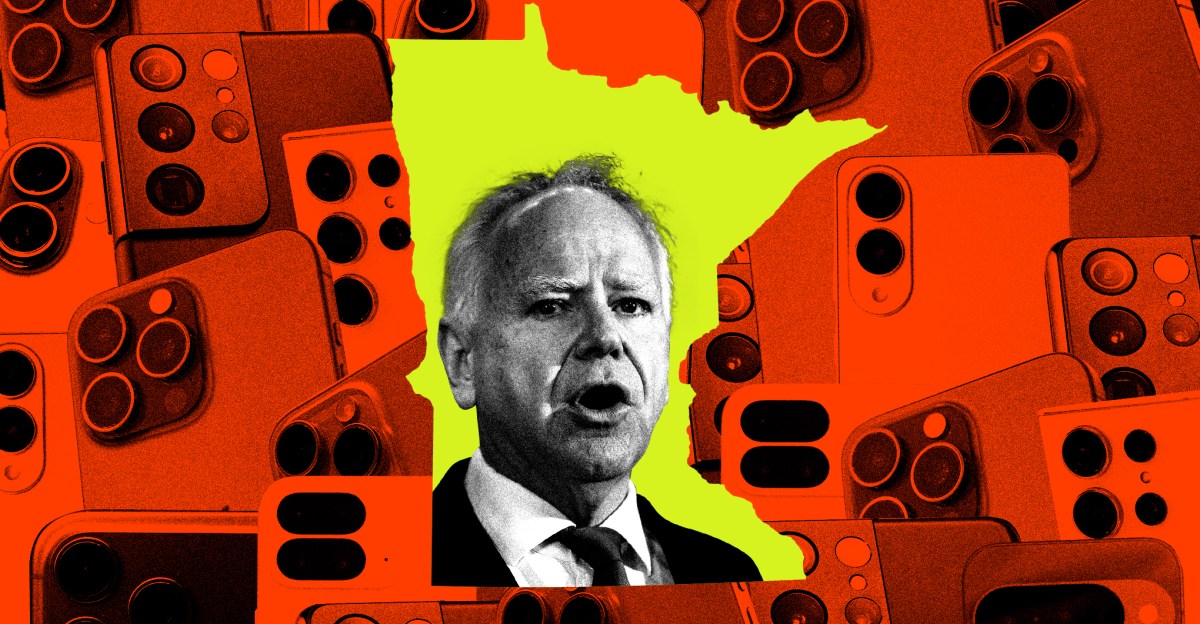

Amidst the presence of masked and armed agents in the Twin Cities, Governor Tim Walz urged Minnesotans on television to film ICE activities. He stated that these videos, as per a press release, would serve as a “database of the atrocities against Minnesotans” to document events and gather evidence for potential future prosecutions.
As federal agents conducted operations at hospitals, school bus stops, and retail stores, Governor Walz envisioned a future involving legal accountability. His address highlighted the importance of the legal system and democratic processes, offering both comfort to residents and a message to the courts. The implication was that Minnesota would adhere to the law, expecting legal protection in return.
Minnesota, alongside Minneapolis and St. Paul, has filed a lawsuit seeking a federal injunction against “Operation Metro Surge,” which involves 2,000 ICE agents in the Twin Cities. The legal challenge employs various arguments, but a central theme is states’ rights. The lawsuit contends that federal actions, by excluding local authorities and disregarding their jurisdiction, infringe upon the fundamental principles of the Bill of Rights, asserting Minnesota’s right to govern within its borders.
The federal government has violated the fundamental agreement of the Bill of Rights.
Donald Trump’s administration has primarily targeted liberal states and cities with sanctuary policies. The lawsuit, Minnesota v. Noem, emphasizes this pattern, noting Trump’s past electoral complaints about Minnesota. Cities like Los Angeles, Portland, and Chicago, led by Democratic mayors, have also faced federal actions and responded with strong resistance, both publicly and legally. The Supreme Court recently ruled against Trump in National Guard cases via a shadow docket decision. Following this, Trump announced a “withdrawal” from those cities, then shifted focus to Minnesota.
The lawsuit asserts that “The Tenth Amendment grants the State of Minnesota and its subdivisions, including Minneapolis and Saint Paul, undeniable sovereign authority to safeguard the health and wellbeing of all individuals residing, working, or visiting within their boundaries.” It further claims that the ICE surge has instilled fear and caused dysfunction throughout the city.
The lawsuit argues that federal actions have undermined local authorities by terrorizing Minnesotans. It states that residents possess the right to work, attend school, and move freely in public and private areas without fear of federal government violence against themselves or their families. Furthermore, they are entitled to use city services and facilities without harassment from federal agents.
The core of the dispute between the Trump administration and those affected by its policies is the desire for self-determination. Sanctuary cities are communities that have, through democratic processes, opted not to fully cooperate with federal immigration enforcement. From this perspective, the conflict clearly revolves around states’ rights.
However, the situation is also marked by significant irony. “States’ rights” has historically been a conservative argument since the Civil War, evolving into a pro-segregation stance during the Civil Rights Movement and later merging with right-wing extremist and militia movements in inconsistent ways.
The 1992 Ruby Ridge standoff and the Waco incident the following year fostered a distinct anti-government subculture. Events at Ruby Ridge, involving a homestead, homeschooling, and a birthing shed, influenced figures like Timothy McVeigh, who cited Ruby Ridge and Waco as motivations for the 1995 Oklahoma City bombing. Later militia groups, such as those involved in the 2016 Malheur National Wildlife Refuge takeover, viewed Ruby Ridge and Waco as “primary symbolism” of federal overreach.
Ultimately, Idaho charged an FBI sniper for the death of a woman at Ruby Ridge. Law professor Carolyn Shapiro suggests that, by similar logic, Minnesota officials could prosecute the ICE agent responsible for Renee Good’s death. A state-level conviction, she notes, would be beyond a presidential pardon.
The similarities between an ICE agent shooting Renee Good in her car and an FBI sniper shooting Vicki Weaver are apparent. Weaver’s death, occurring during crossfire that also killed a US marshal, might seem less straightforward than Good’s. A heavily armed mountain homestead differs significantly from a car slowly moving away.
Militias have not mobilized in support of Renee Good.
Regardless, a mother has died, and militias have not rallied in Renee Good’s name. Any militia presence in Minneapolis would likely be in opposition to her cause. Prior to Trump’s second term, militia groups had expressed willingness to assist in mass deportations. While it is unknown if militia members are integrated into ICE, it is known that ICE’s recruitment process is reportedly lax, to the extent that a journalist on a right-wing “antifa” watchlist received a job offer. If militias are not within ICE, it suggests either a lack of commitment or unique rejection from the agency. The pretense of anti-authoritarianism has dissolved. Resistance to federal overreach is now manifesting in urban areas with digital tools, not armed standoffs. Justice for Renee Good may depend on a state prosecution, contingent on Minnesota asserting its states’ rights.
Federal authorities appear unwilling to allow state prosecution. They are denying Minnesotan authorities access to evidence and, on Friday, the Justice Department initiated a criminal investigation into Governor Walz and Mayor Jacob Frey. Earlier, the DOJ reportedly pressured the US attorney’s office to charge Renee Good’s wife, leading to the resignation of at least six federal prosecutors. Among them was a career prosecutor, a Minnesota native, who had been managing fraud cases related to state safety net programs since 2022. These legitimate cases were recently distorted by a conservative influencer from Utah into unsubstantiated and viral fraud claims against Somali-operated daycare centers.
Nick Shirley’s YouTube video garnered millions of views and, crucially, caught the attention of the president, who repeatedly cited “fraud” as the justification for Operation Metro Surge. This media cycle ultimately resulted in a mother’s death in her car.
Digital content initially drew ICE’s attention, and now Minnesota is using content to counter ICE. The Minneapolis city council president regularly posts videos, including one showing an ICE agent pushing him. He commented, “If this is how they treat the President of the Minneapolis City Council who is legally observing, just think of what they’re doing to everyone else in our City.” Governor Walz has also appeared on television, advising residents to “carry your phone with you at all times, and if you see ICE in your neighborhood, take out that phone and hit record.”
Numerous videos are being uploaded to social media, showing Minnesotans gathering around arrests, recording with their smartphones as agents apprehend individuals.
The president’s actions suggest a desire for civil conflict.
Governor Walz’s assurance that the collected videos will be used for accountability has some basis. The lawsuit, Minnesota v. Noem, already includes numerous references to videos depicting the arrests of US citizens. The complaint’s footnotes contain links to platforms like YouTube, X, and Truth Social. The administration’s highly charged social media posts are cited as evidence of irrational hostility towards Minnesota, while the ICE arrest videos are presented as objective proof of this hostility manifesting as a campaign of terror, unrelated to legitimate immigration enforcement.
However, questions remain: What if a judge denies the injunction? What if there is no ultimate accountability? What if the current administration persists? What if legal avenues fail to protect Minneapolis from federal intervention?
A less aggressive government would likely have withdrawn ICE from Minneapolis following Renee Good’s death. Instead, federal authorities are reportedly attempting to imprison her wife, the mayor, and the governor. The president’s behavior suggests a desire for civil conflict, or perhaps an acknowledgment that such a conflict is already underway. Governor Walz’s directive to film ICE operations implies a belief that either the judiciary or the electoral system will curb the administration’s actions. Sousveillance represents a final, peaceful assertion of states’ rights. If these rights are exercised within constitutional bounds, it reflects the system functioning. Beyond those limits, the nation risks moving towards the civil unrest that some suggest the president desires.
Concurrently, the continuous flow of videos from Minneapolis has created its own narrative. In a notable reversal of the xenophobic sentiment that contributed to the president’s election, ICE is now portrayed as an invading force within the homeland. Similar to the federal presence at Ruby Ridge, these agents are depicted as unwelcome outsiders, pursued by residents with whistles and vehicles. The sentiment is that these “invaders” must be removed, and Minnesota should be governed by Minnesotans.
