


This represents a significant change, especially after a recent editor transition. However, developments at Medium suggest this will ultimately benefit all involved: authors, readers, and publications.
The aim is to encourage individuals to start their own publications, offering guidance on effective strategies. For authors, numerous existing publications are available, with the hope of more emerging soon.
Medium’s publications have historically functioned as a hybrid of group blogs and sub-reddits. Editors play a crucial role in maintaining quality, providing feedback, and connecting authors with an audience, making publications a core component of the Medium platform.
The landscape for successful publications is evolving. Previously, success often came from publishing a wide array of content. This led to Medium being dominated by broad, high-volume publications. Better Programming exemplified this approach, covering diverse topics that often lacked overlapping readership. For instance, few programmers actively use all of Go, Rust, Javascript, Ruby, Python, Swift, Kotlin, and Dart simultaneously.
Given its broad scope, Better Programming frequently published content that might not appeal to all readers. Medium is now shifting towards optimizing for more focused publications.
Two key areas of focus appear particularly promising. Firstly, publications can serve as de facto communities for enthusiasts. Secondly, they can contribute a higher level of expertise to Medium’s Boost program. These are specific perspectives, and other creative approaches may also prove successful.
Both scenarios strongly suggest the need for highly focused publications.
To cultivate an enthusiast community around a specific topic, such as Kotlin, where members share projects and learning experiences, it is not necessary to include authors writing about unrelated subjects like Swift.
Medium also relies on the expertise of publication editors to act as nominators for the Boost program. Maintaining credible expertise becomes challenging with an overly broad focus. Most nominators possess firsthand knowledge beyond their published work. For example, an editor might credibly nominate content related to Rails or Regular Expressions based on extensive experience, but lack expertise in many other areas.
Operating a publication requires dedication and is not a path to quick wealth. The most successful publications stem from genuine interest in a subject. While technical topics can offer financial incentives, the primary motivation should be to channel a passion. The strong impulse for community building is evident from the number of publications launched on Medium over time.
For those interested in starting a publication, here are some tips, presented in a suggested order.
- Publications are straightforward to initiate, and at a minimum, you can contribute your own stories. Start a new publication here.
- To accept contributions from other authors, establish clear instructions. Most publications that welcome external writers create a “write for us” page with guidelines, feature it as a publication tab, develop a style guide, and use a Google form for author applications. An example can be found here.
- Consider focusing on inclusivity. This approach emphasizes support and encouragement over a strict editorial bar. While individuals may be hesitant about judgment, it is often observed that all writing benefits the writer and can be valuable to some readers, even if it doesn’t achieve widespread popularity on platforms like Reddit or HackerNews.
- Alternatively, a focus on exclusivity involves curating the highest quality ideas and information on a given topic. Medium’s Boost program offers editors a recruitment tool, allowing them to promise increased readership for exceptional stories. This requires boosting only the best content, making it a highly selective strategy. For instance, a publication focused on running might leverage Boost to collaborate with professional coaches and athletes. In programming, a similar approach could involve recruiting prominent figures in a specific language community, such as inviting Larry Wall for a Perl publication.
- Becoming a Boost nominator is an option, but it demands a keen eye for truly outstanding content. While all Medium stories aim for quality, some stand out as particularly important, accurate, and helpful. Although not official policy, it is generally considered appropriate to apply to be a Boost Nominator once a publication has three authors and ten stories.
- Launching a publication necessitates author recruitment. Ideally, individuals already know potential contributors, even if they are not yet on Medium. A strong understanding of a subject, coupled with existing connections to others who share similar enthusiasm and expertise, is often crucial for a successful publication. Beyond personal networks, many publications recruit authors by monitoring relevant Medium tags and using private notes to invite recently published stories.
- Regarding financial aspects, publications that boost stories receive an honorarium, and building an audience can increase earnings for personal stories. However, prioritizing Medium earnings above all else overlooks a larger opportunity. Writing and editing serve as valuable portfolio building activities. The software engineering field offers significantly higher compensation than Medium’s writing payments. Therefore, focusing solely on Medium earnings can be a limited approach, as a strong reputation built through writing can lead to far greater financial gains in career advancement or job opportunities.
For those who start or already manage a programming publication seeking authors, consider sharing a link in the comments along with submission guidelines.
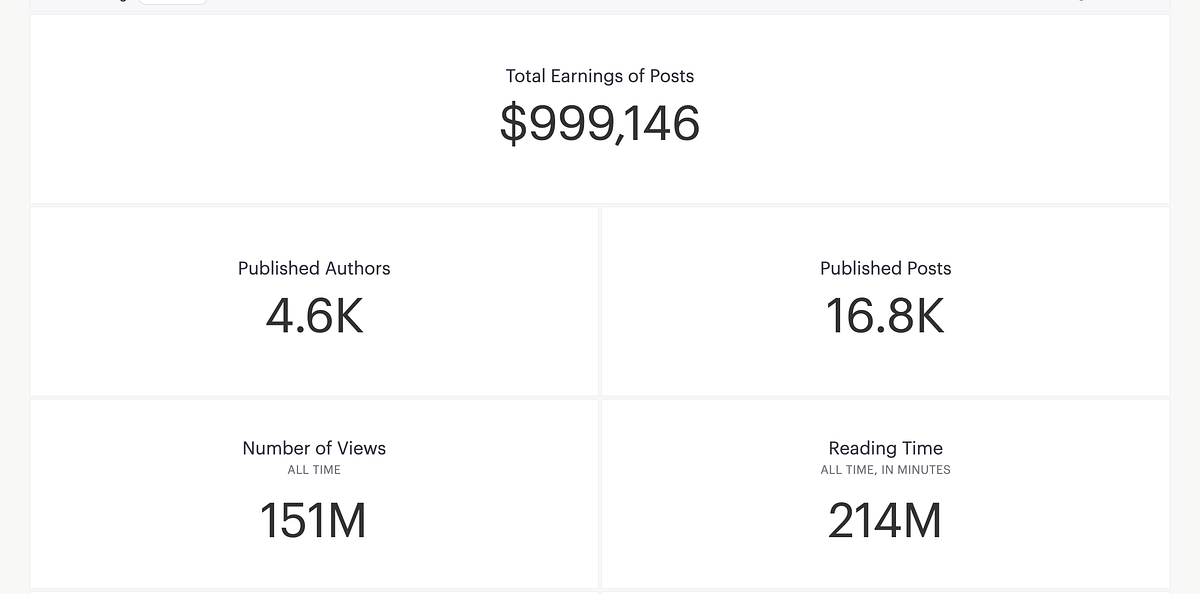
Better Programming’s statistics show that 4,600 authors contributed 16,800 stories, generating 151 million page views. Stories behind the paywall collectively earned authors nearly $1 million. The platform remains a viable option for authors, but exploring new publishing venues is encouraged.
