


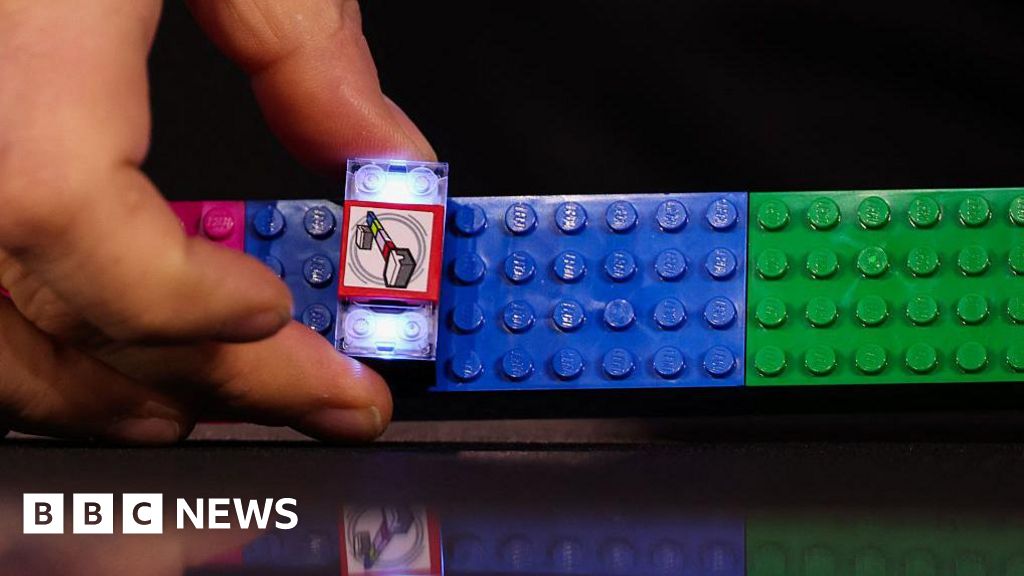


Lego has introduced Smart Bricks, technologically advanced versions of its classic building blocks. These new bricks are designed to bring sets to life with integrated sound, light, and reactions to movement.
However, this new product line has received a mixed reception from play experts. They suggest it risks undermining the unique qualities of Lego for children in an increasingly digital world.
Unveiled at the Consumer Electronics Show (CES) 2026 in Las Vegas, the Danish toymaker’s Smart Play system incorporates new electronic components into its traditional plastic blocks.
Lego describes its new tech-enabled products, set to launch in March with a new Star Wars set, as its “most revolutionary innovation” in nearly 50 years.
Conversely, Josh Golin, executive director of the children’s wellbeing group Fairplay, believes Smart Bricks could “undermine what was once great about Legos” – the way they foster children’s own imagination during play.
He stated that the toy did not require additional features to generate sounds or other effects.
“As anyone who has ever watched a child play with old-school Legos knows, children’s Lego creations already do move and make noises through the power of children’s imaginations,” he explained.
Andrew Manches, a professor of children and technology at the University of Edinburgh, concurred that Lego’s appeal lies in “the freedom to create, re-create, and adapt simple blocks into endless stories powered by children’s imagination.”
Despite this, Professor Manches also acknowledged Lego’s efforts to integrate physical and digital play, particularly with tools that respond to how children interact with its Smart Play products.
Julia Goldin, the company’s chief product and marketing officer, previously indicated that digital technology is seen as an opportunity to “expand physical play and physical building.”
She added that the digital world is not viewed as a threat, and the smart range seamlessly integrates interactivity with physical products.
What are Lego Smart Bricks?
Lego states that its Smart Bricks can detect motion, position, and distance, allowing models to react in various ways during play.
Measuring 2×4 studs, each brick contains sensors, lights, a small sound synthesizer, an accelerometer, and a custom-made silicon chip that enables it to detect and respond to movement.
These bricks are designed to be used in conjunction with Smart Minifigures and Smart Tags tiles, which are two additional products forming Lego’s Smart Play System.
These adapted Lego components feature digital identifiers that trigger different sounds or reactions when they interact with each other.
For example, during a demonstration at CES, a Lego birthday cake recognized when its “candles” were blown out, responding with a cheer and a happy birthday song.
Similarly, a Lego helicopter produced whooshing sounds when moved or rotated, with its Smart Brick lighting up red upon “crashing.”

Using a wireless system developed by Lego, these three components communicate to produce specific responses through the Smart Brick.
Tom Donaldson, head of Lego’s Creative Play Lab, mentioned that the technology aims to respond to children’s actions and complement their natural play patterns.
He expressed hope that the Smart Brick’s reactions would “inspire and surprise the user to keep them continuing to play.”
Donaldson also stated that Lego is “building a platform that we want to last for many years.”
Professor Manches noted that the reduced cost and size of components have “enabled more toymakers to integrate digital technology seamlessly into a range of toys.”
However, he added that despite exciting innovation, concerns persist regarding the security and privacy of new smart toys for children, especially those incorporating AI.
“The key is to us all to remain critically reflective of the design of these toys, and to pay much attention to how they influence children’s everyday lives,” he advised.
This is not Lego’s first venture into digital experimentation or its attempt to engage increasingly online audiences.
Since 2017, the company has released augmented reality apps and experiences, allowing users to interact with computer-generated models overlaid onto their physical surroundings.
Through collaborations with video game publishers like Nintendo and Fortnite-maker Epic Games, Lego has also sought to appeal to fans of popular games and new releases, such as the Super Mario Minifigure launched in 2020 with a tiny display screen.
Lego chief executive Niels B. Christiansen indicated in the firm’s 2024 annual report that spending on digital technology had been accelerated as a “strategic area” for the company.
