


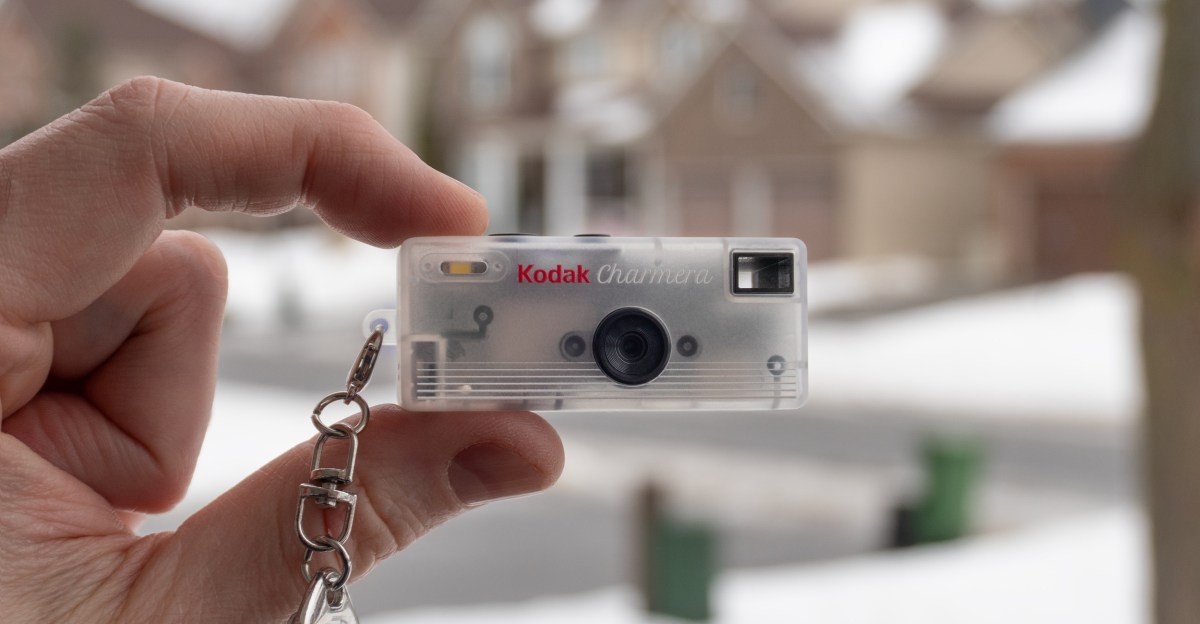

Despite its limitations, the Charmera’s cuteness is undeniable.
Similar to trading cards or collectible figures, the exact design of a Kodak Charmera camera remains a mystery until the box is opened. This element of anticipation, combined with its approximately $30 price point, contributed to the collectible camera quickly selling out and becoming difficult to find after its debut last September. While the Charmera is not intended to replace a smartphone camera or even an older point-and-shoot, it possesses enough charm to warrant a spot on a keyring and offers a unique novelty for capturing lo-fi memories.
The Charmera is available in six retro designs, along with a rarer “secret edition” featuring a transparent shell. The transparent version is a delightful find.

The Charmera’s vibrant, retro-inspired packaging adds to its appeal.
The excitement of opening a blind box collectible is a significant draw, but discovering the camera’s surprisingly small size is equally satisfying. Despite its presence across social media, many expect a device closer in size to a disposable film camera, rather than something comparable to a Chapstick. Its tiny form factor often elicits surprise when revealed as a functional digital camera.
However, the camera’s functionality is quite restricted. The Charmera features five small buttons, but only the shutter release is used for taking pictures. It operates as a completely automatic camera, lacking any options to adjust exposure, focus, white balance, or other settings. It embodies the simplest form of a point-and-shoot camera.

The Charmera’s top features power and shutter buttons.

The camera’s screen is less than an inch, with a smaller portion dedicated to a live preview.

Menu navigation and settings are straightforward, offering minimal customization beyond displaying the date on photos.

The camera’s automatic flash cannot be disabled, but it creates a unique internal glow in the transparent Charmera.
An integrated LED flash activates automatically in low-light conditions, though its effective range is limited to a few feet. In the transparent Charmera model, the LED illuminates the entire camera from within, creating an interesting visual effect.
The Charmera includes built-in storage, but its capacity is minimal. Only two photos can be captured before a “disk full” warning appears, making a microSD card an essential addition. A 4GB card can expand the camera’s capacity to over 14,000 pictures.

The Charmera excels at reproducing bright and saturated colors.

While the camera’s focus is not infinite, it does not produce images with significant background blur.

Optimal results are achieved in bright outdoor conditions, allowing for quick exposures.

Highlights are easily overexposed, and shadows typically lack detail.
The camera accommodates numerous images on a relatively small microSD card due to its modest 1.6-megapixel ¼-inch sensor, which captures photos at 1,440×1,080 pixels. This is paired with a 35mm f/2.4 plastic lens, collectively producing images that often fall short of expectations. Photos tend to be soft, grainy, and noisy, with desaturated colors. Dynamic range is limited, leading to blown-out highlights and shadows devoid of detail. In low-light environments, maintaining a steady hand is crucial to prevent blur from longer exposures, a challenge given the camera’s mere 30-gram weight.

The Charmera’s black-and-white filter is a frequently used option.

Some frame effects are visually appealing, but often resemble promotional material for the Charmera.

Pixel filters are particularly interesting, as they effectively mask the camera’s inherent flaws.

Choices for pixel filters include yellow, red, blue, and gray.
The Charmera offers a selection of color modes, filters, and decorative frames that can be applied during photo capture. While the frames often appear promotional, some filters are worth exploring. A black-and-white mode provides occasional enjoyment, and high-contrast red, blue, yellow, and gray “pixel” filters can generate two-tone images that are sometimes more compelling than the camera’s standard output.
Videos, recorded as AVI files, are even less impressive. They are marred by compression artifacts and jerky movements if the camera is in motion. The audio quality is similarly poor, and if the included metal keychain is attached and not secured during recording, its jangling noise will likely dominate the audio track.
Framing shots also presents a challenge. The Charmera’s tiny LCD screen, less than an inch in size, dedicates only a small portion to a live preview. Users may find themselves straining to frame a shot or navigate the camera’s basic menu system, which offers options for setting the time and date, formatting the memory card, or deleting images. An even smaller optical viewfinder, essentially a pass-through hole, proves even less effective.
The Charmera’s limited camera controls, poor photo and video quality, short battery life, and tiny screen are not surprising. What is remarkable is how little these shortcomings detract from its appeal. It functions as a charming electronic trinket that many find themselves using more often than anticipated. Much like the Charmera itself, taking photos with it is a blind box experience. While most results may be candidates for deletion, occasionally a fun or unique snap emerges that is worth sharing. Ultimately, the Charmera’s true appeal lies in its inherent charm.
