




A campaign earlier this year encouraged individuals to embrace online choice and assert independence in their digital lives. This initiative, titled Open What You Want, champions autonomy and personal expression online, beginning with the fundamental decision of selecting a web browser. This choice is crucial, influencing one’s web experience, data protection, and online self-expression.
To gain insight into how people perceive, express, and defend choice in their daily routines, a series of in-person events were organized to engage with communities and gather information.
From coffee raves to cosplay: What was learned about choice IRL
Events were held in various cities and cultural centers where creativity, fandom, and freedom of expression are prominent. These included
and the House Blend day-rave series in Chicago, Berlin, LA, and Munich, as well as TwitchCon in San Diego, the Footbrawl tournament in Berlin, and Comic Con in Stuttgart.
Across all locations, a consistent observation emerged: individuals value genuine choice in significant aspects of their lives, from selecting a coffee blend to choosing a cosplay or gaming character, or determining their online presence.
However, in the online realm, the sense of choice and control has diminished. Frequently, what appears to be a personal decision has already been predetermined by major technology platforms.

The reality of online choice today
To investigate this issue, a survey was conducted with 8,000 adults aged 18 and over across France, Germany, the UK, and the U.S., exploring their experiences with choice and control both online and offline.
The survey, carried out by YouGov, revealed a conflict between individuals’ desire for control over their data and digital privacy, and the current state of the internet. This online environment, largely shaped by major technology platforms, often hinders people’s ability to make meaningful choices:
- Only 16% of respondents reported feeling in control of their privacy choices, with Germany showing the highest percentage at 21%.
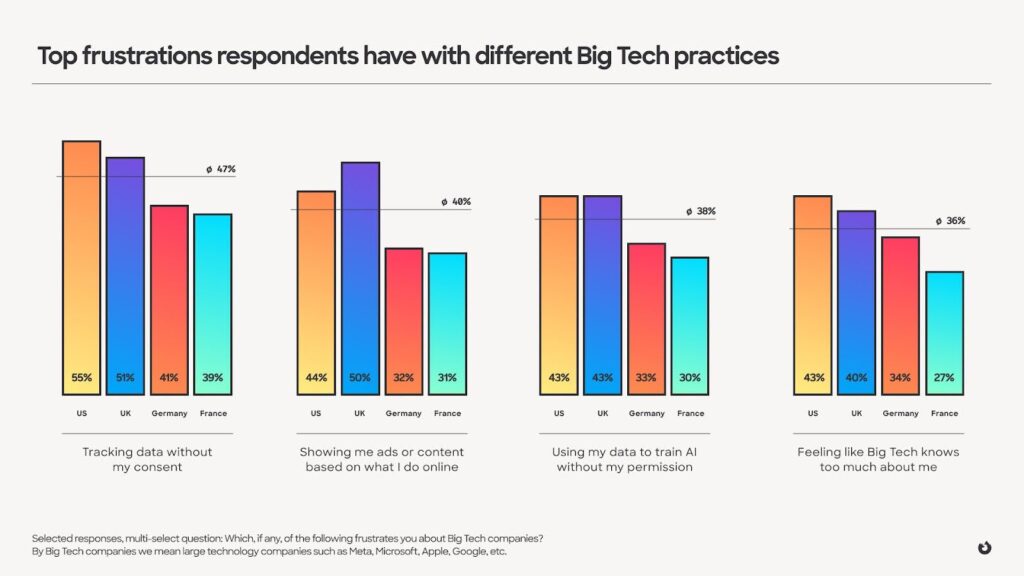
- A quarter (24%) felt it was “too late” to regain control, believing Big Tech already possessed excessive influence or knowledge about them. Furthermore, 36% expressed frustration over major technology companies knowing too much, a sentiment particularly strong in the U.S. (43%) and the UK (40%).
- Frustrating practices identified by respondents included Big Tech utilizing their data for AI training without consent (38%) and tracking their data without permission (47%), with this frustration peaking in the U.S. (55%) and being lowest in France (39%).
Previous research on browser choice further indicates that difficult-to-change defaults and complex settings can obscure alternative options, thereby restricting individuals’ capacity for self-selection. This underlying issue contributes significantly to the observed dynamics.
These combined insights may clarify why, when questioned about the most potent expressions of online independence, opting not to share personal data (44%) consistently ranked among the top three responses across all surveyed countries (46% in the UK; 45% in the U.S.; 44% in France; 39% in Germany).
Ajit Varma, Product Vice President at Firefox, stated, “This study fundamentally demonstrates the necessity for technology to prioritize humanity, with product design centered on user agency, choice, and trust. Companies that adopt this approach can empower users and foster healthy competition, resulting in superior products for all.”
A significant trend also emerged regarding how individuals consider the communities and platforms they choose to join; for 29% of respondents, this represented one of their top three expressions of online independence.
Christina Lang, VP of Global Marketing, commented, “The type of web communities that flourish—those that are open, curious, and user-shaped—are increasingly conflicting with the environments being constructed by major technology companies and their founders. Today’s dominant platforms often aim to confine users within specific ecosystems and dictate the online products they utilize. For Firefox, community has always been central, and efforts will continue to restore genuine choice and control to users, ensuring the web truly belongs to the communities that define it.”
The Open What You Want campaign aimed to convey a crucial message through engaging, unconventional experiences: that selecting one’s browser is among the most significant digital decisions an individual can make.
Further details on local country findings from the survey are available in the France, Germany, UK, and U.S. press releases, which include the U.S. findings deck.
