


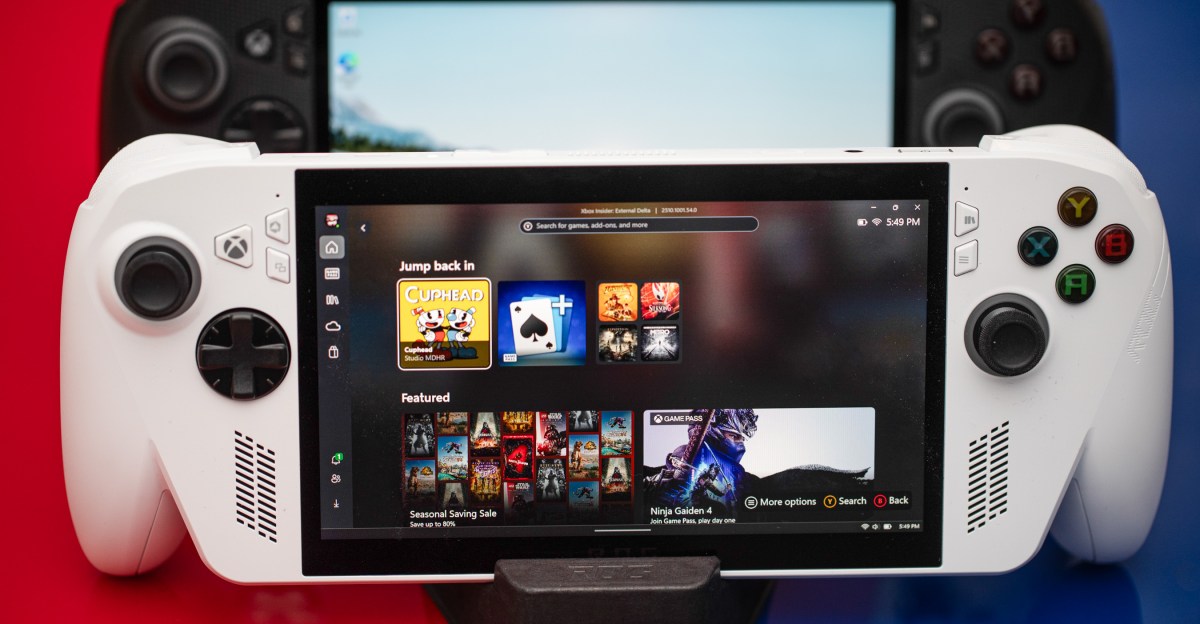
 An Xbox Ally in front of an Xbox Ally X.
Despite initial reservations about the Xbox Ally and its Windows-based Full Screen Experience (FSE), a significant improvement has been observed in a long-standing Windows issue. This comes two months after a critical review of the more affordable white Xbox Ally and a cautious assessment of the pricier black model.
Testing of these handheld devices continued beyond the initial October review, involving games like Hollow Knight: Silksong and Blue Prince. The FSE was also installed on an MSI Claw 8 AI Plus. Following numerous updates, two of these handhelds are now considered more reliable for saving game progress and preserving battery life during sleep mode. The third unit has also shown some improvement.
 The Xbox Ally X.
The ability to reliably put a device to sleep has historically been a key advantage for handhelds like the Steam Deck or Nintendo Switch over Windows counterparts. This feature is crucial for handheld gaming, allowing users to pause and resume games instantly with a single button press. This enables tackling longer games in short bursts, fundamentally changing the gaming experience by eliminating the need to save and quit frequently.
Windows’ sleep functionality has been notoriously poor for years. However, in December, the more expensive black Xbox Ally X demonstrated reliable sleep performance, with no game progress lost. One instance involved a game left open for nine days, resuming exactly where it left off. Battery drain during sleep also appears reasonable, with a daily loss of 4 to 8 percent, totaling 40 percent over the nine-day period.
Other issues persist, such as occasional delays in regaining control after resuming from sleep, and temporary unresponsiveness of Xbox and Asus buttons during background Windows updates. Additionally, after extended sleep periods, Windows may unexpectedly require re-authentication and a PIN reset.
A notable concern is the failure of an SSD in another Xbox Ally X unit, though its sleep function was reliable prior to that. Assuming the SSD issue is attributable to the drive manufacturer, the Xbox Ally X is becoming a more acceptable product. Asus has been contacted regarding the SSD.
 Close-up on the white Xbox Ally.
The white, standard Xbox Ally, equipped with AMD’s Z2 A chip, presents a different experience. After months of testing two such units and applying all available Windows, Asus, Game Bar, and Xbox App updates (some specifically targeting sleep issues), both devices consistently woke up autonomously. This behavior, observed while the units were unattended, led to significant battery drain.
For example, on November 19th, a black Xbox Ally X (96% battery) and a white Xbox Ally (93% battery) were put to sleep simultaneously. Thirteen hours later, the white unit was fully depleted, while the black unit retained 91% charge.
Another test on November 20th, starting with 88% and 82% battery for the black and white units respectively, showed similar results. After almost four days, the white unit was dead, whereas the black unit still had 61% battery remaining.
A factory reset on one of the white units appeared to yield some improvement, with games often resuming correctly from sleep. However, on December 6th, the device was found overheating in a bag. Logs indicated it had woken up around midnight, turned off its screen an hour later, but failed to re-enter sleep mode. The silent fan and dark screen meant its active state went unnoticed when placed in the bag.
 Windows logs show it never went back to sleep after waking itself up that day.
Furthermore, on December 7th, the same factory-reset and fully updated Xbox Ally inexplicably ceased charging overnight, stopping at 54 percent battery.
Asus has stated an inability to replicate these issues. However, these problems have been observed across two distinct units, with similar reports found online. It is known that the Xbox Ally’s AMD Z2 A processor inherently supports fewer sleep modes compared to the Xbox Ally X. Notably, Bazzite required consultation with AMD to enable proper sleep functionality for the Z2 A chip in Linux.
The delay in Microsoft addressing this issue in Windows, and its complexity, remain unclear. Microsoft has not provided immediate or substantive comments. It is speculated that the problem might be specific to the Z2 A chip, as the Intel Lunar Lake in the MSI Claw 8 AI Plus has not presented similar difficulties, especially after a manual BIOS update.
The Intel Claw 8, initially unreliable for sleep, now performs well, exhibiting as little as 2 percent daily battery drain in sleep mode. While testing the Insider Preview, some bugs were encountered, such as a black screen and a persistent 30fps frame rate cap requiring power mode changes, but such issues are anticipated in preview builds.
Similar to how the Steam Deck required time to mature, Microsoft’s Windows handhelds may also need further development. If Microsoft successfully resolves the PC sleep issue, with the standard Xbox Ally being an isolated case, it could significantly alter perceptions of Windows-based handheld gaming devices.
Currently, the standard Xbox Ally might still be a viable option. It is available for $489 on Amazon or for $499 at Asus, with the recommendation to install Bazzite. Bazzite has proven more reliable, offers better performance, and generally outperforms Windows in tests, unless specific games require incompatible anti-cheat software or a user is heavily invested in a library of “Xbox” PC games.
