


How it Started
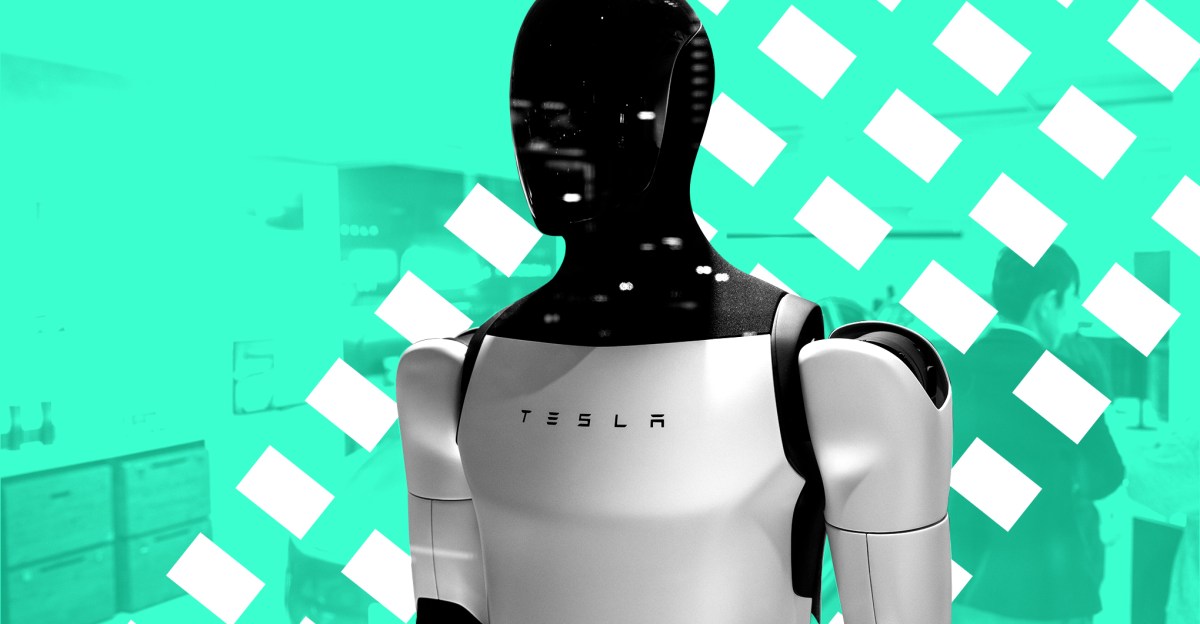
Many find robot fail videos amusing, and a recent clip of Tesla’s Optimus robot collapsing at an Autonomy Visualized event in Miami has garnered significant attention online.
The footage shows Elon Musk’s much-hyped humanoid robot attempting to distribute water bottles, only to knock several over, flail its arms, and fall backward. Observers noted a water plume from a crushed bottle and a movement resembling someone removing a VR headset.
This incident is not the first time Tesla has faced scrutiny regarding the autonomy of its robots. Previous demonstrations of the Tesla Bot (now Optimus) involved a dancer in a bodysuit and later, humans remotely controlling the robots, often using VR headsets, a method Tesla employs during development.
Humanity’s fascination with robots spans centuries, from ancient automatons to modern AI. Much of the current excitement around humanoids stems from Elon Musk, who has a history of ambitious predictions. He has promised a ‘robot army’ of a million humanoids. While robotics has seen many hype cycles where technology couldn’t match the enthusiasm, there’s a current belief that AI is finally prepared to deliver on these promises.
What does this ‘ready to deliver’ state truly entail in 2025?
How it’s Going
A significant surge of interest in humanoid robots is currently underway. Major tech companies such as Nvidia, Meta, SoftBank, Google, Amazon, Microsoft, Intel, and Tesla are heavily investing in this sector, viewing it as the next frontier. Smaller companies like Apptronik, Boston Dynamics, Figure AI, and 1X are also actively participating.
China is also heavily involved, with Beijing identifying embodied AI, encompassing humanoids, drones, and other autonomous machines, as crucial for future economic growth. The nation is investing substantially and providing state subsidies to establish itself as a global leader in robotics, attracting companies like Ant Group, Baidu, Unitree, and AgiBot.
Based on the numerous demonstrations from China and other regions, one might assume the era of humanoid robots has fully dawned. This past summer, robots participated in dance, combat, and athletic events at China’s inaugural World Humanoid Robot Games, with a similar International Humanoid Olympiad taking place in Greece. Robot combat events, ranging from organized competitions and underground clubs to sparring with executives, appear to be gaining unexpected popularity.
Companies are also focused on bringing robots from industrial settings into homes. Proponents argue that humanoids are ideal for these human-centric environments, despite potentially simpler alternative robot designs. Figure showcased its new Figure 03 robot performing domestic chores in a video, including washing dishes and folding clothes. 1X introduced Neo, marketed as a safe and “consumer-ready humanoid robot.” There are also
of Neo performing basic household tasks with some instability. 1X is offering Neo units for $20,000, with US deliveries expected next year.
Despite impressive advancements, practical applications for humanoid robots are still limited, and polished demonstrations often do not reflect fully autonomous products. Many demos are staged, scripted, or even remotely controlled. For instance, Ant Group’s R1 was shown cooking at a trade show, but at an extremely slow pace
. The appeal of 1X’s Neo diminishes when considering that its operation may involve remote human control. Similarly, robot sporting events are entertaining precisely because of the robots’ instability and unpredictability, rather than their athletic prowess.
This disparity between technological capability and public excitement prompts a question: if the technology isn’t fully matching the hype, why the enthusiasm? The answer might be that, for the first time in a while, the underlying technology is beginning to catch up.
What Happens Next
Historically, robots struggled with basic human tasks like walking or grasping objects due to hardware and, more significantly, software limitations, restricting them to controlled environments and specific functions. However, advancements in AI are now accelerating robot development, addressing these challenges.
Significant progress in AI, particularly in image and text generation by companies like OpenAI and Google, is attributed to large language models (LLMs). These models utilize complex networks to identify and replicate patterns from vast datasets, enabling generalized behavior instead of rigid, pre-programmed rules. Roboticists are now applying this approach to equip robots with the flexible understanding of the physical world necessary for real-world operation.
A primary obstacle is data acquisition. While LLM training data is plentiful online, robot training requires extensive real-world movement examples, which are scarce at scale. Companies are actively addressing this, with significant efforts to generate the necessary data. For instance, Tesla employs workers who wear cameras and sensors to teach Optimus human-like behaviors. Similarly, companies like 1X deploy semi-autonomous robots into homes, allowing them to collect data from complex tasks performed remotely, such as loading dishwashers.
Humanoid robots are also becoming more accessible, especially in China, due to decreasing hardware costs and economies of scale. Prices range from as low as $1,400 for the Chinese Bumi model to $13,500–$20,000 for models from Unitree or 1X, with industrial versions being significantly more expensive. As prices become more consumer-friendly, more robots are entering real-world environments, fostering a feedback loop: more data leads to improved models and robots, increasing their desirability for home integration.
Despite these advancements, the current excitement might still be largely hype. China’s economic planning agency issued a warning in November about a potential humanoid robot bubble, noting the discrepancy between extensive investment and a lack of practical applications. Since these robots are not yet truly autonomous, their appeal beyond hobbyists and researchers is questionable. Hiring a human cleaner, for instance, remains a more cost-effective and reliable option than investing in a non-autonomous robot for household tasks.
Until companies move beyond flashy promotional videos and remote operation of supposedly autonomous robots, the true state of humanoid robot development will remain unclear. The future could bring genuinely capable robots, or simply more entertaining fail videos. Only time will reveal which path unfolds.
By the Way
- The robotics surge is fostering a new industry for data creation and labeling. Globally, individuals are compensated for generating data to train robot models; for example, workers in an Indian town are filmed folding towels.
- Real-world data isn’t always necessary. Google DeepMind reports its AI world model can create 3D environments for robot training.
- For those who appreciate robot mishaps, a Russian humanoid recently had a notable fall during its debut.
