


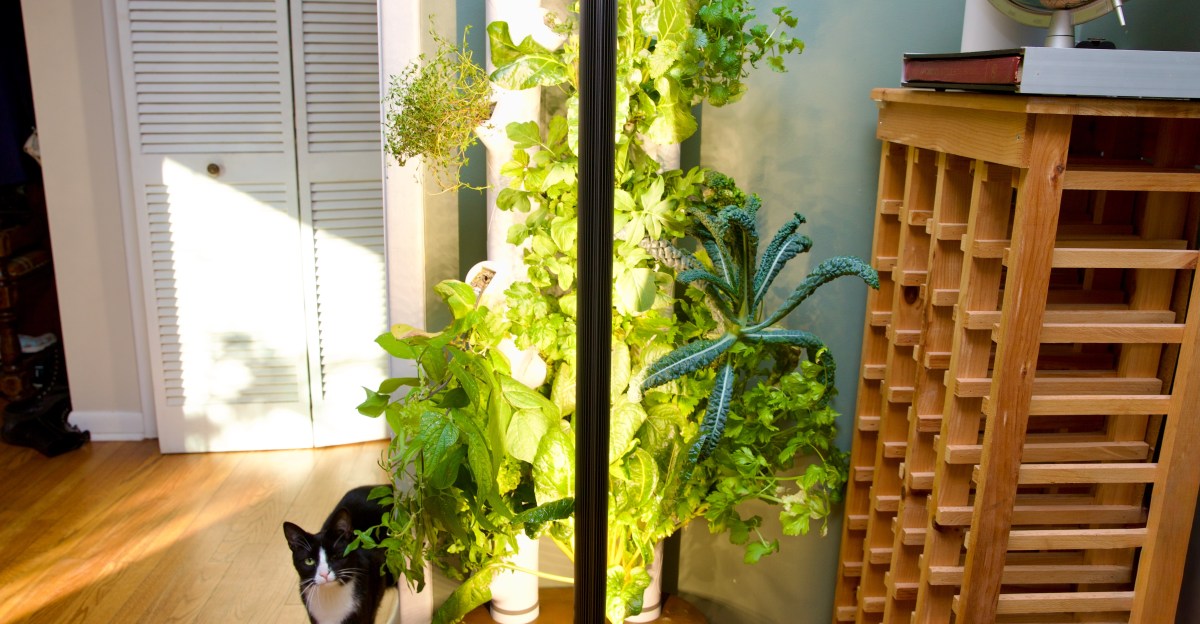

 The Gardyn Studio presents a rare piece of technology that integrates well into a home environment.
Many individuals struggle with gardening, facing disappointment despite efforts to cultivate plants. Challenging climates often contribute to these difficulties, leaving some with minimal yields even from robust plants like cherry tomatoes.
The prospect of successfully growing one’s own food can seem daunting, especially for those who find it difficult to keep even store-bought herbs alive. However, the Gardyn Studio 2 offers a solution.
This smart indoor garden functions as an automated growing platform, utilizing AI to oversee and properly care for plants, addressing common gardening challenges.


Gardyn Studio 2
The Good
- Effortless indoor gardening
- Simple setup and minimal upkeep
- The Kelby AI assistant provides valuable guidance
- Subscription includes complimentary plants
The Bad
- High initial cost
- Expensive monthly subscription
- Grow light may be too bright for many indoor spaces
The system operates through hydroponic watering, automated lighting, a camera that captures plant images, and algorithms that analyze growth stages to adapt conditions. An AI assistant named Kelby, available with a subscription, manages light and water cycles, sends intervention alerts, and processes sensor and camera data to support plant growth.
This system is impressive, though quite expensive. Over three months, a variety of plants were successfully grown, including a sunflower, kohlrabi, basil, lettuce, green beans, chard, and other unique vegetables. Current projects include strawberries, cherry tomatoes, lavender, jalapeño peppers, and buttercrunch lettuce, even in winter conditions indoors.
While many appreciate the concept of growing their own food, limitations in space, time, or expertise often hinder success. Gardening, much like baking, can be more challenging than it appears.
The Gardyn Studio 2 aims to overcome these obstacles. Priced at $549, it offers an optional $25 monthly subscription (or $19 with a two-year plan). This membership provides access to Kelby’s assistance, monthly seed pod refills, and discounts on plant food, among other benefits.
The Gardyn began producing within six weeks, potentially reducing a household’s weekly produce purchases by half, easily offsetting the monthly subscription cost. Fresh, ready-to-harvest produce is consistently available, leading to significantly less food waste.


The Gardyn Studio 2, assembled and prepared for cultivation.
The Studio 2 is Gardyn’s latest model, a more compact version of its flagship $900 Gardyn Home. It accommodates 16 plants, compared to the Home’s 30, and is a redesign of the original Studio from 2024. According to founder and CEO FX Rouxel, the Studio concept emerged from customer feedback indicating the Gardyn Home produced too much for smaller households and had too large a footprint.
Specs: Gardyn Studio 2
- Price: $549 (or $23/month for two years)
- What’s in the box: Gardyn Studio, 16-plant starter kit, grow guide
- Membership: Starting at $19 a month paid annually or $25 paid monthly (includes monthly plant refills, Kelby AI assistant in app, additional features like Vacation Mode).
- Size: 17”W x 12”D x 54”H, 1.4 sq ft footprint
- Sensors: water level, humidity, and interior temperature
- Camera: 8MP ultra-wide camera (can be disabled, photos only)
- Lights: 60W full spectrum LED lights
- Connectivity: Wi-Fi, 2.4GHz band
- Warranty: 2 years
The Studio 2 features updated columns designed for reduced maintenance, an enhanced camera with higher resolution, and a broader field of view for improved plant monitoring. A new sunrise/sunset lighting mode for the powerful 60-LED lamp also aids plant growth.
The columns are a distinctive feature of Gardyn among indoor plant systems. This patented vertical hydroponic growing system is described by Rouxel as “the most compact way to grow food at home.”
Proprietary yCube seed pods, which use rockwool as a growing medium, are placed into these columns. The columns rest on a large water tank with an internal pump and an attractive wooden lid. A strip of LED lights with an integrated camera is positioned in front of the plants, facing the wall, capturing images of the plants every 30 minutes without monitoring the user.
Gardyn includes straps for wall anchoring, a necessary precaution as fully grown plants can make the system top-heavy. A button at the base allows for quick light control, and scheduling options are available through the Gardyn app.
Assembly of the Gardyn system was straightforward, taking approximately 20 minutes. It came with a 16-seed pod starter kit, “Chef’s Favorites,” featuring herbs like thyme, basil, and lemon balm, alongside celery, collard greens, green tatsoi, spinach, salanova, yellow chard, and a sunflower.


The initial plant kit, set up in late August, showed significant growth by early October.
After inserting the pods according to the app’s guidance for optimal positioning, the Gardyn system largely managed itself. Beyond refilling water as prompted by Kelby and adding plant food, no other intervention was required until four weeks in, when a tank cleaning and root check were advised.
Growing strawberries, cherry tomatoes, and lavender indoors in December is made possible by this technology.
Finding an appropriate location for the Gardyn can be a challenge. Measuring 1.4 square feet wide and about 5 feet tall, it occupies a considerable footprint. While a kitchen might seem ideal, the intense light can be disruptive in open-plan living areas. Gardyn recommends 14-16 hours of full light daily, leading to its placement in a dining room adjacent to the kitchen.
Once plants began to bud, Kelby advised trimming certain ones to promote stronger growth. Within a couple of weeks, the first harvest of young sprouts was ready, making for a unique and flavorful salad.
Harvesting became more frequent as plants matured. The green tatsoi, in particular, grew rapidly and began to obstruct light from other herbs. This necessitated strategic repositioning of pods and regular harvesting, with tatsoi proving to be an excellent bok choy alternative.
The desire for a smaller Gardyn model is understandable, though a larger variety of regularly used plants might simplify management.

Within a few weeks, several plants, including chard and celery, thrived, prompting their transplantation to an outdoor garden, where their longevity without AI supervision remains to be seen. This also allowed for the introduction of new plant varieties.
Two pods failed to sprout, and bull’s blood beets showed minimal progress, leading to their replacement with three new pods: green beans, cherry tomatoes, and strawberries. These required initial sprouting outside the Gardyn as they cannot receive plant food immediately. While these varieties take longer to mature, a serving of green beans was harvested within a month.
Determining the optimal plant combination for individual culinary preferences will require some experimentation. With a consistent rotation aligned with cooking habits, the Gardyn system has the potential to significantly reduce fresh produce purchases.


Frequent harvesting is necessary once leafy greens begin to flourish.
Experimentation with transplanting mature plants to an outdoor garden is ongoing. However, outside the controlled environment, they will be without Kelby’s constant monitoring. The Gardyn’s AI assistant proved highly beneficial, essentially performing the tasks a novice gardener might overlook: continuously observing and caring for plants, and prompting the user for actions like adding water, plant food, thinning sprouts, harvesting, and pruning roots to encourage growth.
For those with greater plant attentiveness, many of these tasks could be performed manually. However, for beginners or those with a history of gardening struggles, Kelby appears to be quite essential.
FX Rouxel, founder and CEO, explained that the AI models process data from temperature, humidity, and water sensors, along with plant images, to calculate growth rates and optimize variables for healthy development. He describes it as “having a personal master gardener on your side 24/7, always monitoring what’s going on, taking action where it can, and when it cannot, it lets you know what to do.”

The indoor plant cultivation proved enjoyable for many.
Should a user choose to forgo Kelby after the complimentary trial month, plant growth can continue with automated watering and lighting on a customizable schedule. New yCubes can also be purchased directly through the Gardyn app, starting at $5 per plant.
The Gardyn system offers a rewarding experience, producing delicious harvests. While some maintenance is required, it is considerably less demanding than traditional gardening. The success of transplanting vegetables to an outdoor garden remains to be seen, but for anyone desiring fresh produce, fruits, flowers, and herbs at home, Gardyn provides a reliable system.
