


TechRadar Verdict
The Hisense L9Q, despite its high price and lack of an included screen, offers a complete package for home theater enthusiasts. It delivers powerful projection, robust audio, strong gaming capabilities, and supports numerous sources, including direct streaming via Google TV.
-
Very bright and color-rich image
-
240Hz gaming mode
-
Four HDMI ports
-
Powerful, 10-speaker sound system
-
Some rainbow effects
-
No included screen
-
Expensive
Hisense L9Q: two-minute review
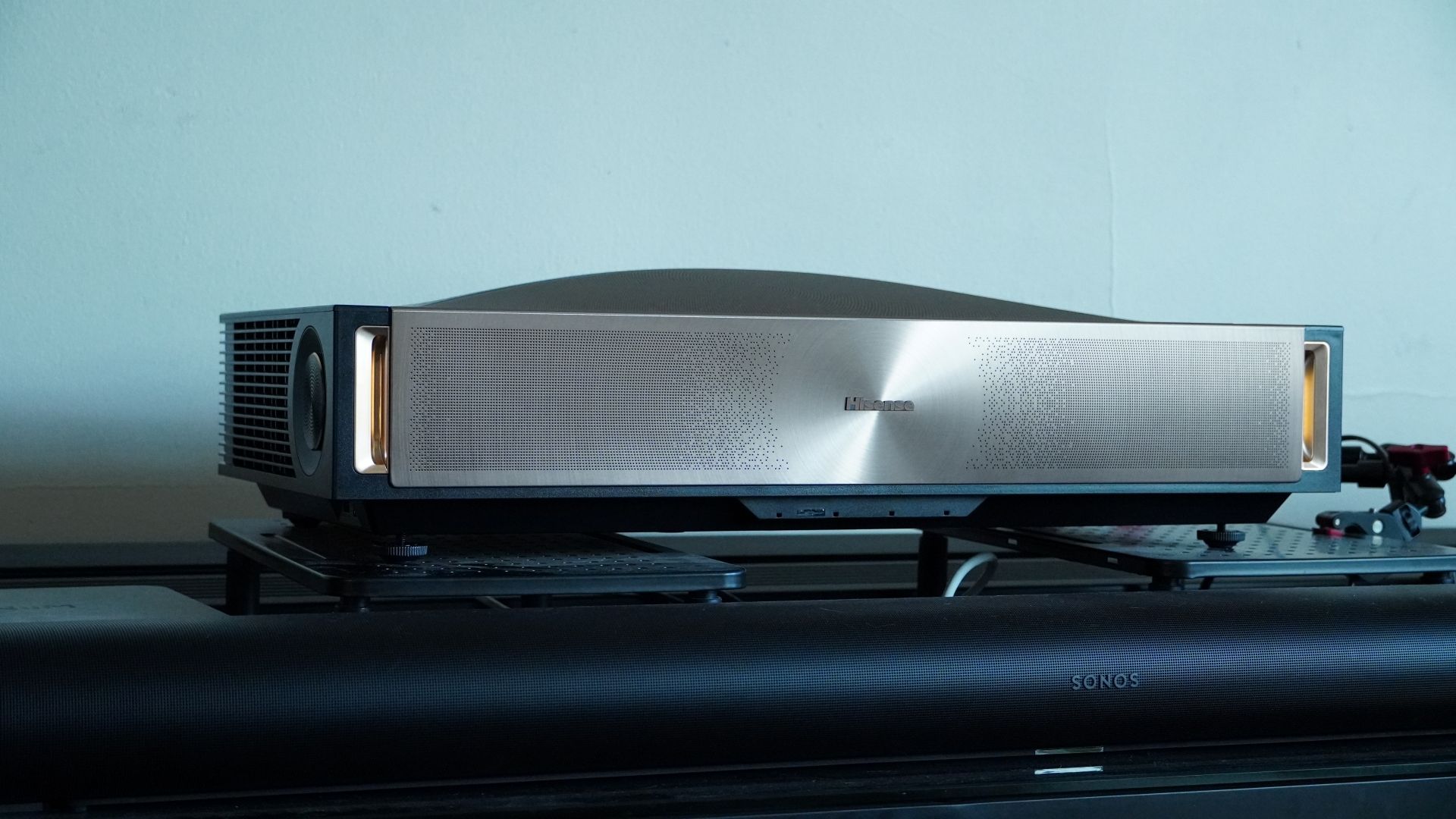
The Hisense L9Q showcases Hisense’s top capabilities in home theater projection. It is a remarkably bright 4K ultra short throw (UST) projector, featuring the wide color gamut of triple-laser technology and the accurate color reproduction of Pantone Validated hardware.
The Hisense L9Q functions as a capable streamer with its integrated Google TV, and its fast hardware ensures smooth operation of the system. It can also act as a central hub for various video sources, offering multiple HDMI ports and an ATSC 3.0 tuner input, a rare feature among many 4K projectors. Unlike some earlier Hisense L9 models, this version does not include a screen but features variable focus to adapt to different setups.
While most projectors typically feature two or four speakers, the L9Q incorporates an impressive ten Devialet-designed speakers in a 6.2.2 configuration, delivering exceptional sound for a projector. While it may not surpass dedicated surround sound systems, its audio performance is superior to many soundbars.
The L9Q also serves as a strong gaming projector, capable of displaying 4K 60Hz gameplay with minimal input lag or switching to 1080p 240Hz for incredibly smooth visuals and responsive gaming.
This comprehensive package comes with a high-end price of $5,999 / £3,999. Although this may seem substantial, the cost becomes more favorable when considering how quickly TV prices increase beyond 75 inches. The L9Q can project a 150-inch picture as easily as a 100-inch one, and it includes flexible setup features for quick installation.
For individuals who do not require the enhanced brightness and already possess a quality sound system, the $3,499 / £2,499 Hisense PX3-Pro presents a more economical alternative. However, for those seeking peak performance, the L9Q delivers.
Hisense L9Q Review: price and release date
- First available: September 2025
- MSRP: $5,999 / £3,999 / AU$9,999 (includes 120-inch screen)
The Hisense L9Q is available for $5,999 / £3,999. In Australia, the projector includes a 120-inch screen and is priced at AU$9,999. Having launched towards the end of 2025, significant discounts on the L9Q are not anticipated until late 2026.
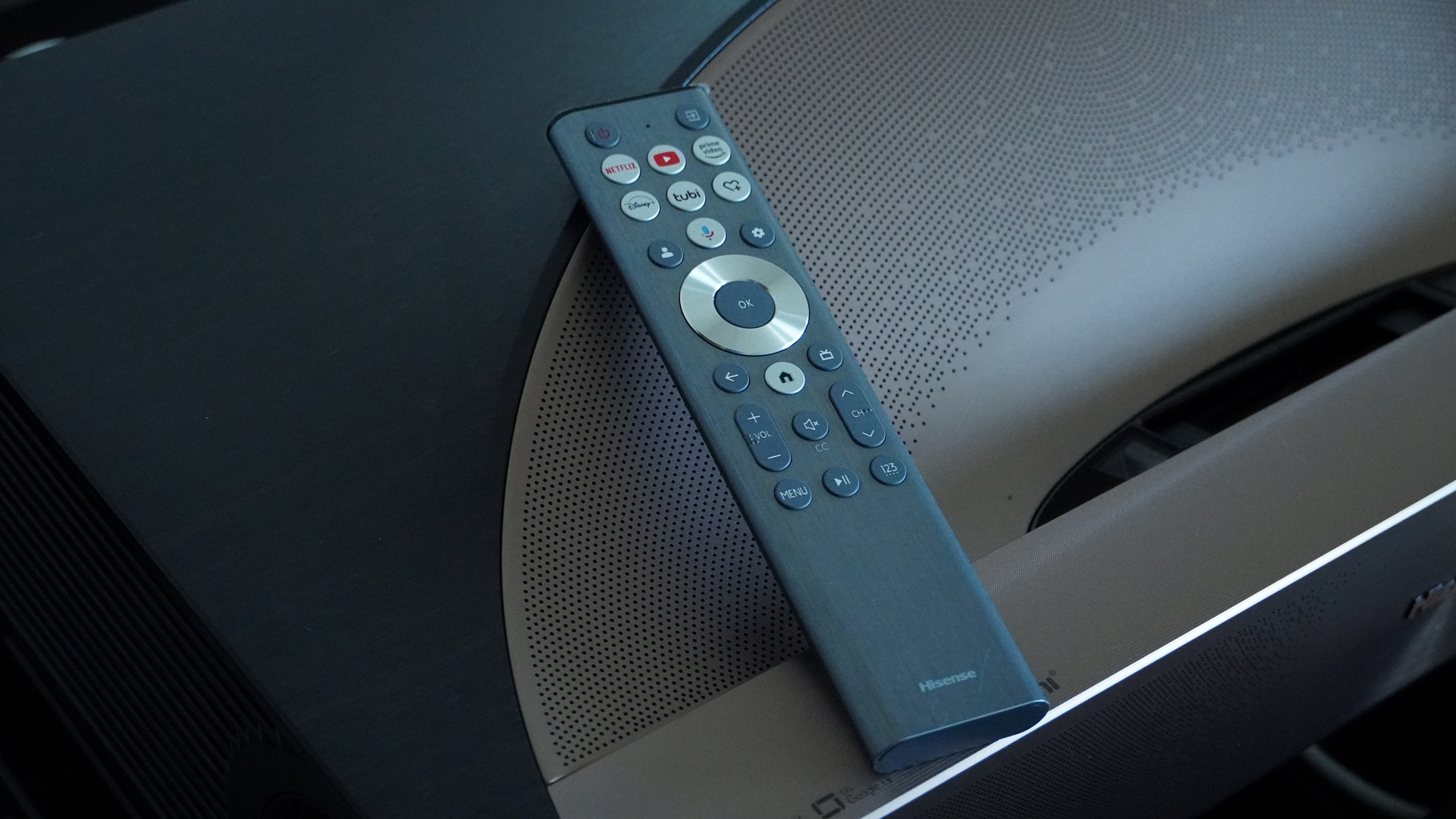
The Hisense L9Q comes with a full-size remote control and uses the Google TV platform for streaming
Hisense L9Q Review: Specs
- Screen sizes supported: 80-200 inches
- Brightness (specified): 5,000 Lumens
- HDR support: Dolby Vision, HDR10+, HDR10, HLG
- Optical technology: 3-laser DLP
- Smart TV: Google TV
- Connections: 2x HDMI 2.1, 2x HDMI 2.0 (1x eARC), optical audio out, USB 2.0, USB 3.0, USB-C 3.0 (data only), Ethernet, RF antenna
- Dimensions: 24.6 x 12.5 x 6.5 inches (623 x 31.7 x 165cm)
- Weight: 28.4 pounds (12.8 kg)
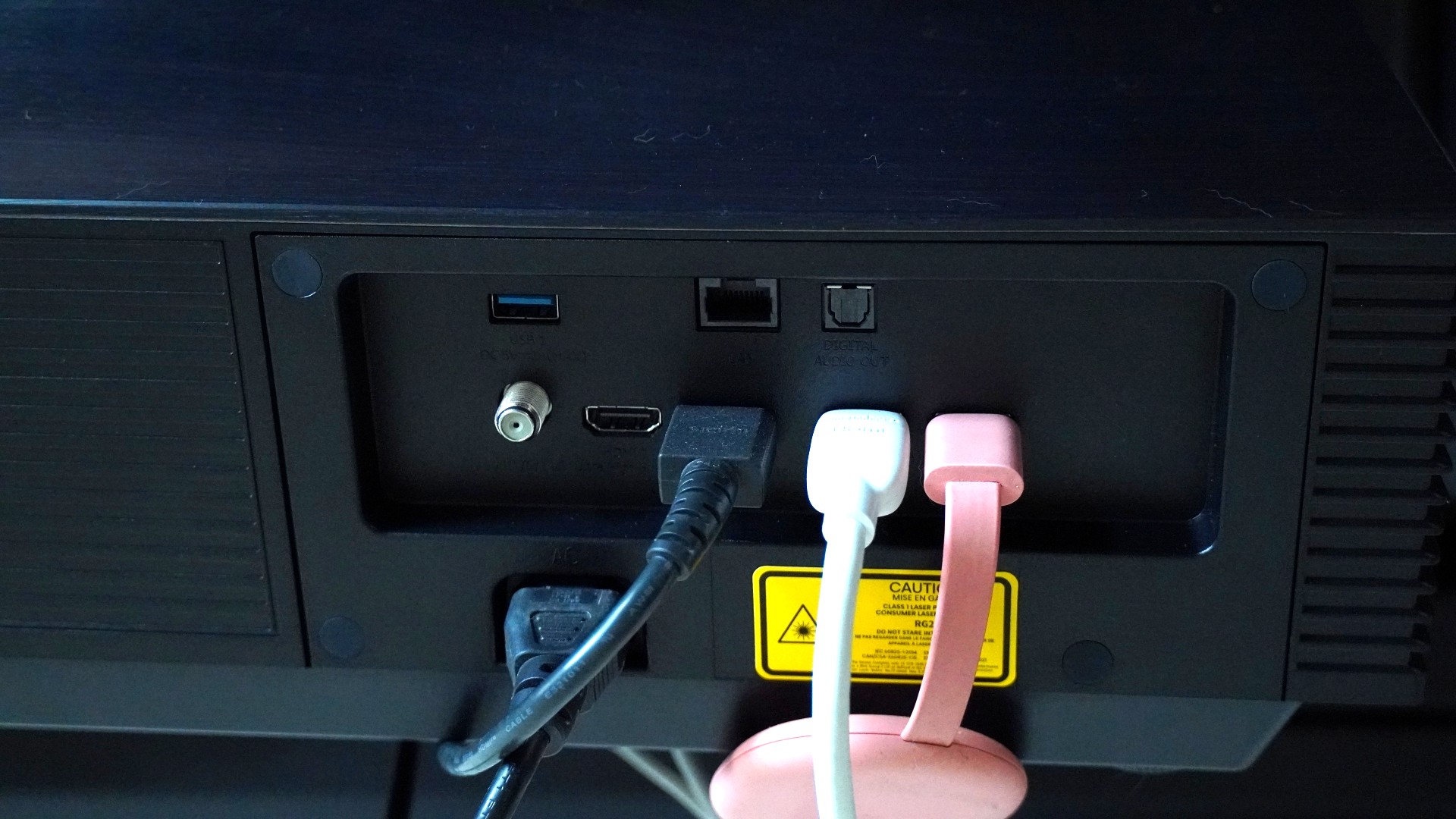
The L9Q has four HDMI ports (1 with eARC and two HDMI 2.1) and supports gaming at 1080p/240Hz
Hisense L9Q Review: design and features
- Stunning design
- Projector, sound system, and streamer all in one
- Plentiful connection options
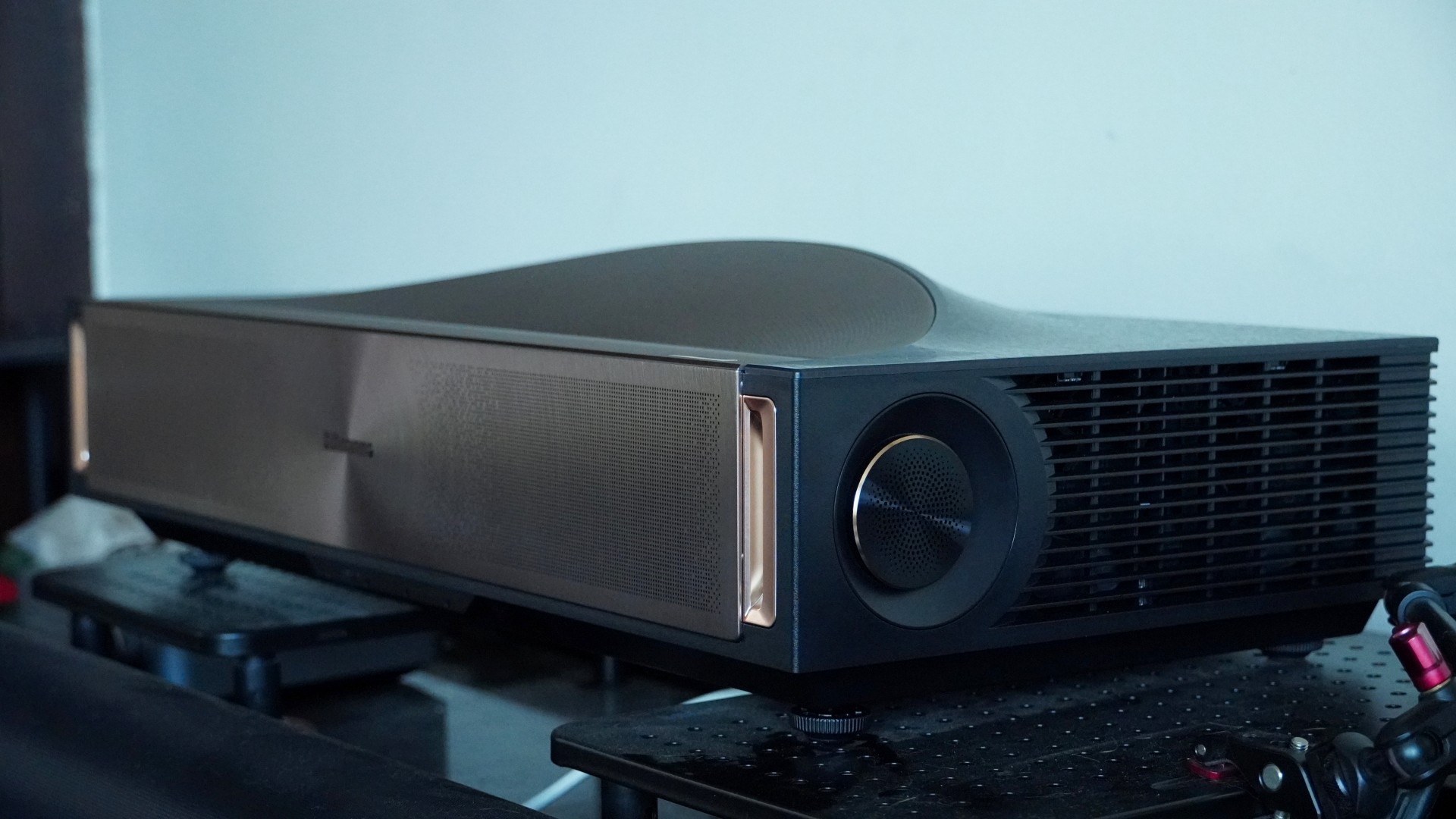
Hisense has crafted its most aesthetically pleasing UST projector to date with the L9Q. It incorporates design elements from the retro-futuristic PX line, resulting in a bronze-accented work of art. The L9Q’s frame is largely simple and boxy with clean lines, but the front features small channels with power indicator lights, and the top boasts a curved wave-like design reminiscent of Roman amphitheaters. This design is not merely for style, as the top integrates several speakers. The front displays concentric rings and a grille concealing additional speakers. On the side, two discs house another pair of speakers.
Beyond its appealing design, the projector is highly functional. It rests on four height-adjustable feet, allowing for precise leveling and a perfectly square image. Unlike its predecessor, the Hisense L9G, which was designed for specific screen sizes and included them, the L9Q offers greater flexibility with adjustable keystone and focus to suit various needs. However, the L9Q does not come with a screen, which was a significant inclusion worth over $1,000 on previous models. Regardless of the screen used, the projector can automatically adjust the picture to fit, though this is a software solution that may slightly reduce the actual image resolution.
An additional set of sensors on top of the projector provides eye protection. These sensors detect proximity to the projection, dimming the display and turning it off entirely after 5 seconds. This feature is beneficial given the projector’s bright lasers, and the sensors have demonstrated good responsiveness during testing.
Another enhancement in the L9Q is a reduced throw ratio of 0.18:1, enabling a large image from a closer wall distance.
The rear of the L9Q offers a comprehensive selection of connections. It includes four HDMI ports, two of which are HDMI 2.1 compliant. A dedicated HDMI port supports eARC, preventing the need to use an HDMI 2.1 port for audio output. Other connections include an optical digital audio output, an Ethernet input, and an RF input for the L9Q’s ATSC 3.0 receiver. The projector also supports a PVR recording system for broadcast TV when an external storage device is connected. Three USB ports are available, with two offering USB 3.0 speeds, one of which uses a Type-C connection.
Even without external sources, content can be streamed using the built-in Google TV operating system. While many projectors feature integrated operating systems, the L9Q possesses the necessary hardware for smooth performance. During testing, the system remained responsive when launching and navigating apps, and projector controls were consistently reliable. The Wi-Fi 6E connection for the streaming platform is also robust.
Hisense’s included remote is nearly identical to the one provided with the PX3-Pro. It is a long, silver plastic handset with the standard Google TV navigation ring. At the top, it features several shortcuts to streaming apps, including one customizable shortcut. A dedicated input select button is also present, which is always convenient. A notable difference between the remotes is the L9Q remote’s channel select button instead of a brightness control. Both this and the volume controls are tall, pill-shaped buttons that are easy to locate by touch. A useful feature of the remote is its motion-activated backlighting for many controls, which is highly beneficial in a dark home theater environment.
- Design and features score: 5/5

Powered by 5,000 lumens, the Hisense L9Q’s picture stands out even in bright lighting conditions
Hisense L9Q Review: performance
- Wonderfully bright picture with rich color
- Support for 1080p/240Hz gaming
- Potent 10-speaker Dolby Atmos sound
The Hisense L9Q elevates UST projector picture quality. While earlier models like the L9G and PX3-Pro were impressive, the L9Q pushes boundaries further. It is Hisense’s brightest projector to date, while still delivering the stunning color of its RGB laser light engine.
Its specified 5,000 lumen brightness may be ambitious, as maximum brightness is achieved through a high-brightness mode that introduces significant color shift. However, even without this mode, the projector beams a brilliant picture. The vivid colors it produces do not compromise accuracy, as the L9Q is both Pantone Validated and Pantone SkinTone certified.
All these qualities are delivered with strong contrast. While black levels are not so deep that letterbox bars completely vanish, particularly in darker movie scenes, the bars become less noticeable when the projector emits bright images due to its contrast capabilities.
The L9Q’s black levels and contrast do not quite reach the standard of the Sony Bravia Projector 7, but it comes closer than most projectors available, achieving this with more vivid color and higher brightness. Furthermore, the L9Q is nearly half the price of Sony’s projector.
Most picture presets unfortunately default to motion smoothing for SDR and HDR profiles. While this can benefit some content by smoothing camera pans and moving objects, it introduces a “soap opera effect” to movies. The “Film” setting, however, avoids these visual artifacts while maintaining subdued judder.
The L9Q provides excellent corner-to-corner focus with manual setup, maximizing its 4K resolution. The level of detail visible in pictures stretched up to 100 inches or larger is exceptional.
Gamers will find much to appreciate in the L9Q. Even when projecting a 4K 60Hz picture, input latency remains low enough for a responsive experience. Similar to the Hisense PX3-Pro, the L9Q can switch to 1080p and increase its refresh rate to 240Hz for incredibly smooth gaming (ensure the HDMI input source is set to Enhanced Pro, otherwise it will cap at 120Hz). Gaming on it was remarkably smooth with virtually no detectable lag.
Although the L9Q generally minimizes the rainbow effect, it is susceptible to it, like many other DLP projectors. This effect was not frequently observed when watching 4K content, appearing only occasionally and most visibly on white areas of the image. It was more noticeable when the projector operated at 1080p/240Hz.
The projector’s robust speaker system was a particularly pleasant surprise. It features a total of 10 speakers in a 6.2.2-channel configuration: four in the front, two on the sides, and four positioned along the curved top. While it may not offer the immersion of a dedicated surround system or the deep bass of a double-sub setup, the sound is substantial, loud, and creates a surprisingly wide soundstage for a compact unit.
With Dolby Atmos audio during Star Wars: The Force Awakens, blaster shots appeared to originate from distinct points in space, TIE fighters flying overhead had a sense of height, and explosions were appropriately impactful. Ultimately, pairing a projector of this caliber with an external sound system is recommended, but the built-in speakers offer significant audio quality if an external system is not used.
- Performance score: 4.5/5
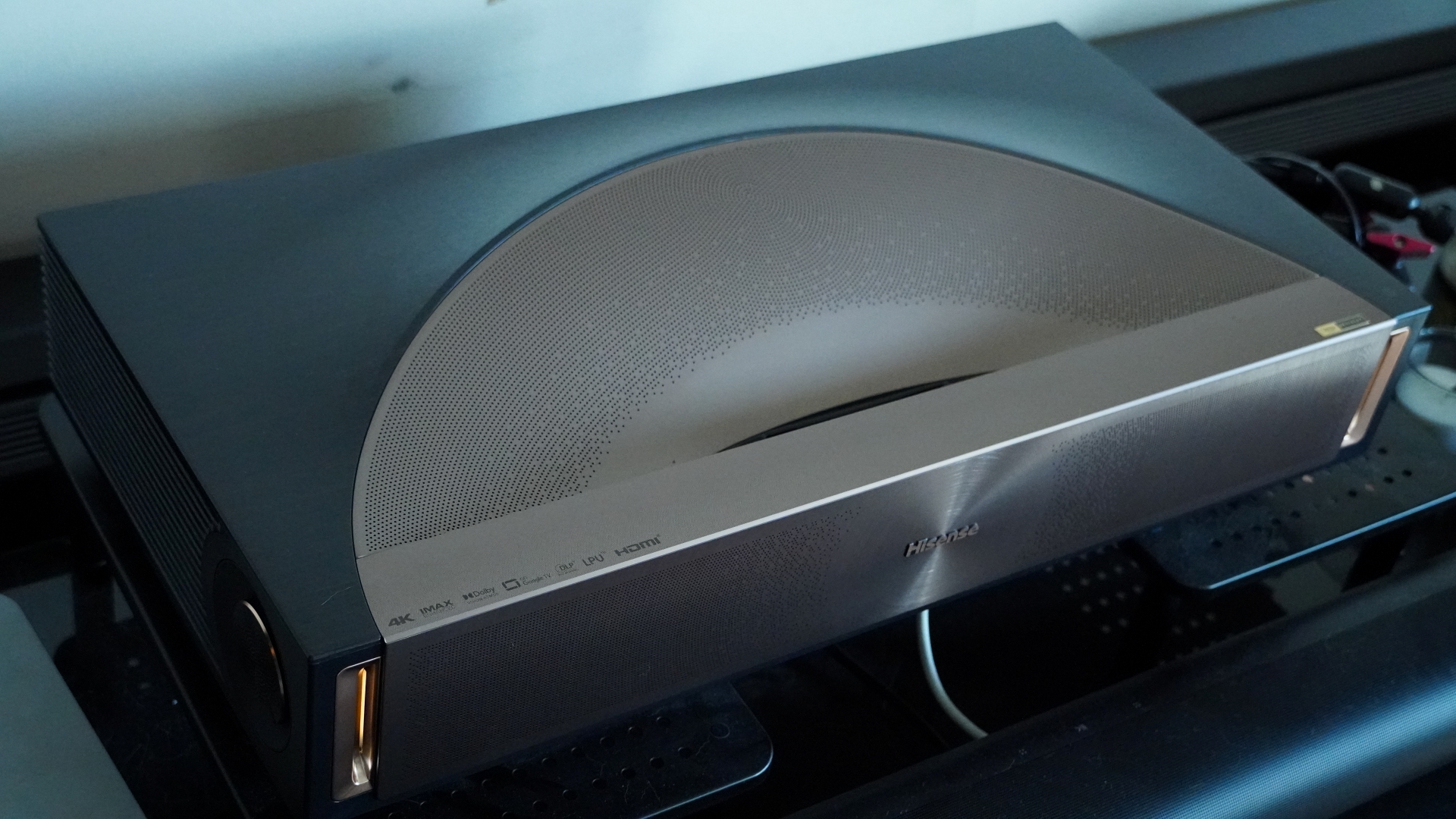
The L9Q has a very appealing, yet functional design
Hisense L9Q Review: value
- High price
- Extra value as an all-in-one system
- No projector screen included in US and UK
The Hisense L9Q is a premium device with a matching price. At $5,999 / £3,999, high expectations are set for this home theater projector, and it largely meets them. Its picture is bright and rich in color, it boasts powerful built-in sound, and it includes Google TV for streaming. However, for many, the $3,499 Hisense PX3-Pro will be a more practical choice, offering a similar experience without quite the same level of brightness, audio power, or extensive connectivity.
It is unfortunate that the L9Q does not come bundled with a projector screen in the US and the UK, but its flexible lens control allows it to be paired with various screens. Hisense previously offered pre-order customers a choice between a free screen or its HT-Saturn wireless speaker system, which would have significantly enhanced its value, but that promotion has since ended.
- Value score: 4/5
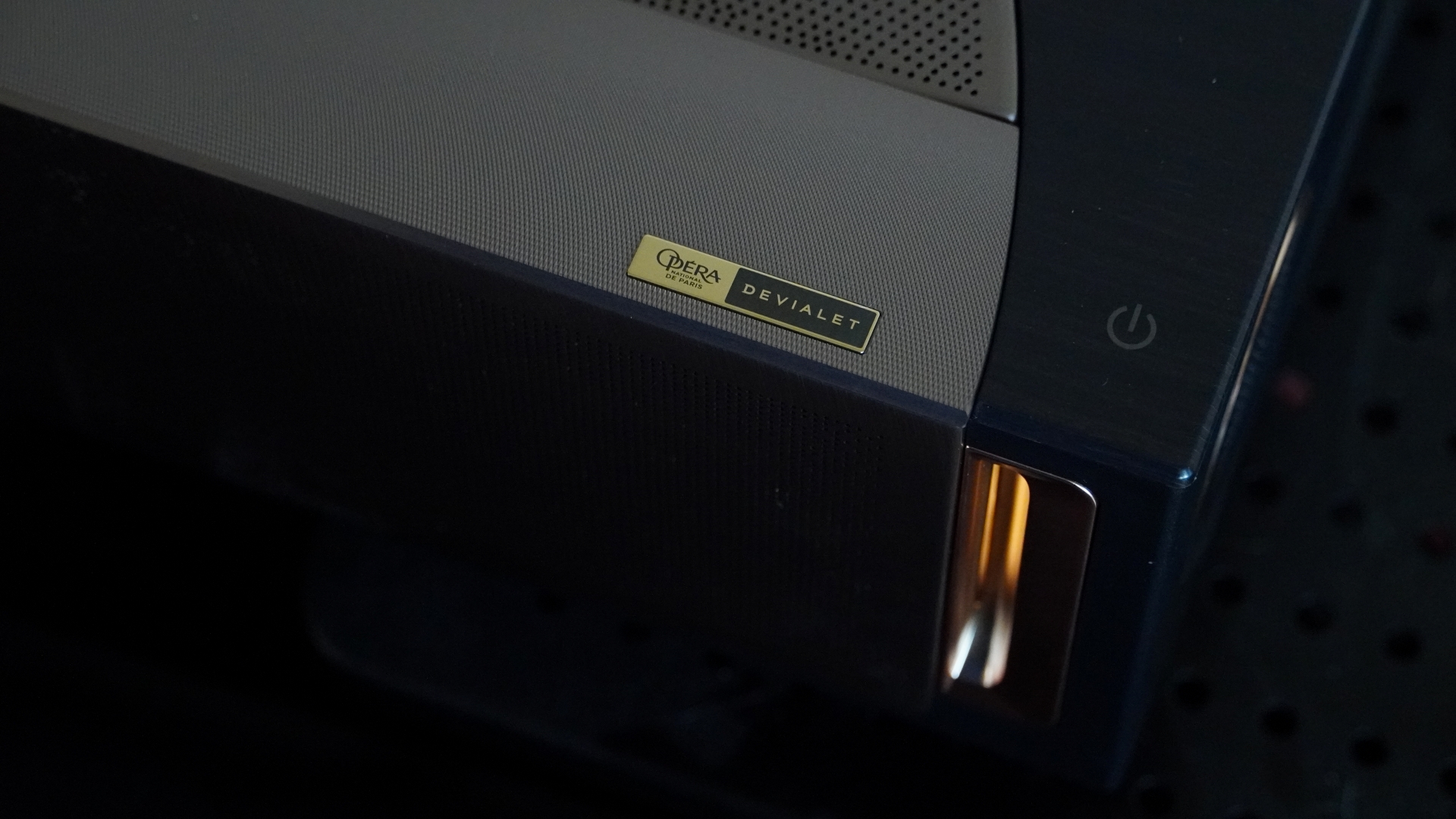
French speaker and amplifier manufacturer Devialet designed the L9Q’s built-in audio system
Hisense L9Q Summary
- Design and features: 5/5
The Hisense L9Q features a gorgeous design and is packed with features. It includes the most robust sound system found in a projector, offers bright and flexible projection, and comes with Google TV and ample ports for various video sources.
- Performance: 5/5
The L9Q’s picture quality is stunning. This projector delivers bright images, a wide color gamut, strong contrast, and excellent clarity. It performs well for both movies and games. The operating system also runs smoothly, which is not always the case with projectors utilizing Google TV.
- Value: 4.5/5
The Hisense L9Q offers a comprehensive package. Its price is reasonable for its projection capabilities alone, and the integrated speaker system further justifies the cost. The absence of an included screen is a minor drawback.
Should I buy the Hisense L9Q?
Buy it if…
You want the ultimate UST projector
The Hisense L9Q projects bright images and features powerful audio. It handles fast-paced video games as effectively as it displays cinematic masterpieces. Additionally, it provides all necessary ports and integrated Google TV.
You want powerful built-in audio
The L9Q’s speaker system is significantly more robust than those found in competing models. For a projector that can deliver strong audio without needing an external sound system, this is an excellent choice.
You need a projector for brighter rooms
While few projectors excel in bright rooms, there is a substantial difference in viewability between a 1,000-lumen and a 5,000-lumen projector. The L9Q’s high brightness offers a significant advantage over competitors in such environments.
Don’t buy it if…
You plan to always watch in the dark
A key aspect of this projector is its brightness. If viewing will consistently occur in a dark home theater, the L9Q’s 5,000-lumen brightness might be excessive. A more cost-effective option like the PX3-Pro could be considered, with savings allocated to a quality screen and sound system.
You want a sub-100-inch picture.
The L9Q can support smaller pictures, but achieving one is impractical. A 5.4-inch distance from the wall produces a 100-inch picture, while a 2.2-inch distance results in an 80-inch picture.
You won’t use a screen and have imperfect walls
Despite the L9Q’s quality, its picture relies on external factors. It performs best with a screen, though it can still look good on a bare wall. However, due to the extreme angle of UST projection, any wall imperfections—such as warping, pits, or texture—will be more noticeable in the projected image.
Also consider…
Epson EpiqVision Ultra LS800
- Price: $3,499
- Screen sizes supported: Up to 150 inches
- Brightness (specified): 4,000 lumens
- HDR support: HDR10, HLG
- Optical technology: 3LCD, Laser
- Smart TV: Android TV
- Connections: 3x HDMI 2.0 (1 with ARC)
While it may not match the L9Q’s color or audio, Epson’s EpiqVision Ultra LS800 offers comparable brightness, delivering a picture suitable for brighter rooms. Its 3LCD technology prevents rainbow artifacts, and the projector is considerably more affordable. Read our full Epson EpiqVision Ultra LS800 review
Xgimi Aura 2
- Price: $3,499
- Screen sizes supported: 80-150 inches
- Brightness (specified): 2,300 lumens
- HDR support: HDR10, HLG, Dolby Vision
- Optical technology: Dual Light 2.0 (Laser + LED)
- Smart TV: Android TV
- Connections: 2x HDMI, 1x HDMI eARC, optical digital audio out, 3.5mm audio out, 3x USB-A, Ethernet
The Xgimi Aura 2 is a capable alternative, providing a quality picture with a wide color gamut. It features an elegant design and a throw ratio similar to the Hisense. Although it is not as bright and lacks the same gaming capabilities, it remains a strong option for a sleek UST home theater projector. Read our full Xgimi Aura 2 review
Hisense PX3-Pro
- Price: $3,499
- Screen sizes supported: 80 to 150 inches
- Brightness (specified): 3,000 lumens
- HDR support: HDR10+, HDR10, HLG, Dolby Vision
- Optical technology: 3 laser DLP
- Smart TV: Google TV
- Connections: 2x HDMI 2.1, 1x HDMI 2.0 (with eARC), 1x RF, optical
For those who may not require the L9Q’s extreme brightness or powerful built-in speakers, the PX3-Pro is a suitable choice. It utilizes similar underlying technology to deliver a beautiful, colorful picture and shares the same 240Hz gaming prowess. It is also slightly more compact. Crucially, it is significantly more affordable, allowing for a larger budget allocation towards a sound system and a high-quality screen. Read our full Hisense PX3-Pro review
How I tested the Hisense L9Q
- Tested at home in multiple, real-world viewing conditions
- Presented the display with a variety of media and formats
- Experience with numerous projectors and displays over the last half-decade
The Hisense L9Q was tested in a home environment under real-world conditions. This involved evaluating its performance against ambient light from multiple windows, in-room lighting, and ambient noise that both the projector and its speaker systems needed to overcome. The projector was assessed using both a bare, white wall and an Akia Screens CineWhite screen. Content included streamed media, both HDR and non-HDR, and PC gameplay.
The projector’s performance was evaluated in relation to its price and in comparison to other models tested by industry professionals.
Experience in testing projectors dates back to 2021, with display testing experience extending even further.
First reviewed: December 2025
