


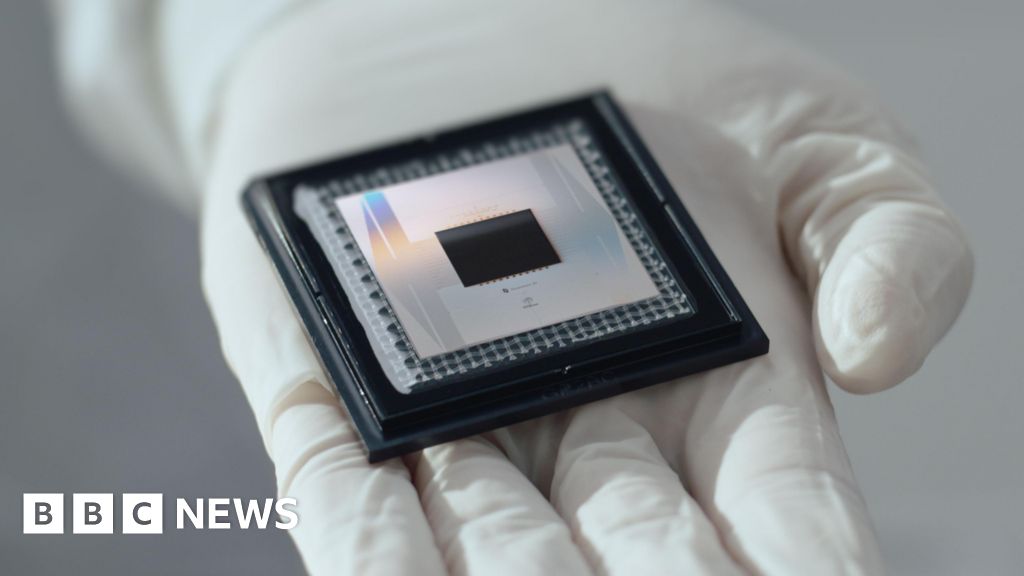

Google has initiated a partnership with the UK, inviting researchers to explore potential applications for its advanced quantum chip, Willow.
The company is among several entities striving to develop a robust quantum computer, a technology considered a significant advancement in the future of computing.
Scientists anticipate that these machines could solve complex problems in areas like chemistry and medicine, tasks currently unachievable by conventional computers.
Professor Paul Stevenson from the University of Surrey, who was not involved in the agreement, commented that this collaboration represents “great news for UK researchers.”
This partnership between Google and the UK’s national quantum computing laboratory will broaden access to the technology for more researchers.
Professor Stevenson noted, “The new ability to access Google’s Willow processor, through open competition, puts UK researchers in an enviable position.”
He added that it also benefits Google, as the company will gain from the expertise of UK academics.
Quantum devices operate on principles distinct from those of conventional computers found in smartphones and laptops, utilizing particle physics to solve problems.
However, the technology’s complete potential remains largely untapped, with most existing quantum machines being experimental and having limited practical uses.
Providing UK researchers with access to Willow is expected to facilitate the discovery of “new real-world applications.”
Scientists can submit proposals detailing their intended use of the chip, collaborating with experts from Google and the UK quantum lab to design and execute experiments.
Quantum Competition
Google’s Willow chip, introduced in 2024, was considered a major advancement in the quantum computing sector.
Competitors such as Amazon and IBM are also actively developing their own quantum technologies.
The UK boasts a notable quantum industry. For instance, Quantinuum, with headquarters in Cambridge and Colorado, US, achieved a $10 billion (£7.45 billion) valuation in September.
Throughout 2025, various companies announced new developments, leading some experts to predict that powerful quantum machines with real-world impact could emerge within the next decade.
Dr. Michael Cuthbert, Director at the National Quantum Computing Centre (NQCC), stated that the partnership is expected to “accelerate discovery.”
He suggested that the advanced scientific research supported by this initiative could eventually lead to quantum computing applications in fields like “life science, materials, chemistry, and fundamental physics.”
The NQCC currently houses seven quantum computers from UK-based companies, including Quantum Motion, ORCA, and Oxford Ionics.
The government has pledged £670 million to support this technology, identifying it as a priority within the UK’s Industrial Strategy.
Officials project that quantum technology could contribute £11 billion to the UK economy by 2045.
