


Generative AI agents operating in production environments necessitate resilience strategies that extend beyond conventional software patterns. These agents make autonomous decisions, consume significant computational resources, and interact with external systems in unpredictable ways. Such characteristics introduce failure modes that traditional resilience methods may not adequately address.
This article introduces a framework for analyzing AI agent resilience risks, applicable across most AI development and deployment architectures. It also examines practical strategies to help prevent, detect, and mitigate common resilience challenges encountered when deploying and scaling AI agents.
Generative AI agent resilience risk dimensions
To identify resilience risks, generative AI agent systems can be broken down into seven key dimensions:
- Foundation models – Foundation models (FMs) are crucial for core reasoning and planning. The choice of deployment method influences resilience responsibilities and costs. Options include fully self-managed solutions like Amazon Elastic Compute Cloud (Amazon EC2), server-based managed services such as Amazon SageMaker AI, or serverless managed services like Amazon Bedrock.
- Agent orchestration – This component manages the coordination of multiple AI agents and tools to achieve complex objectives. It includes logic for tool selection, triggers for human escalation, and multi-step workflow management.
- Agent deployment infrastructure – This refers to the underlying hardware and systems where agents operate. Infrastructure choices range from fully self-managed EC2 instances to managed services like Amazon Elastic Container Services (Amazon ECS), and specialized managed services for agent deployment, such as Amazon Bedrock AgentCore Runtime.
- Knowledge base – This dimension covers vector database storage, embedding models, and data pipelines that generate vector embeddings, which are essential for Retrieval Augmented Generation (RAG) applications. Amazon Bedrock Knowledge Bases offers support for fully managed RAG workflows.
- Agent tools – This category encompasses API tools, Model Context Protocol (MCP) servers, memory management, and prompt caching features, all of which extend an agent’s capabilities.
- Security and compliance – This dimension covers user and agent security controls, alongside content compliance monitoring, ensuring proper authentication, authorization, and content validation. Security involves inbound authentication for managing user access to agents and outbound authentication/authorization for controlling agent access to other resources. Outbound authorization can be intricate as agents may need their own identity. Amazon Bedrock AgentCore Identity is a service specifically for AI agents, offering inbound and outbound authentication and authorization. To prevent compliance breaches, organizations should implement thorough responsible AI policies. Amazon Bedrock Guardrails offers configurable safeguards for responsible AI policy enforcement.
- Evaluation and observability – These systems monitor metrics ranging from fundamental infrastructure statistics to detailed AI-specific traces. This includes continuous performance evaluation and the detection of behavioral anomalies. Agent evaluation and observability necessitate a blend of traditional system metrics and agent-specific signals, such as reasoning traces and tool invocation outcomes.
The diagram below illustrates these dimensions.
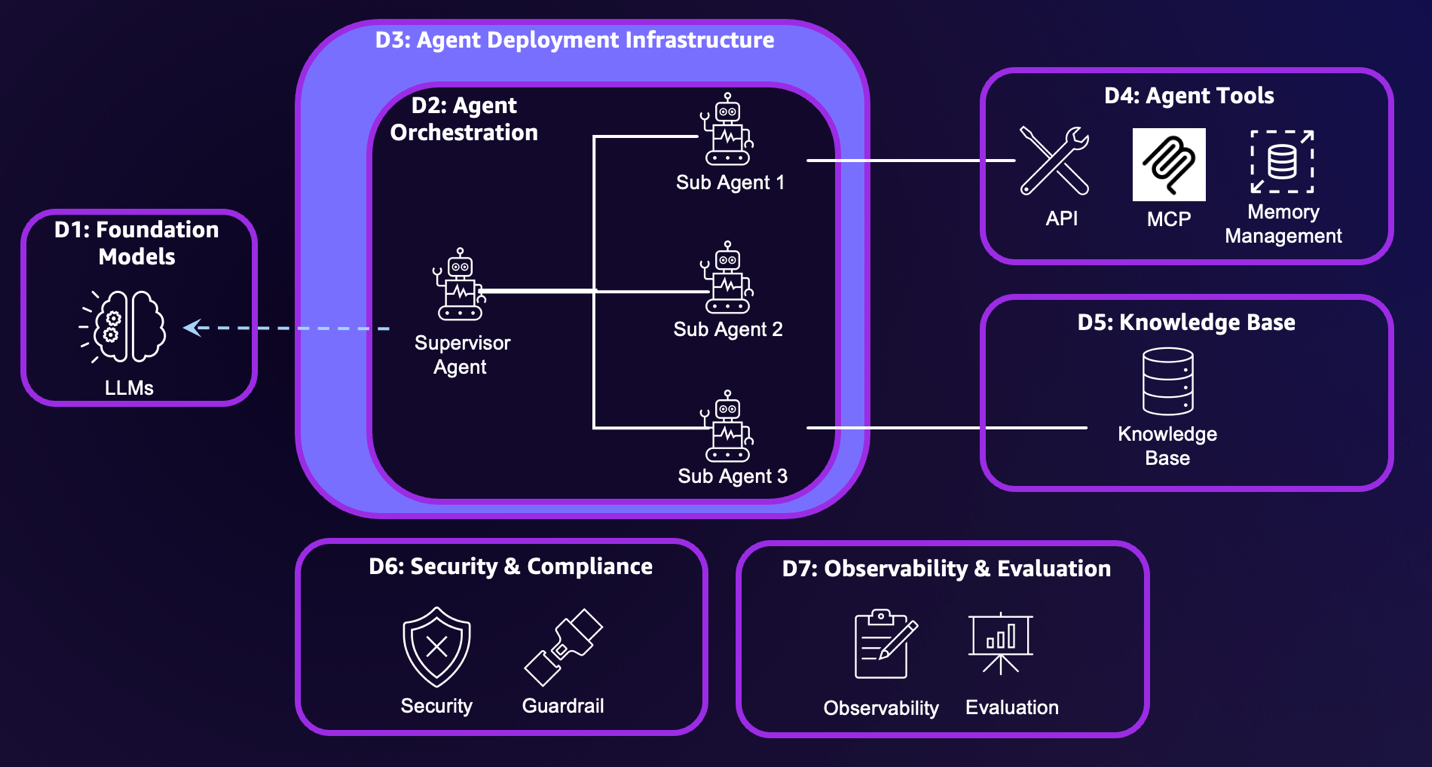
This configuration offers visibility into agent applications, facilitating targeted resilience analysis and mitigation recommendations in subsequent sessions.
Top 5 resilience problems for agents and mitigation plans
The Resilience Analysis Framework outlines fundamental failure modes that production systems should prevent. This article identifies five primary failure modes for generative AI agents and offers strategies to help establish resilient properties.
Shared fate
Shared fate describes a scenario where a failure in one agent component propagates across system boundaries, impacting the entire agent. Fault isolation is the desired characteristic. Achieving fault isolation requires understanding how agent components interact and identifying their shared dependencies.
The interplay between FMs, knowledge bases, and agent orchestration demands clear isolation boundaries. For instance, in RAG applications, knowledge bases might yield irrelevant search results. Implementing guardrails with relevance checks can help prevent such query errors from cascading throughout the agent workflow.
Tools should align with fault isolation boundaries to limit impact in the event of a failure. When developing custom tools, each should be designed as its own containment domain. For MCP servers or existing tools, it is important to use strict, versioned request/response schemas and validate them at the boundary. Incorporate semantic validations like date ranges, cross-field rules, and data freshness checks. Internal tools can also be deployed across different AWS Availability Zones for enhanced resilience.
Within the orchestration dimension, implement circuit breakers to monitor failure rates and latency, activating when dependencies become unavailable. Establish bounded retry limits with exponential backoff and jitter to manage cost and contention. For connectivity resilience, robust JSON-RPC error mapping and per-call timeouts are crucial, along with maintaining healthy connection pools to tools, MCP servers, and downstream services. The orchestration layer should also manage contract-compatible fallbacks, routing from a failed tool or MCP server to alternatives while maintaining consistent schemas and offering degraded functionality.
If isolation boundaries fail, graceful degradation can be implemented to maintain core functionality while advanced features become temporarily unavailable. Resilience testing, including AI-specific failure injection such as simulating model inference failures or knowledge base inconsistencies, helps test isolation boundaries before production issues arise.
Insufficient capacity
Excessive load can overwhelm even well-provisioned systems, potentially leading to performance degradation or system failure. Adequate capacity ensures systems possess the necessary resources to manage both anticipated traffic patterns and sudden demand surges.
AI agent capacity planning involves demand forecasting, resource assessment, and quota analysis. Key considerations for capacity planning include estimating Requests Per Minute (RPM) and Tokens Per Minute (TPM). However, the stochastic nature of agents introduces unique challenges for these estimations. AI agents typically employ recursive processing, where the agent’s reasoning engine repeatedly invokes FMs until a final answer is reached. This creates two main planning difficulties: first, the number of iterative calls is hard to predict due to task complexity and reasoning paths; second, the token length of each call is also difficult to forecast, as it includes the user prompt, system instructions, agent-generated reasoning steps, and conversation history. This compounding effect complicates agent capacity planning.
Through heuristic analysis during development, teams can establish a reasonable recursion limit to help prevent redundant loops and uncontrolled resource consumption. Additionally, since agent outputs become inputs for subsequent recursions, managing maximum completion tokens helps control one aspect of the increasing token consumption in recursive reasoning chains.
The following equations assist in translating agent configurations into these capacity estimates:
RPM = Average agent level thread per minute * average FM invocation per minute in one thread
    = Average agent level thread per minute * (1 + 60/(max_completion_tokens/TPS))
Token per second (TPS) varies for each model and can be found in model release documentation and open-source benchmark results, such as artificial analysis.
TPM = RPM * Average input token length
    = RPM * (system prompt length + user prompt length + max_completion_tokens * (recursion_limit -1)/recursion_limit)
This calculation assumes no prompt caching feature is implemented.
Unlike external tools, where resilience is managed by third-party providers, internally developed tools require proper configuration by the development team to scale with demand. When resource needs unexpectedly spike, only the affected tools need scaling.
For example, AWS Lambda functions can be converted into MCP-compatible tools using Amazon Bedrock AgentCore Gateway. If popular tools cause Lambda functions to hit capacity limits, increasing the account-level concurrent execution limit or implementing provisioned concurrency can handle the increased load.
In scenarios with multiple action groups executing simultaneously, Lambda functions’ reserved concurrency controls provide essential resource isolation by allocating dedicated capacity to each group. This helps prevent a single tool from consuming all available resources during orchestrated invocations, ensuring resource availability for high-priority functions.
When capacity limits are reached, intelligent request queuing with priority-based allocation can be used to ensure essential services continue operating. Implementing graceful degradation during high-load periods can also be beneficial, maintaining core functionality while temporarily reducing non-essential features.
Excessive latency
Excessive latency negatively impacts user experience, decreases throughput, and diminishes the practical utility of AI agents in production. Developing agentic workloads requires balancing speed, cost, and accuracy. Accuracy is paramount for AI agents to earn user trust. Achieving high accuracy often necessitates agents performing multiple reasoning iterations, which inherently introduces latency challenges.
Managing user expectations is crucial; establishing Service Level Objective (SLO) metrics before project initiation sets realistic targets for agent response times. Teams should define specific latency thresholds for various agent capabilities, such as sub-second responses for simple queries versus longer durations for analytical tasks requiring multiple tool interactions or extensive reasoning chains. Clearly communicating expected response times helps prevent user frustration and supports appropriate system design decisions.
Prompt engineering presents the most significant opportunity for latency improvement by minimizing unnecessary reasoning loops. Vague prompts can lead agents into prolonged deliberation cycles, whereas clear instructions accelerate decision-making. For example, asking an agent to “approve if the use case is of strategic value” creates a complex reasoning chain where the agent must first define strategic value criteria, then evaluate applicable criteria, and finally determine significance thresholds. Conversely, explicitly stating the criteria in the system prompt can significantly reduce agent iterations. The following examples illustrate the difference between ambiguous and clear instructions.
An example of an ambiguous agent instruction:
You are a generative AI use case approver.
Your role is to evaluate GenAI agent build requests by carefully analyzing user-provided
information and make approval decisions. Please follow the following instructions:
<instructions>
1. Carefully analyze the information provided by the user, and collect use case information,
such as use case sponsor, significance of the use case, and potential values that it can bring.
2. Approve the use case if it has a senior sponsor and is of strategic value.
</instructions>
An example of a clear, well-defined agent instruction:
You are a generative AI use case approver.
Your role is to evaluate Gen AI agent build requests by carefully analyzing user-provided
information and make approval decisions based on specific criteria.
Please strictly follow the following instructions:
<instructions>
1. Carefully analyze the information provided by the user. Collect answers to the following questions:
<question_1>Does the use case have a business sponsor that is VP level and above? </question_1>
<question_2>What value is this agent expected to deliver? The answer can be in the form of
number of hours per month saved on certain tasks, or additional revenue values.</question_2>
<question_3>If the use case is external customer facing, please provide supporting information
on the demand. </question_3>
2. Evaluate the request against these approval criteria:
<criteria_1>The use case has business sponsor at VP level and above. This is a hard criteria. </criteria_1>
<criteria_2>The use case can bring significant $ value, calculated by productivity gain or
revenue increase. This is a soft criteria. </criteria_2>
<criteria_3>Have strong proof that the use case/feature is demanded by customers. This is a
soft criteria. </criteria_3>
3. Based on the evaluation, make a decision to approve or deny the use case.
- Approve: If the hard criterion is met, and at least one of the soft criteria is met.
- Deny: The hard criterion is not met, or neither of the soft criteria is met.
</instructions>
Prompt caching substantially reduces latency by storing repeated prompt prefixes between requests. Amazon Bedrock prompt caching can decrease latency by up to 85% for supported models, particularly benefiting agents with lengthy system prompts and stable contextual information across sessions.
Asynchronous processing for agents and tools enhances latency reduction by enabling parallel execution. Multi-agent workflows achieve significant speedups when independent agents operate in parallel instead of waiting for sequential completion. For agents utilizing tools, asynchronous processing allows for continuous reasoning and preparation of subsequent actions while tools execute in the background, optimizing the workflow by overlapping cognitive processing with I/O operations.
Security and compliance checks must minimize latency impact while maintaining protection across all dimensions. Content moderation agents can implement streaming compliance scanning, which evaluates agent outputs during generation rather than waiting for complete responses. This approach flags potentially problematic content in real-time while allowing safe content to proceed immediately.
Incorrect agent response
Accurate output ensures an AI agent performs reliably within its defined scope, delivering precise and consistent responses that satisfy user expectations and business requirements. Nevertheless, misconfiguration, software bugs, and model hallucinations can degrade output quality, resulting in incorrect responses that erode user trust.
To enhance accuracy, deterministic orchestration flows should be utilized whenever feasible. Allowing agents to improvise tasks using LLMs can lead to deviations from the intended path. Instead, explicit workflows should be defined, specifying how agents interact and sequence their operations. This structured approach minimizes both inter-agent calling errors and tool-calling mistakes. Furthermore, implementing input and output guardrails significantly improves agent accuracy. Amazon Bedrock Guardrails can scan user input for compliance checks prior to model invocations and provide output validation to detect hallucinations, harmful responses, sensitive information, and blocked topics.
Should response quality issues arise, human-in-the-loop validation can be deployed for high-stakes decisions where accuracy is critical. Automatic retry mechanisms with refined prompts can also be implemented when initial responses fail to meet quality standards.
Single point of failure
Redundancy establishes multiple paths to success by minimizing single points of failure that could lead to system-wide disruptions. Single points of failure compromise redundancy when multiple components rely on a solitary resource or service, creating vulnerabilities that bypass protective boundaries. Effective redundancy necessitates both redundant components and redundant pathways, ensuring that if one component fails, alternatives can take over, and if one pathway becomes unavailable, traffic can be rerouted.
Agents require coordinated redundancy for their FMs. For self-managed models, multi-Region model deployment with automated failover can be implemented. When utilizing managed services, Amazon Bedrock provides cross-Region inference, offering built-in redundancy for supported models by automatically routing requests to alternative AWS Regions if primary endpoints encounter problems.
The agent tools dimension must coordinate tool redundancy to enable graceful degradation when primary tools become unavailable. Instead of complete failure, the system should automatically route to alternative tools offering similar functionality, even if less sophisticated. For instance, if an internal chat assistant’s knowledge base fails, it can revert to a search tool to provide alternative output to users.
Maintaining permission consistency across redundant environments is crucial to prevent security gaps during failover scenarios. Given that overly permissive access controls present significant security risks, it is vital to validate that both end-user permissions and tool-level access rights are identical between primary and failover components. This consistency ensures security boundaries are upheld regardless of which environment is actively serving requests, helping to prevent privilege escalation or unauthorized access that might occur during operational transitions between different permission models.
Operational excellence: Integrating traditional and AI-specific practices
Operational excellence in agentic AI involves combining established DevOps practices with AI-specific requirements for reliably running agentic systems in production. Continuous Integration and Continuous Delivery (CI/CD) pipelines manage the entire agent lifecycle, while Infrastructure as Code (IaC) standardizes deployments across environments, minimizing manual errors and enhancing reproducibility.
Agent observability necessitates a blend of traditional metrics and agent-specific signals, such as reasoning traces and tool invocation results. While conventional system metrics and logs are available from Amazon CloudWatch, agent-level tracing requires additional software development. The recently announced Amazon Bedrock AgentCore Observability (preview) supports OpenTelemetry for integrating agent telemetry data with existing observability services, including CloudWatch, Datadog, LangSmith, and Langfuse. For further details on Amazon Bedrock AgentCore Observability features, refer to Launching Amazon CloudWatch generative AI observability (Preview).
Beyond monitoring, agent testing and validation also extend beyond typical software practices. Automated test suites, such as promptfoo, assist development teams in configuring tests to evaluate reasoning quality, task completion, and dialogue coherence. Pre-deployment checks confirm tool connectivity and knowledge access, and fault injection simulates tool outages, API failures, and data inconsistencies to uncover reasoning flaws before they impact users.
When issues arise, mitigation relies on playbooks addressing both infrastructure-level and agent-specific problems. These playbooks support live sessions, enabling seamless handoffs to fallback agents or human operators without loss of context.
Summary
This article introduced a seven-dimension architecture model for mapping AI agents and analyzing potential resilience risks. It also identified five common failure modes associated with AI agents and their corresponding mitigation strategies.
These strategies illustrate how resilience principles apply to typical agentic workloads, but they are not exhaustive. Every AI system possesses unique characteristics and dependencies. It is essential to analyze a specific architecture across the seven risk dimensions to pinpoint resilience challenges within individual workloads, prioritizing areas based on user impact and business criticality rather than solely technical complexity.
Resilience is an ongoing journey, not a final destination. As AI agents evolve and address new use cases, resilience strategies must adapt accordingly. Establishing regular testing, monitoring, and improvement processes ensures AI systems remain resilient as they scale. For additional information on generative AI agents and resilience on AWS, consider the following resources:
- Chaos Engineering Scenarios for GenAI workloads
- Designing generative AI workloads for resilience
- Introducing Amazon Bedrock AgentCore: Securely deploy and operate AI agents at any scale (preview)
- Implement effective data authorization mechanisms to secure your data used in generative AI applications: Part 1 and Part 2
