


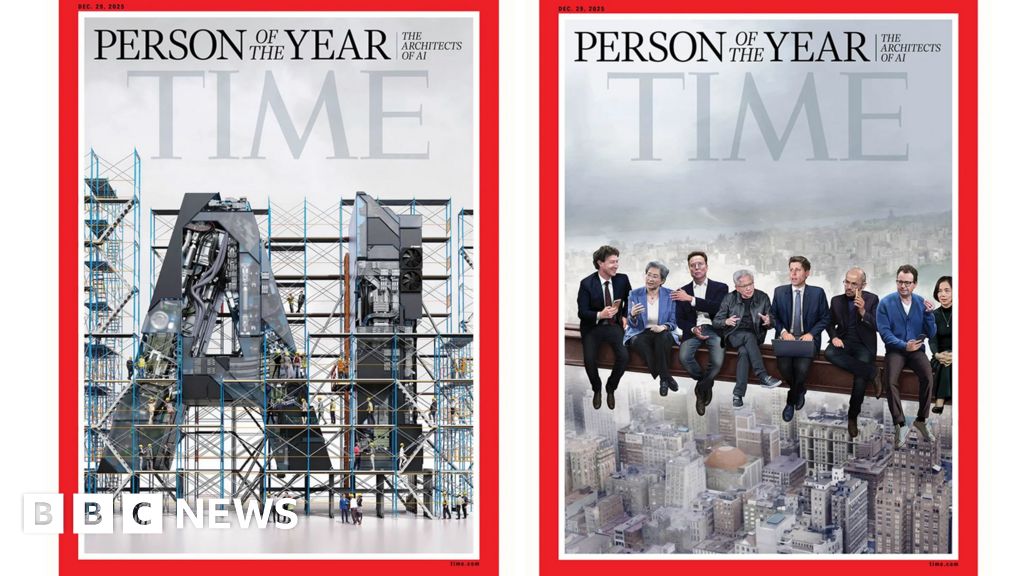
Time Magazine has designated ‘the architects’ of artificial intelligence (AI) as its Person of the Year for 2025, moving away from recognizing a single individual.


Nvidia boss Jensen Huang is among the tech leaders featured on one of Time Magazine’s covers.
Prominent figures such as Nvidia CEO Jensen Huang, Meta head Mark Zuckerberg, X owner Elon Musk, and AI ‘godmother’ Fei-Fei Li are among those depicted on one of the magazine’s two covers. This selection highlights the rapid societal transformation driven by AI and the companies developing it.
The recognition follows a sustained boom in AI technology, initiated by OpenAI’s ChatGPT launch in late 2022. OpenAI’s CEO, Sam Altman, stated in September that its chatbot serves approximately 800 million users weekly. Major technology companies are investing billions into AI and its supporting infrastructure to maintain a competitive edge.
Time Magazine released two distinct covers for this year’s Person of the Year: one is an artistic representation of the letters AI surrounded by workers, while the other is a painting featuring the tech leaders themselves.

One cover references the classic New York photograph “Lunch atop a Skyscraper,” reimagined with tech figures.
Mark Zuckerberg has reportedly reoriented Meta’s focus towards AI, integrating its AI chatbot into the company’s popular applications. Zuckerberg, Huang, Musk, Li, and Altman were joined on the cover by AMD CEO Lisa Su, Anthropic chief Dario Amodei, and Google’s AI lab lead Sir Demis Hassabis.
Time Magazine, in its announcement, stated that the year’s discourse shifted from responsible AI deployment to a rapid acceleration of its implementation. The publication suggested that caution has been sidelined, with figures like Huang, Son, and Altman driving humanity towards a highly automated and uncertain future at an unprecedented pace.
Sam Jacobs, Time’s editor-in-chief, asserted that no other group had a greater impact in 2025 than the individuals who conceived, designed, and built AI. Jacobs added that humanity will shape AI’s trajectory, with each individual having a role in defining its structure and future.

According to Forrester analyst Thomas Husson, 2025 marks a ‘tipping point’ for AI’s integration into daily life. Husson noted that many consumers utilize AI without conscious awareness. He further explained that AI’s rapid adoption across hardware, software, and services surpasses the pace of the Internet or mobile revolutions.
Individuals are increasingly choosing chatbots over traditional search engines and social media for tasks such as planning holidays, finding Christmas gifts, and discovering recipes. Conversely, some individuals are opting out of AI use due to concerns about its energy consumption, training data, and potential impact on livelihoods.
Nik Kairinos, founder and CEO of Fountech AI, described the covers as an ‘honest assessment’ of AI’s influence, but cautioned that ‘recognition should not be confused with readiness’. He stated that AI currently holds the potential to be either a savior or a scourge for humanity. The development of dependable, accountable, and human-aligned AI systems remains in its nascent stages. Significant responsibility rests with those developing and marketing AI tools.
Groups Recognized Over Individuals

Steve Jobs was among the tech founders who represented the computer in 1982.
This is not the first instance of Time’s Person of the Year recognizing a collective, with previous recipients including Ebola fighters in 2014 and whistleblowers in 2002.
In 1982, the magazine honored ‘The Computer,’ noting a widespread ‘giddy passion’ for the device among Americans. Time characterized this enthusiasm as ‘partly fad’ but also a recognition of how life could be improved. The computer’s representation included contemporary tech entrepreneurs such as Apple co-founder Steve Jobs and IBM president John Opel.
Later, in 2006, ‘You’ was named Person of the Year, symbolizing the growing influence of individuals online. Examples cited included Wikipedia contributors, early YouTubers, and MySpace users, illustrating ‘the many wresting power from the few and helping one another for nothing’. The magazine further stated that this shift would ‘not only change the world, but also change the way the world changes’.
