


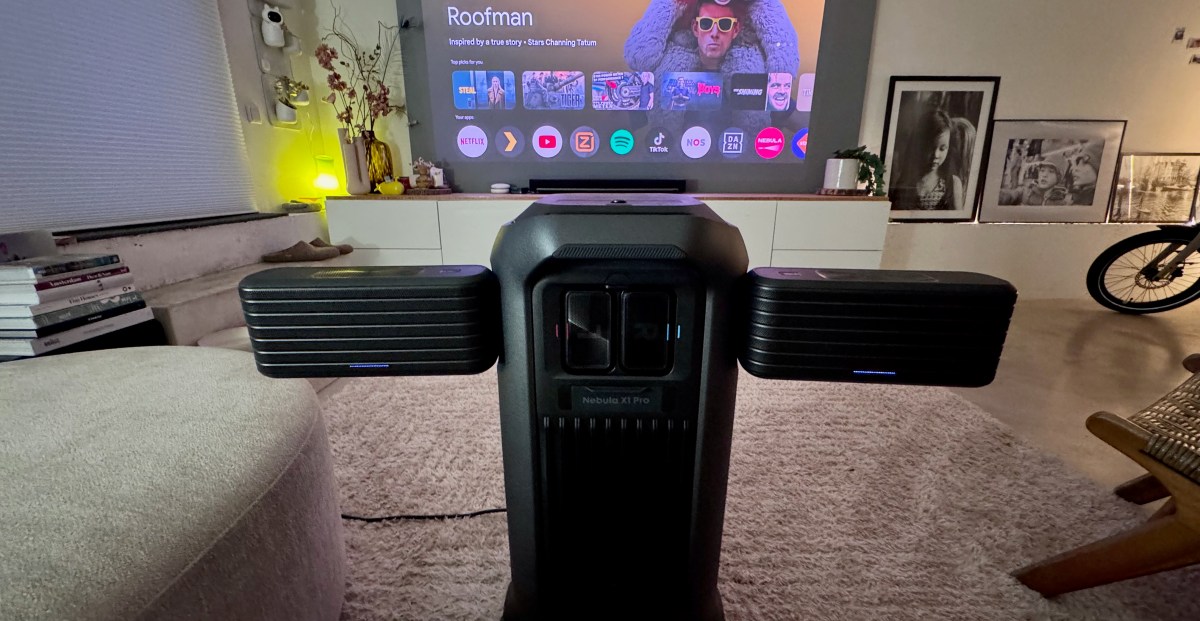


The Soundcore Nebula X1 Pro is an unconventional device, combining the impressive 4K projector and karaoke features of Anker’s Nebula X1 with a robust five-speaker Google TV system on wheels. Its unique design offers a comprehensive portable entertainment solution.
This system features the same liquid-cooled, triple-laser projector with automatic image correction found in the original Nebula X1. It operates remarkably quietly for a 3500 ANSI lumen projector, which is touted as the brightest and most vivid all-in-one portable projector available. The new Nebula X1 Pro enhances this with an additional 400W of audio power, making it exceptionally loud.
The X1 Pro incorporates a powerful internal subwoofer, delivering significant bass. It also includes four battery-powered speakers that deploy automatically, contributing to a total of seven horizontal channels and four overhead channels for wireless 7.1.4 Dolby Atmos audio.
Aside from its considerable size and occasional connectivity problems, a notable observation is that the Nebula X1 Pro can sometimes be excessively loud, an unusual characteristic for a portable all-in-one projector.
Priced at $4,999 / €4,999.98 / £4,499, the Anker Nebula X1 Pro offers a compelling option for those seeking a premium portable home theater experience.


Anker Nebula X1 Pro
The Good
- Complete home theater on wheels
- Bright, vivid picture
- Wireless Dolby Atmos surround
- Powerful bass
- Doubles as a Bluetooth speaker
The Bad
- Expensive
- Questionable portability
- Intermittent Wi-Fi connections
$4999 at Amazon$4999 at Walmart$4999 at Soundcore
Given that the video and karaoke functionalities of the projector are identical to those of the Nebula X1, this discussion will primarily focus on the X1 Pro’s enhanced sound capabilities.
Upon first glance at the X1 Pro, the integrated speakers might not be immediately apparent. The subwoofer is housed internally. The two front speakers automatically extend outwards with a distinct sound when a button is pressed, while the two rear speakers detach from the unit with a firm push.
 Transforming into 5.1.2 mode is a neat and useful party trick.
The X1 Pro offers three distinct sound configurations: 2.1 audio with all speakers docked (rear speakers inactive), 5.1.2 surround sound when the front speakers are unfolded, and full 7.1.4 separation by distributing all four speakers around the room. Anker includes animated instructions to assist with setting up the 7.1.4 configuration.
The four satellite speakers are entirely wireless, offering over eight hours of battery life. They can be charged using pogo pins when docked with the projector or via USB-C. For optimal audio, the X1 Pro incorporates a 4-microphone array that automatically calibrates the sound to the room, allowing users to define a “sweet spot” for listening. Anker’s Flexwave spatial audio calibration technology performed effectively in an open-plan living room, though the optimal listening area is limited to approximately two people.
When separated from the main unit, the four front and rear speakers utilize a proprietary 5.8GHz Wi-Fi signal for audio synchronization, rather than Bluetooth, ensuring superior, low-latency, and lossless sound. The X1 Pro’s speakers connected automatically to the projector upon activation, without the audio interruptions observed with the X1’s single speaker pair. The speakers also entered a sleep mode when the X1 Pro was powered off, conserving battery life.
However, some unexplained Wi-Fi connectivity issues were encountered with Google TV. On several occasions over a two-week testing period, the device failed to reconnect to the home network, despite other devices functioning normally. A reboot consistently resolved the issue, though it proved disruptive during film viewing.
 The X1 Pro in 7.1.4 mode with all four speakers distributed around the room.
 The motorized front speakers unfurl automatically for 5.1.2 sound, and detach for improved audio separation.
 The rear speakers are spring loaded.
 The mics are tucked away in a lit compartment up top.
The 160W subwoofer in the X1 Pro delivers impressive bass for a portable projector, occasionally to an overwhelming degree. Each front surround speaker contains four 20W drivers for upward, center, front, and surround channels. The smaller rear speakers each feature two 20W drivers for upward and rear surround channels. Both front and rear satellites are equipped with folding legs and tripod mounts for flexible positioning.
When operating in 7.1.4 movie mode, with all four speakers detached and strategically placed in the room’s corners and calibrated with Flexwave, the audio performance was comparable to a dedicated 5.1 Sonos system comprising a soundbar, subwoofer, and two rear satellites.
The Dolby Atmos experience, particularly with films like Top Gun: Maverick, provided distinct overhead audio effects. Content such as The Dark Knight, All Quiet on the Western Front, and Blade Runner 2049 demonstrated excellent visual and audio quality, with accurate positional sound. Dialogue was clear in the front center channel, while effects like whizzing bullets and ambient sounds were convincingly rendered. Even at 30 percent volume, the bass output was substantial, suggesting strong performance for outdoor movie events.

 3500 ANSI lumens is very bright for a portable projector, but the image still looks best in a dark room.
For music enthusiasts, the X1 Pro can swiftly transform into a nearly silent Bluetooth speaker, avoiding the typical fan noise of most projectors. In 2.1 audio mode with external speakers docked, its performance rivals large JBL party speakers, albeit without the accompanying light effects.
 Portable until you have to lift it.
Music playback on the X1 Pro was generally excellent. Miles Davis tracks featured bright, clear horns against a solid bassline. For some genres, such as Ye’s “Black Skinhead” or Alice in Chains’ “Nutshell,” reducing the bass in Spotify’s equalizer was necessary for optimal listening. However, Bob Dylan’s vocals in “Masters of War” exhibited less warmth compared to a Sonos system. The X1 Pro could be comfortably played at 50 percent volume, but audio clarity began to diminish beyond 70 percent.
Overall, the Nebula X1 Pro offers a significant audio upgrade compared to the Nebula X1. However, describing the X1 Pro as truly “portable” is an overstatement.
While the telescoping handle and wheels provide some mobility for the 435 × 343 × 761mm (17.13 × 13.50 × 29.96 inches) X1 Pro, its substantial weight of 32.8kg (72.31 pounds) means assistance will likely be needed to move it up stairs or into a vehicle.
Transporting the delicate internal components over uneven surfaces is not advisable. The manufacturer’s guidelines suggest using it on hard surfaces such as concrete and wood, and explicitly advise against dragging it across grass, large gravel, cobblestone, or through water exceeding 50mm in depth. Given its cost, investing in a $400 electric wagon for transport might be a practical consideration.
The unit’s IP43 rating for water and dust resistance comes with a caveat: it only applies when the lens cap is closed and the speakers are retracted and docked. This condition is unlikely to be met if the X1 Pro is inadvertently left outdoors after use. A slip-on cover is included for added protection.


 The Nebula X1 Pro from Anker’s Soundcore brand.
The Nebula X1 Pro is a unique product in the market, showcasing Anker’s innovative approach. For those seeking a portable 4K projector, the Nebula X1 with an optional speaker kit offers sufficient volume for outdoor use and is approximately $1,000 less expensive. However, for users prioritizing powerful bass and a comprehensive audio experience, the Soundcore Nebula X1 Pro delivers.
Photography by Thomas Ricker / The Verge
