


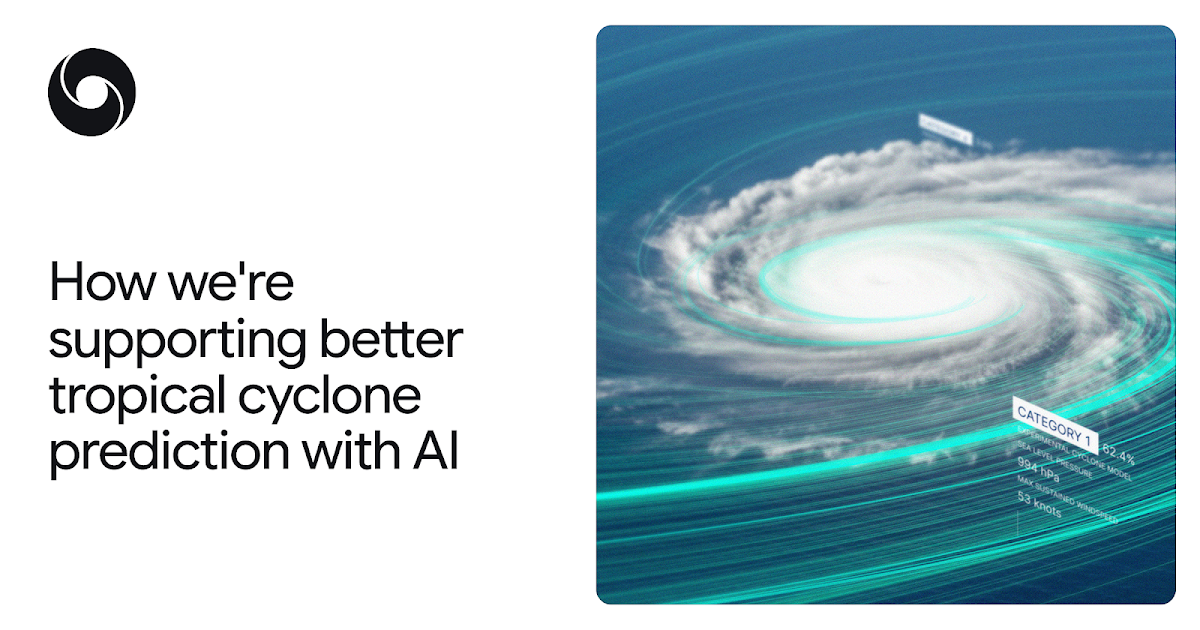
Weather Lab has been launched, showcasing experimental cyclone predictions. This initiative involves a partnership with the U.S. National Hurricane Center to enhance their forecasts and warnings during the current cyclone season.
Tropical cyclones pose immense dangers, threatening lives and causing widespread devastation. Over the last five decades, these storms have resulted in an estimated $1.4 trillion in economic losses.
These large, rotating storms, also known as hurricanes or typhoons, develop over warm ocean waters, driven by heat, moisture, and convection. Their sensitivity to minor atmospheric variations makes accurate forecasting particularly challenging. Nevertheless, enhancing the precision of cyclone predictions can safeguard communities by enabling more effective disaster preparedness and facilitating earlier evacuations.
Google DeepMind and Google Research have introduced Weather Lab, an interactive platform designed to share artificial intelligence (AI) weather models. The platform highlights an experimental AI-based tropical cyclone model, utilizing stochastic neural networks. This model is capable of predicting a cyclone’s formation, track, intensity, size, and shape, offering 50 potential scenarios up to 15 days in advance.

Animation illustrates a prediction from the experimental cyclone model. The model (in blue) accurately forecasted the paths of Cyclones Honde and Garance, south of Madagascar, during their active periods. It also successfully captured the paths of Cyclones Jude and Ivone in the Indian Ocean, nearly seven days ahead, reliably predicting areas of stormy weather that would later develop into tropical cyclones.
A new paper detailing the core weather model has been published. Weather Lab also offers an archive of historical cyclone track data for evaluation and backtesting purposes.
Internal assessments indicate that the model’s predictions for cyclone track and intensity are comparable to, and frequently surpass, the accuracy of existing physics-based methods. A partnership with the U.S. National Hurricane Center (NHC), which evaluates cyclone risks in the Atlantic and East Pacific basins, is underway to scientifically validate the approach and its outputs.
NHC expert forecasters are currently reviewing live predictions from the experimental AI models, presented alongside other physics-based models and observations. This data is expected to enhance NHC forecasts and deliver earlier, more precise warnings for tropical cyclone-related hazards.
Live and Historical Cyclone Predictions in Weather Lab
Weather Lab provides live and historical cyclone predictions from various AI weather models, as well as physics-based models from the European Centre for Medium-Range Weather Forecasts (ECMWF). Several AI weather models, including WeatherNext Graph, WeatherNext Gen, and the latest experimental cyclone model, operate in real time. Weather Lab also offers over two years of historical predictions for experts and researchers to download and analyze, facilitating external evaluations of these models across all ocean basins.
An animation demonstrates the model’s prediction for Cyclone Alfred when it was a Category 3 cyclone in the Coral Sea. The model’s ensemble mean prediction (bold blue line) accurately foresaw Cyclone Alfred’s swift weakening to tropical storm status and its eventual landfall near Brisbane, Australia, seven days later, indicating a high probability of landfall along the Queensland coast.
Users of Weather Lab can explore and compare predictions from various AI and physics-based models. Collectively, these predictions can assist weather agencies and emergency service experts in more accurately anticipating a cyclone’s path and intensity. This capability could enable experts and decision-makers to better prepare for diverse scenarios, disseminate risk information, and support decisions aimed at managing a cyclone’s impact.
It is crucial to note that Weather Lab functions as a research tool. The live predictions displayed are produced by models still in development and do not constitute official warnings. Users should bear this in mind when utilizing the tool, particularly when making decisions based on its predictions. For official weather forecasts and warnings, individuals should consult their local meteorological agency or national weather service.
AI-Powered Cyclone Predictions
Physics-based cyclone prediction often faces a challenge: a single model struggles to accurately predict both a cyclone’s track and its intensity due to operational approximations. A cyclone’s track is influenced by large-scale atmospheric steering currents, while its intensity relies on intricate turbulent processes within its core. Global, low-resolution models are effective for track prediction but fail to capture the fine-scale processes crucial for intensity, necessitating regional, high-resolution models.
The experimental cyclone model represents a unified system designed to overcome this trade-off. Internal evaluations demonstrate state-of-the-art accuracy for both cyclone track and intensity. This model is trained using two distinct data types: a comprehensive reanalysis dataset that reconstructs global past weather from millions of observations, and a specialized database containing critical information on the track, intensity, size, and wind radii of nearly 5,000 observed cyclones over the last 45 years.
Combining analysis data with cyclone-specific data significantly enhances cyclone prediction capabilities. For instance, initial evaluations of NHC’s observed hurricane data for the 2023 and 2024 test years in the North Atlantic and East Pacific basins revealed that the model’s 5-day cyclone track prediction is, on average, 140 km closer to the actual cyclone location than ENS—the leading global physics-based ensemble model from ECMWF. This level of accuracy is comparable to ENS’s 3.5-day predictions, representing a 1.5-day improvement that has historically taken over a decade to accomplish.
While earlier AI weather models encountered difficulties in calculating cyclone intensity, the experimental cyclone model surpassed the average intensity error of the National Oceanic and Atmospheric Administration (NOAA)’s Hurricane Analysis and Forecast System (HAFS), a prominent regional, high-resolution physics-based model. Initial tests also indicate that the model’s predictions for size and wind radii are comparable to physics-based baselines.
Visualizations of track and intensity prediction errors are presented, along with evaluation results detailing the experimental cyclone model’s average performance up to five days in advance, in comparison to ENS and HAFS.

Evaluations of the experimental cyclone model’s track and intensity predictions are compared against leading physics-based models, ENS and HAFS-A. These evaluations utilize NHC best-tracks as ground truth and adhere to their homogenous verification protocol.
Enhanced Data for Decision Makers
Beyond the NHC, close collaboration has occurred with the Cooperative Institute for Research in the Atmosphere (CIRA) at Colorado State University. Dr. Kate Musgrave, a CIRA Research Scientist, and her team assessed the model, concluding it possesses “comparable or greater skill than the best operational models for track and intensity.” Musgrave expressed anticipation for confirming these results through real-time forecasts during the 2025 hurricane season. Additionally, work has been conducted with the UK Met Office, University of Tokyo, Japan’s Weathernews Inc., and other experts to refine the models.
The new experimental tropical cyclone model marks the latest achievement in the ongoing WeatherNext research series. By responsibly sharing AI weather models via Weather Lab, valuable feedback will continue to be collected from weather agency and emergency service experts regarding how this technology can enhance official forecasts and support critical, life-saving decisions.
