



Agile CRM: Initial Assessment
Agile CRM presents a comprehensive feature set at an affordable price, positioning it as a solid option for small to medium-sized businesses. However, its user interface and customer support aspects show room for considerable improvement.
- Pros
- Comprehensive feature set
- Affordable pricing plans
- Robust integration options
- Cons
- Steep learning curve
- Dated interface
- Inconsistent customer support
Launched in 2013, Agile CRM is a platform designed for small and medium-sized businesses, integrating sales, marketing, and customer service into a single system. This aims to streamline operations and enhance efficiency across various business functions. The platform is notably affordable and offers a wide array of features, including a free plan that supports up to 10 users, which is quite generous compared to many competitors in the small business sector. However, a deeper examination reveals that the user interface and overall user experience could be significantly enhanced. While the platform is feature-rich, navigating it can sometimes be challenging, and the experience may feel less refined than more established CRM platforms.
Agile CRM Core Capabilities
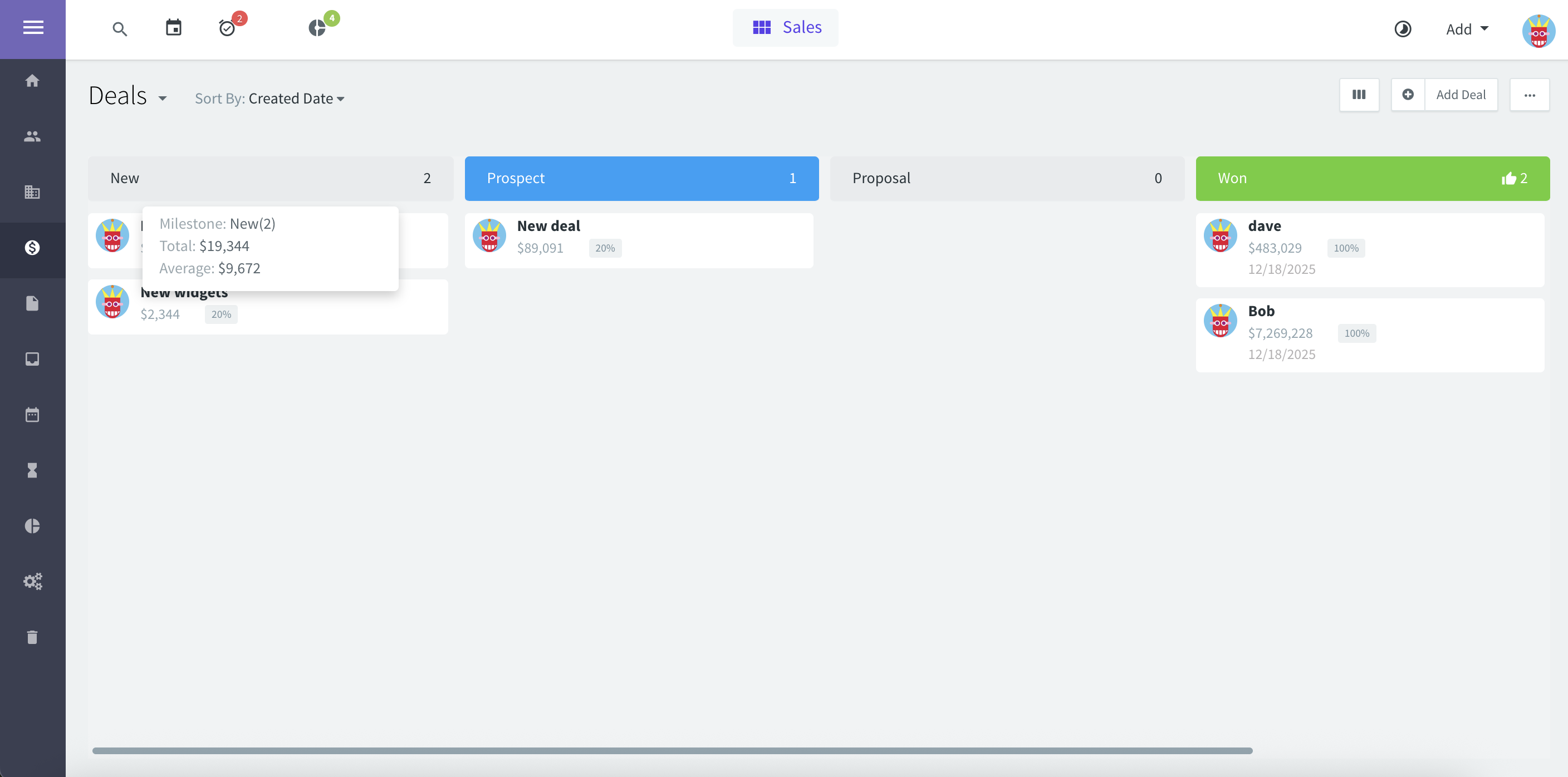
Agile CRM provides a full suite of core capabilities essential for customer relationship management. Contact profiles are detailed, allowing for extensive information storage and organization for customers and prospects. The 360-degree contact views offer a complete picture of each relationship, encompassing communication history, deals, tasks, and more.
For lead management, Agile CRM includes a lead scoring feature that automatically ranks contacts based on their interactions and attributes, aiding in prioritizing follow-ups. Users can create custom deal milestones and stages to align with specific sales processes. The visual pipeline view simplifies moving deals between stages and offers a quick overview of the sales funnel. The system also supports creating multiple pipelines, which is beneficial for managing different products or sales workflows.
Sales forecasting in Agile CRM is adequate but not exceptional. It offers basic revenue projections based on deal values and probabilities. However, the forecasting tools are somewhat limited in handling recurring revenue and deal probability. While sufficient for small businesses with straightforward forecasting needs, larger organizations might find it less comprehensive.
Reporting capabilities in Agile CRM have both strengths and weaknesses. The platform offers a good selection of pre-built reports covering sales, marketing, and service metrics. Users can also create custom reports and dashboards to track specific key performance indicators. Nevertheless, the depth of data analysis and visualization options is not as extensive as some competing products.
The Agile CRM mobile app, available for iOS and Android, facilitates managing contacts, deals, and tasks on the go. The app is responsive and well-designed, providing most of the core functionality found in the desktop version. The ability to access and update CRM data from any location is highly valuable for field sales and remote work.
Unlike some CRM systems where marketing features are secondary, Agile CRM provides robust tools for email marketing, landing page creation, and campaign management. The drag-and-drop campaign builder is particularly impressive, enabling the creation of multi-step marketing workflows. The system also includes ticketing, a knowledge base, and customer feedback tools, allowing businesses to manage customer support directly within the CRM.
An interesting addition to Agile CRM is its gamification features, designed to motivate sales teams. While not a primary CRM function, this can help drive engagement and performance among sales representatives through contests and leaderboards based on various sales metrics.
Ease of Use with Agile CRM
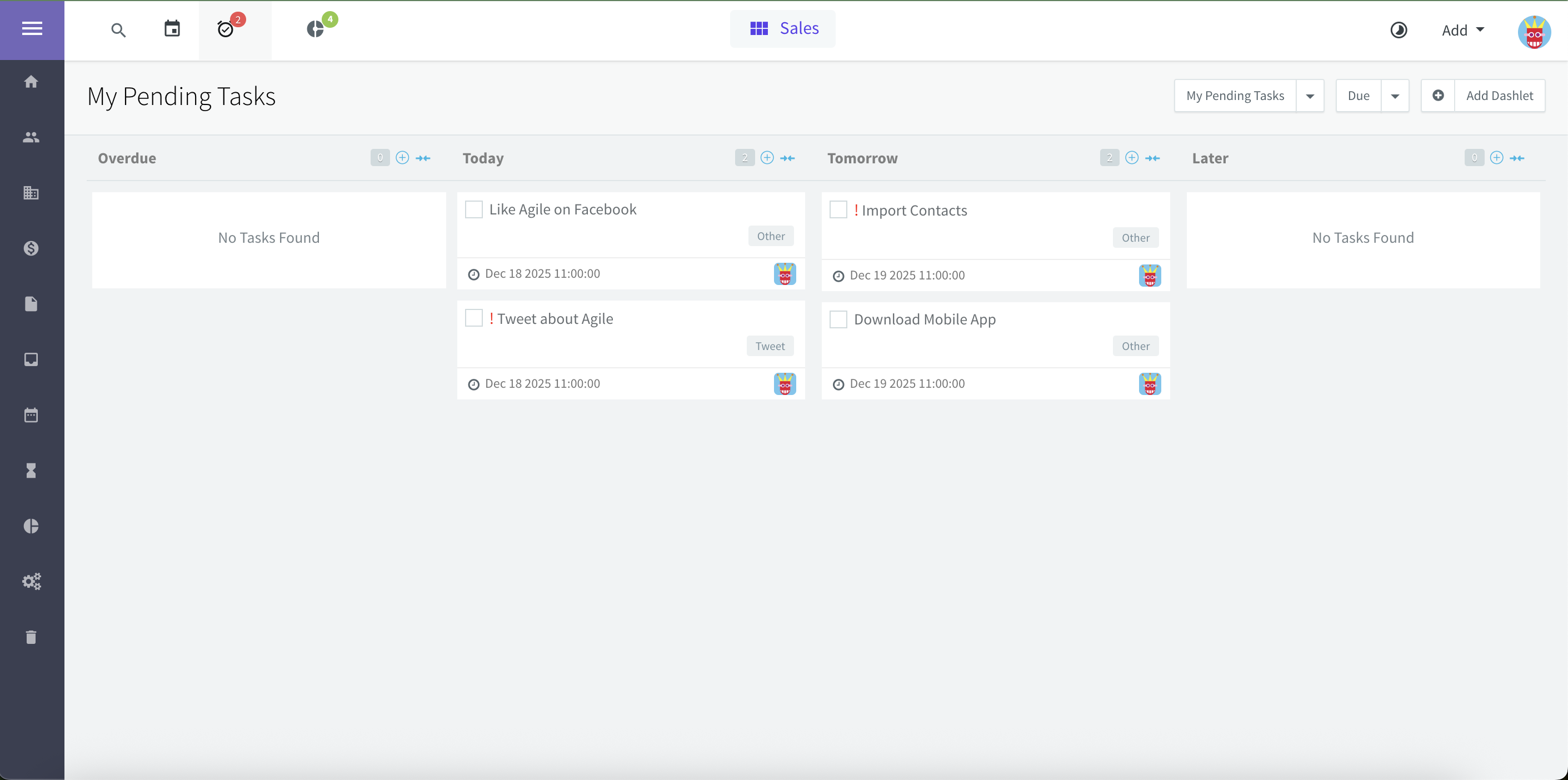
Agile CRM aims to balance functionality with simplicity, primarily catering to small businesses. The dashboard is clean, intuitive, and minimalistic, designed to prevent new users from feeling overwhelmed. A prominent left-side menu provides quick access to contacts, deals, and marketing, which is a standard layout for CRM systems.
The drag-and-drop interface further enhances navigation, particularly within the marketing automation module, where visual campaign builders significantly simplify the creation of multi-step workflows.
The learning curve for Agile CRM can vary based on a user’s prior CRM experience. The platform offers extensive customization options, allowing users to tailor the interface to their specific requirements. This includes creating custom fields, modifying layouts, and setting up personalized dashboards with custom KPIs. While these options increase flexibility, they can also introduce complexity for less technically proficient users.
Regarding accessibility, Agile CRM supports keyboard navigation and offers readable font sizes. However, documentation does not extensively mention screen reader compatibility or advanced accessibility features.
Onboarding and training resources are available, though they might not be as comprehensive as those from larger providers. Agile CRM offers a knowledge base, video tutorials, and webinars to assist users in getting started. The depth of these learning resources can vary across different topics.
Context-sensitive help is a beneficial feature, displaying relevant help articles and tips as users navigate through different sections of the software. This can reduce the time spent searching for information and accelerate user adoption.
Despite these positive aspects, some users have reported that certain elements of the software feel dated or clunky compared to more modern CRM solutions. Agile CRM’s attempt to incorporate a broad range of features into a single platform sometimes results in a less polished user experience.
Agile CRM Integrations
Agile CRM offers strong integration capabilities, enabling connections with a wide variety of third-party applications and services. These integrations can be established through pre-built connectors, iPaaS vendors like Zapier or Make, or custom integrations using its API.
Direct connections are available for popular business tools, including email services such as Gmail and Office 365, social media platforms like Twitter and LinkedIn, and e-commerce solutions such as Shopify and WooCommerce. These are generally straightforward to set up and modify.
The platform also integrates with web tracking and form integration tools, which are useful for enhancing customer engagement. Connections to various telephony services, including Twilio and RingCentral, are also supported.
For users needing integrations beyond the native options, Agile CRM supports multiple iPaaS vendors. Through Zapier, users can connect Agile CRM to over 1,000 additional SaaS applications, facilitating complex automation workflows across various platforms. Support for Make (formerly Integromat) and Webhooks is also provided.
Agile CRM features an open API, allowing developers to create custom integrations to extend the platform’s functionality. The API documentation appears comprehensive, supporting deep integration with external systems and the development of powerful custom widgets within the interface.
Data syncing with third-party platforms generally proved reliable during testing. Agile CRM offers both real-time and scheduled syncing options for most integrations, allowing users to select the most suitable method for their needs.
While Agile CRM’s integration features are robust, some limitations exist. The depth of integration can vary significantly between different connected applications. Some integrations offer solid two-way synchronization, while others may have a more restricted scope.
Agile CRM Support Quality
Agile CRM employs a diverse approach to customer support, combining live assistance with self-service options. Email support serves as the primary live channel, complemented by a comprehensive self-service resource ecosystem designed to help new users familiarize themselves with the CRM.
The email support system is generally responsive, though response times can vary. Most users report receiving initial replies within 24 hours, which is acceptable but not industry-leading. More complex issues often require longer resolution times, sometimes spanning several days of communication.
Phone support is also available, albeit not always easily accessible. Standard support hours are from 9:00 AM to 5:00 PM EST, with additional scheduling options. However, the availability of agents can pose a challenge when urgent assistance is required.
To compensate for limited live support options, Agile CRM offers a strong self-service ecosystem. Its knowledge base is comprehensive and well-organized, covering topics from basic setup to advanced features. Articles are typically clear and often include screenshots or step-by-step guides.
In addition to the knowledge base, Agile CRM provides video tutorials and webinars. These resources are particularly beneficial for users who prefer interactive learning, covering various aspects of the platform from initial setup to advanced features, serving as a solid foundation for new users and a reference for experienced ones.
A community forum allows users to interact, share experiences, and offer solutions to common problems. This forum appears to be actively participated in by both users and staff, functioning as both a feedback channel and a support resource.
User feedback regarding support quality is mixed. Some users praise the helpfulness and patience of support staff, especially for complex issues. Conversely, other testimonials indicate inconsistencies in support quality, with some users expressing frustration over response times or the depth of assistance provided.
Agile CRM Pricing and Plans
Agile CRM utilizes a tiered, subscription-based pricing model, featuring four distinct plans tailored to businesses of various sizes and requirements. The pricing structure is designed to scale with a company’s growth, starting with a free plan and progressing through increasingly feature-rich paid tiers.
At the entry level, the Free plan supports up to 10 users and 1,000 contacts. This plan includes basic CRM features such as contact management, deal tracking, and limited marketing automation. While generous compared to many competitors, it primarily functions as an extended trial, allowing users to experience the system before committing to a paid plan.
The Starter plan, priced at $8.99 per user per month, represents the beginning of the paid offerings. It increases the contact limit to 10,000 and introduces additional features like two-way email integration, custom deal milestones, and social monitoring. This plan offers good value for small businesses seeking to expand their CRM capabilities beyond basic contact management.
Moving up, the Regular plan costs $29.99 per user per month with annual billing. This tier supports up to 50,000 contacts and includes more advanced features such as marketing automation, custom deal tracks, and mobile marketing. This plan aims to balance functionality and cost, making it suitable for growing small to medium-sized businesses.
The top-tier Enterprise plan is available at $47.99 per user per month with annual billing. This plan provides unlimited contacts and access to the full suite of Agile CRM features, including call recording, custom reporting, and role-based access control. Although the most expensive, it offers the most comprehensive set of tools for businesses with complex CRM needs.
Significant discounts are offered for annual billing across all paid plans, ranging from 33% to 40% compared to monthly billing. This can be a substantial incentive for businesses to commit to longer-term subscriptions. Agile CRM also provides volume discounts for businesses requiring a large number of user licenses, though the specific terms are not publicly disclosed.
Agile CRM offers a 14-day free trial of its paid plans, allowing users to test the full feature set before making a purchase decision. This trial period, combined with the free plan, provides potential customers ample opportunity to evaluate the system’s suitability for their business needs.
Agile CRM Review: Final Verdict
Agile CRM’s primary strengths lie in its affordability and scalability. Its pricing model is structured to appeal to businesses at various growth stages, offering a generous free plan and competitive paid tiers. The platform is also rich in features, with notable additions like sales gamification and multi-step automation.
However, Agile CRM suffers from a dated interface that requires modernization. While its advanced features are beneficial, their execution can sometimes feel clunky, which may diminish user satisfaction. Despite this, the platform is generally easy enough to use, with some accessibility features included. More live support options would be a welcome improvement, especially given the somewhat outdated user experience.
Overall, Agile CRM is recommended for small to medium-sized businesses seeking an affordable CRM solution packed with features. While it may not be the most intuitive platform, its ease of use, combined with available training resources, should facilitate user adoption.
