


TechRadar Verdict
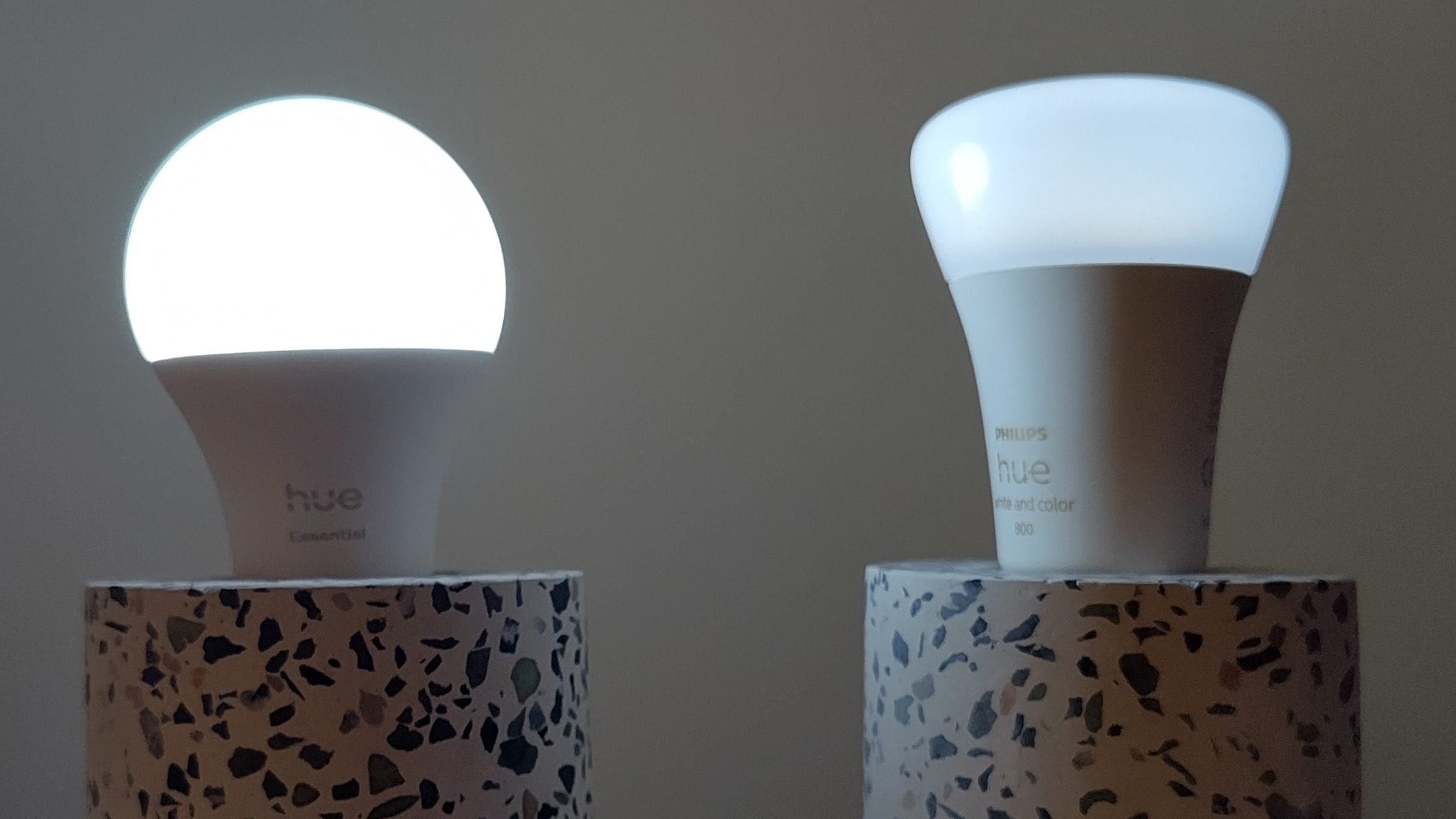
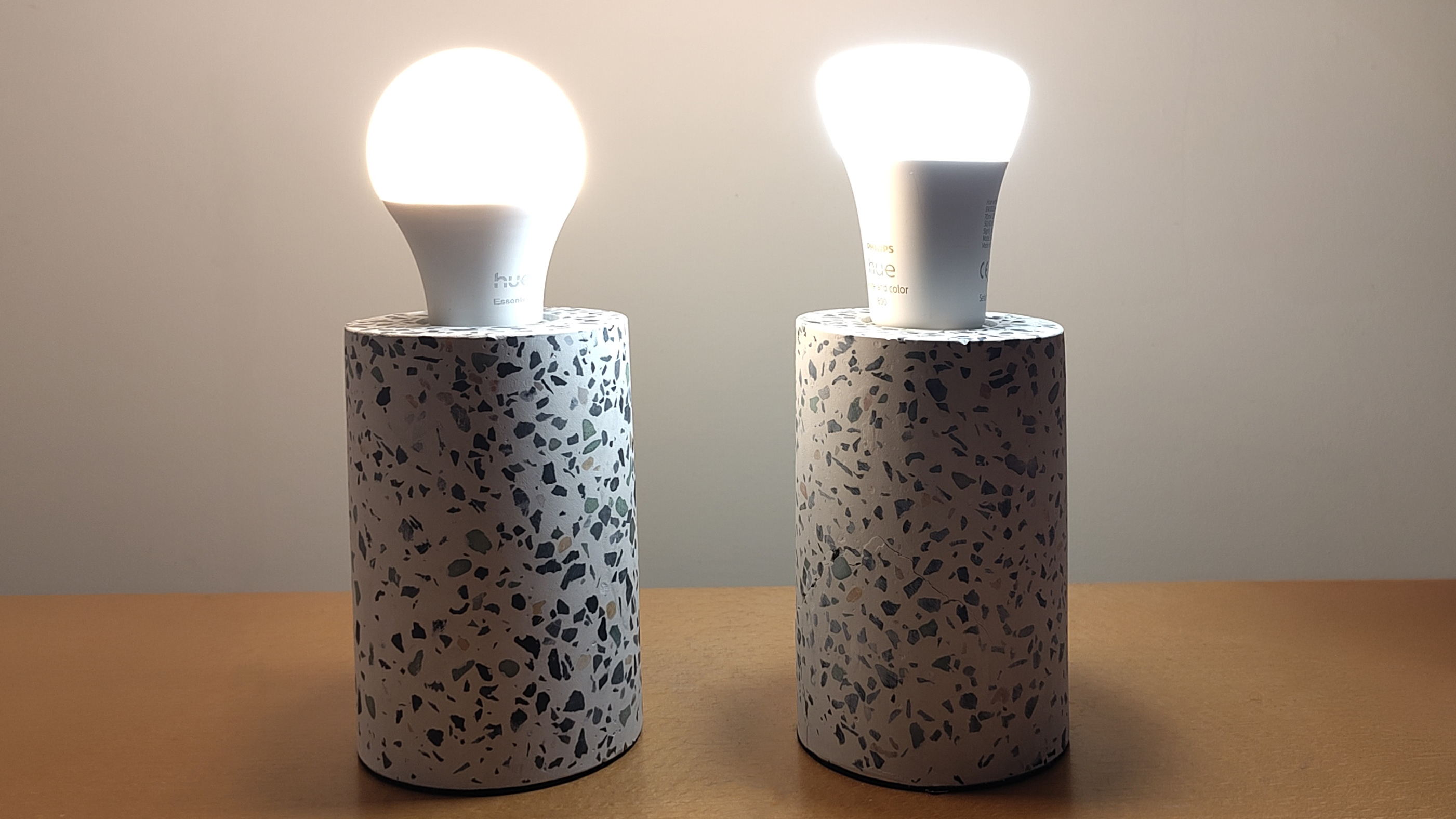
Philips’ Hue Essential series is a great entry-level range of smart lights that is fully compatible with other Hue devices, with the bulbs working brilliantly in most situations. The main drawback is that they can only dim to 2% (on the left in the image above) compared to 0.2% for regular Hue lights (right). Their white light spectrum is narrower, too. Mixing and matching them within the same room is not recommended. However, when used independently, they offer fantastic value and are an excellent way to start a Hue setup or extend an existing one without breaking the bank.
Pros
-
Much more affordable than regular Philips Hue lights
-
Very good color reproduction
-
Fully compatible with Philips Hue app and accessories
-
All Essential bulbs offer tuneable white and colored light
Cons
-
Dimmable to 2% brightness, compared to 0.2% for a regular Philips Hue bulb
-
Only three bulb types available
-
Darker ‘halo’ sometimes visible around top of bulb
Philips Hue Essential: two-minute review
Philips Hue Essential bulbs are a more affordable version of the company’s standard smart lights, and they perform incredibly well considering they’re less than half the price. There are a few limitations, though. For example, Philips Hue Essential bulbs offer a maximum brightness of 803 lumens, whereas standard Philips Hue White & Color Ambiance bulbs range from 800 to 1,600 lumens.
In most other respects, the two are very similar, and during testing there was only one clear instance where the standard bulb really outshone the Essential version.
To see how the two would compare, a pair of lamps was set up – one with a Philips Hue Essential bulb, and the other with an 800-lumen Philips Hue White & Color Ambiance bulb. They were added to the same room in the Philips Hue app, enabling simultaneous control and direct comparison of their output.
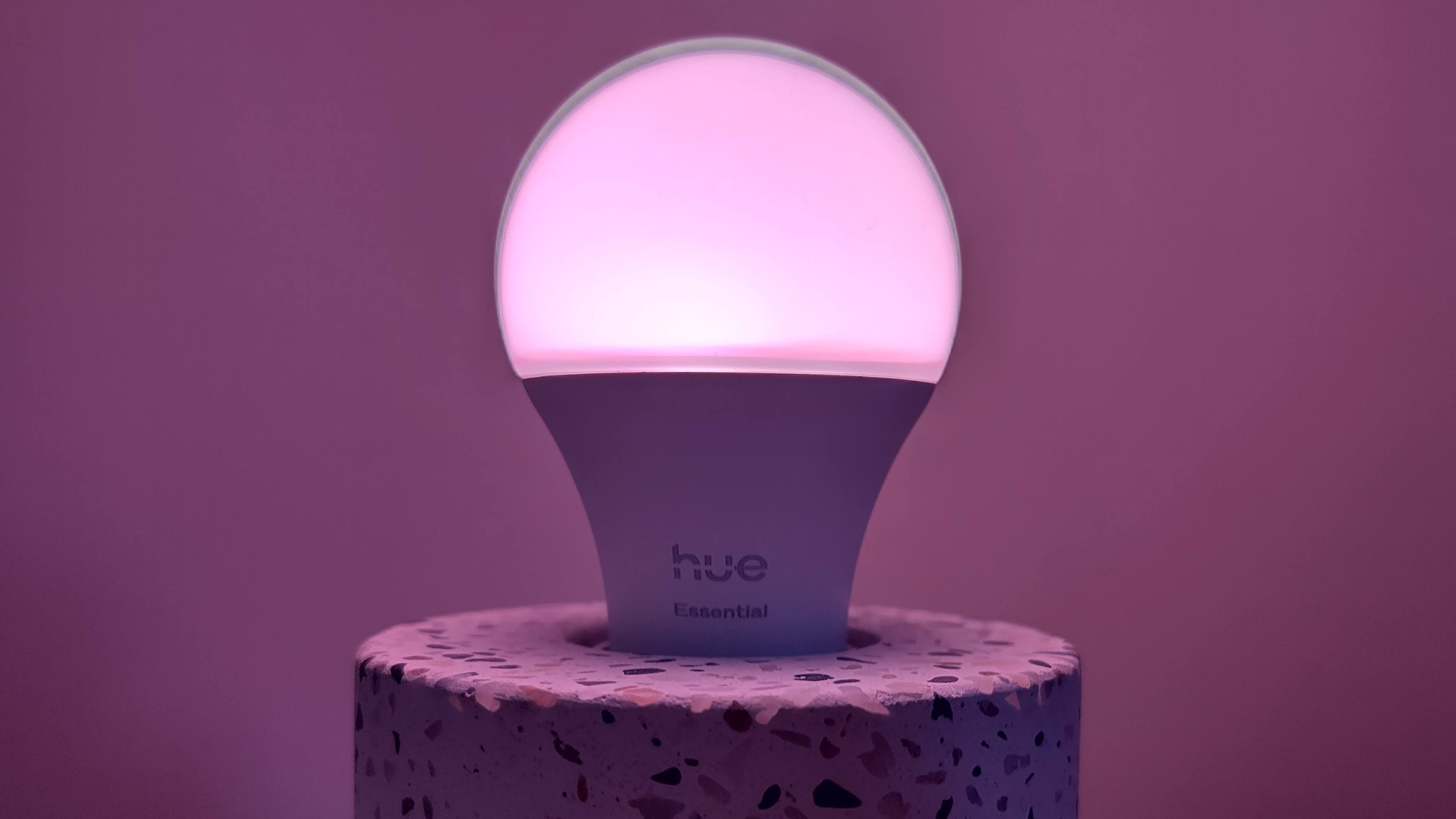
During most tests, it was difficult to spot any difference between the two. Both were equally responsive, and produced colors that were identical to the naked eye when switching between scenes. According to Signify (the company behind the Philips Hue brand), Essential bulbs use different color-matching technology to regular Hue lights; however, a noticeable difference was not apparent.
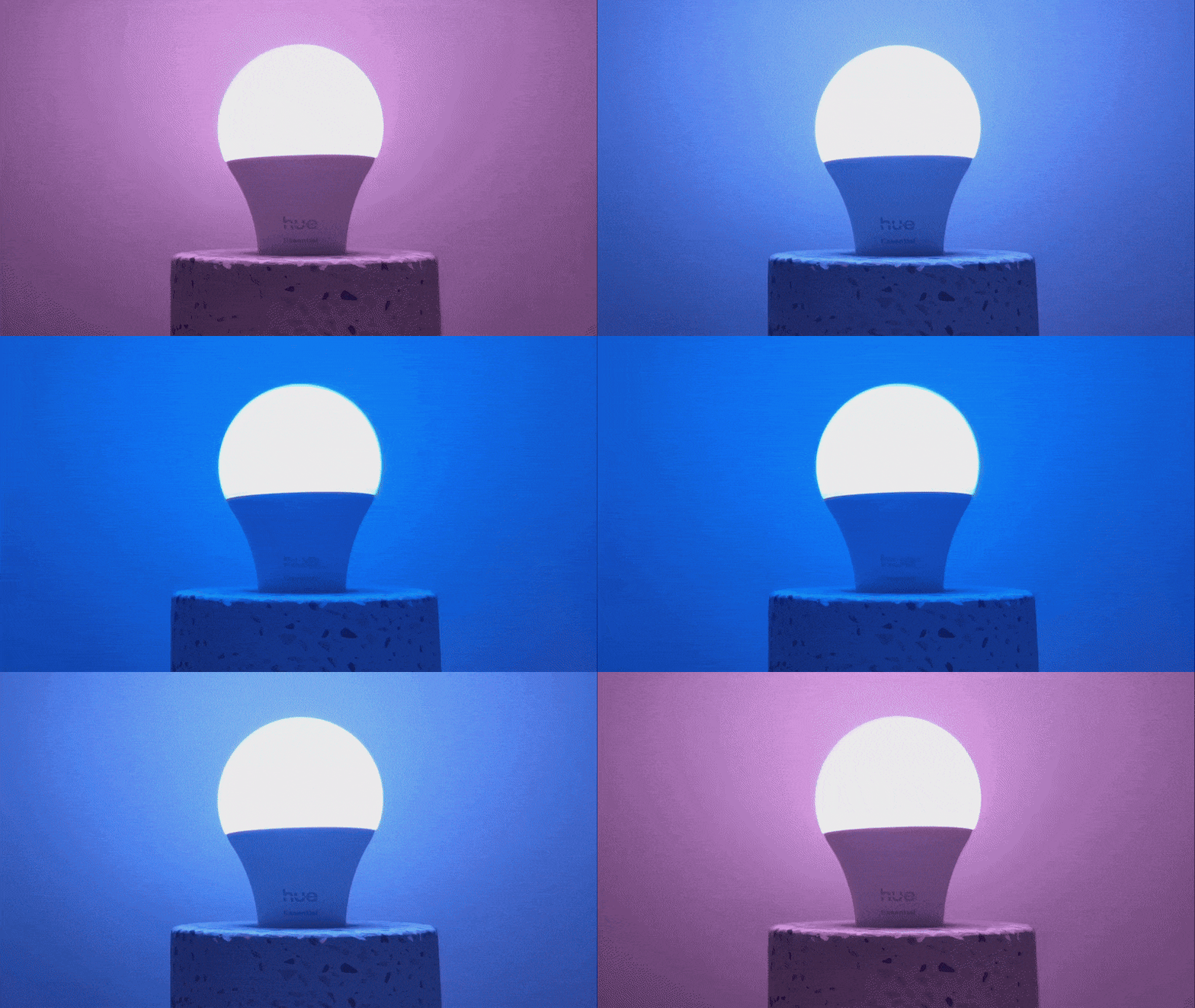
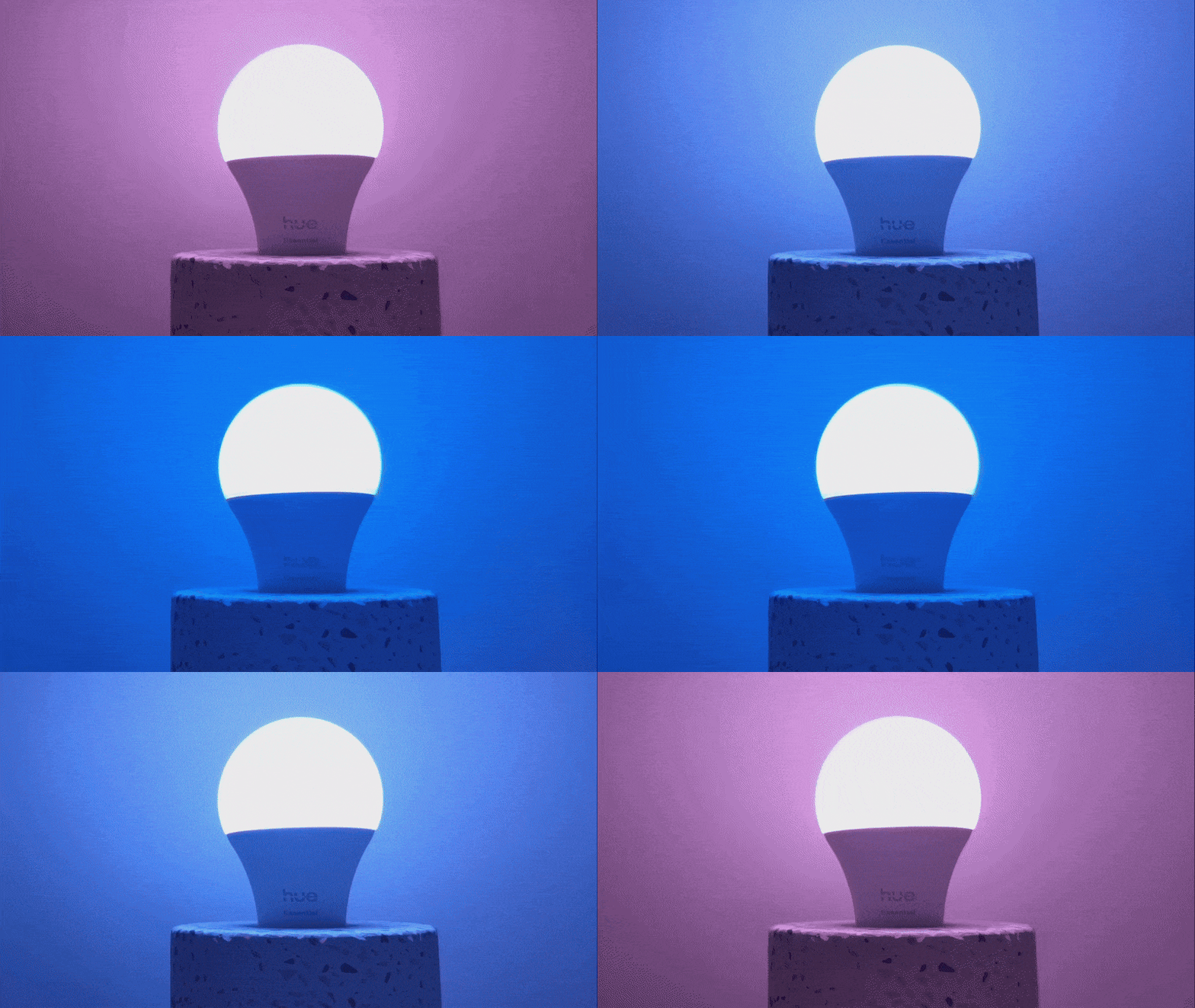
A dark band was noticed at the top of the Essential bulb, which was not present on the premium bulb. This was most apparent with purple and blue light. This is not something typically noticed when using the bulb in a ceiling light or a table lamp, and is therefore unlikely to be a deal-breaker unless one is exceptionally picky.
The two were equally bright (as expected), although if a higher-output White & Color Ambiance bulb had been used, it would have been appreciably brighter.
However, there’s one important difference to be aware of, particularly for those looking for smart bulbs that will produce a natural-looking sunrise and sunset to aid waking up refreshed, or to create subtle ambient lighting in a living room.
With both bulbs dialed down to their dimmest setting, the Hue Essential bulb was much brighter than the more expensive White & Color Ambiance model, as can be seen in the photo below. That’s because the Hue Essential bulb can only be dimmed to 2% of its maximum brightness, whereas the regular bulb can drop to just 0.2%.
The Essential bulb also tended to show a slightly warmer cast, due to its narrower white light spectrum (2,200–6,500K compared to 1,000-20,00K for a regular Hue bulb). Depending on the preferred light temperature, the difference could be apparent if the two different types of bulbs are used in close proximity.
Mixing and matching regular Hue and Hue Essential bulbs within the same room is not recommended. However, they’re an excellent option for those wanting to set up a Philips Hue system but have previously been intimidated by the price. They’re also great if one is looking to extend an existing system to more rooms in a home, without splashing too much cash.
- Performance score: 4.5/5
Philips Hue Essential: price and availability
- Much cheaper than regular Philips Hue bulbs
- Even more affordable when bought as a multipack
- A Philips Hue Bridge may also be desired
The Philips Hue Essential range is designed to be an accessible entry point into the world of smart lighting, with the bulbs coming in at a much cheaper price than standard Philips Hue ones.
One Philips Hue Essential bulb (either screw or bayonet) costs $24.99 / £19.99 (about AU$40). For those wanting several, savings can be made by opting for a multipack. A twin-pack costs $44.99 / £32.99 (about AU$70), and a four-pack comes in at $59.99 / £49.99 (about AU$90).
For comparison, a twin-pack of regular 800-lumen Philips Hue White & Color Ambiance bulbs costs $98.99 / £84.99 / AU$149.25, and a four-pack is $185.99 / £169.99 / AU$290.50. That’s the starting price for a maximum brightness of 800 lumens; brighter bulbs cost even more.
There’s another potential cost to consider, though. Although the color and brightness of Philips Hue Essential lights can be controlled using Bluetooth on a phone, for more advanced features (such as applying scenes, setting schedules, and connecting them to smart speakers or switches) a Philips Hue Bridge is also needed.
A standard Philips Hue Bridge costs $65.99 / £49.99 / AU$99.95, so this should be factored into the budget when planning a new smart lighting system. There’s also a Philips Hue Bridge Pro, but this would be overkill for a new user with a small setup.
At the time of writing, Hue Essential bulbs only seem to be available in Australia as part of a starter kit, costing $170.08 for four bulbs and the Hue Bridge.
- Value score: 5/5
Philips Hue Essential: specifications
Fitting base
E26/E27, B22, GU10
Wattage
60W equivalent
Maximum brightness
806 lumens
Colors
16 million colors, 2,200–6,500K white light
Control options
Hue app, Amazon Alexa, Google Home, Apple HomeKit, Matter, and more
Connection options
Bluetooth, Zigbee
Philips Hue Essential: design
- Only three bulb types available
- All options offer tuneable white and colored light
- Maximum brightness of 806 lumens
Philips offers only a small selection of Hue Essential bulbs, which makes sense for an entry-level option. There are currently three models available – screw, bayonet, and GU10 spotlights – and these should be fine for most fittings around a home. An E27 screw-fitting bulb was tested.
By contrast, regular Philips Hue lights come in virtually every shape and form possible, including candle and “filament”-style bulbs, LED strips, and gradient lamps to name just a few.
All bulbs in the Philips Hue Essential Series are “Warm to Cool White & Color”, meaning they can show eight million colors, plus white light at different temperatures (from 2,200K to 6,500K). Regular Philips Hue smart bulbs are available in three versions:
- Warm white, which lets users tune brightness but not color;
- White Ambiance, which lets users adjust the brightness and temperature;
- White & Color Ambiance, which also lets users pick from eight million colors.
For more details, a look at a complete guide to the different types of Philips Hue smart light bulbs is recommended.
All Philips Hue Essential bulbs offer a maximum brightness of 806 lumens. Regular Philips Hue bulbs range from 800 all the way through to 1,600 lumens.
- Design score: 4.5/5
Should you buy Philips Hue Essential bulbs?
Attribute
Notes
Score
Value
Exceptional value at less than half the price of a standard Hue bulb (and even better in a multipack).
5/5
Design
Only available in three formats, but these cover most everyday use cases.
4.5/5
Performance
Compares favorably with original Philips Hue bulbs, but cannot dim as low and has a slightly warm cast.
4.5/5
Buy them if
The price of regular Hue lights is off-putting
Philips Hue Essential bulbs are less than half the price of standard Hue lights, making them a much more affordable introduction to smart lighting.
You want to extend your Hue setup into more rooms
If a Hue system is in place for an entertainment area, Hue Essential bulbs would be a great way to light areas such as hallways and dining rooms, where dialing the brightness right down is not necessary.
Don’t buy them if
You want to create subtle ambience
The dimmest setting on a Philips Hue Essential bulb is 2%, compared to 0.2% for a standard Hue light, so super-subtle effects cannot be made, and it does not make an ideal wake-up light.
You already have regular Hue bulbs in your room
Philips Hue Essential bulbs are very good, but their limitations might be apparent if used side-by-side with regular Hue lights. It is recommended to use one or the other in a room, rather than a mixture of both.
Philips Hue Essential: also consider
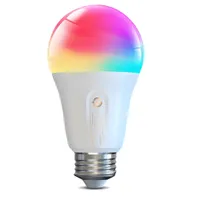
Govee Wi-Fi LED Bulb
Govee’s lights connect directly to a home Wi-Fi network, meaning they can be controlled remotely via an app without the need for an additional hub. There’s a very limited selection of bulb types, though, and during testing their colors were found to lack vibrancy.
Read a full Govee Wi-Fi LED Bulb review
Nanoleaf Matter Essentials
As the name suggests, these smart bulbs are Matter-compatible, which makes them easy to integrate with a mixed smart home. They’re a little cheaper than Hue Essential bulbs, too; but setup was found to be a little buggy in comparison to the smooth Hue experience.
Read a full Nanoleaf Matter Essentials review
How I tested the Philips Hue Essential bulbs
A Philips Hue Essential E27 screw-fitting bulb was tested alongside a standard Philips Hue Essential White & Color Ambiance bulb in identical table lamps for comparison. Both were connected to an existing Philips Hue setup and added to the same zone, allowing for simultaneous control via the Hue app, setting them to the same colors and brightness, and noting similarities and differences.
Testing also involved using the “sunset” automation within the Philips Hue app, with various preset scenes, and by tuning the light color and brightness manually.
For more details, see how products are tested, rated, and reviewed at TechRadar.
