





The development of artificial intelligence is currently shaping the future, and the prevailing direction suggests a future where intelligence becomes a rented commodity. This scenario implies that individuals’ capacity to reason, create, and make decisions would rely on systems beyond their control, inspection, or influence. In such a landscape, terms could change arbitrarily, leaving users with no alternative but to accept what is provided. A better path is possible, and fostering it is now central to Mozilla’s efforts.
The Web’s Transformation
Twenty-five years ago, Microsoft Internet Explorer held a 95% share of the browser market, effectively dictating how most people experienced the internet and the terms for development. Mozilla emerged to challenge this dominance, and Firefox achieved significant success, reducing Internet Explorer’s market share to 55% within a few years and initiating the Web 2.0 era. This led to a fundamentally different internet—faster and richer for users, and a foundation for open standards and open source that decentralized control over core web technologies for developers.
Browsers are often referred to as “user agents” for a reason. They were designed to advocate for users, blocking ads, protecting privacy, and offering choices that websites might not otherwise provide. This represented an initial struggle to maintain an open web, even as social networks and mobile platforms evolved into closed ecosystems.
Today, AI is emerging as the new intermediary, sometimes termed “Layer 8″—an agentic layer mediating interactions between users and the rest of the internet. These systems are poised to negotiate on behalf of users, filter information, influence recommendations, and increasingly define digital interactions.
A crucial question arises: Whose interests will your new user agent serve?
Current Advantages of Closed Systems
It is important to acknowledge the current landscape: Closed AI systems currently lead due to their inherent ease of use. A developer with an idea can quickly create a working prototype in minutes using a single API call from a major provider. GPUs, models, hosting, guardrails, monitoring, and billing are often bundled, offering a seamless experience. This convenience is understandable, as it provides the quickest route from concept to a functional product.
The open-source AI ecosystem presents a different picture. While powerful and rapidly advancing, it remains highly fragmented. Models reside in one repository, tools in another, and components for evaluation, orchestration, guardrails, memory, and data pipelines are spread across numerous independent projects with varying assumptions and interfaces. Although individual components improve quickly, their out-of-the-box integration is often challenging. Assembling a production-ready stack demands expertise and time that many teams lack. This is a fundamental challenge: not a matter of developers prioritizing convenience over principles, but rather a developer experience issue that can be resolved.
Shifting Dynamics
This dynamic has been observed before, and history offers valuable lessons. In the early days of personal computing, open systems were often unrefined and difficult, while closed platforms appeared inevitable due to their polish and simplicity. Yet, openness ultimately prevailed, not because users were driven by principles, but because open systems fostered experimentation and scalability unmatched by closed alternatives. A similar pattern emerged on the web, where early dominance by closed portals like AOL and CompuServe was eventually surpassed by open standards, driven by flexibility and the cumulative benefits of broad participation.
AI has the potential to follow this trajectory, but only if the necessary infrastructure is built. Several shifts are already transforming the landscape:
- Small models have significantly improved. Models ranging from 1 to 8 billion parameters, optimized for specific tasks, can now run on existing organizational hardware.
- Economic factors are evolving. As enterprises encounter limitations with closed dependencies, self-hosting is increasingly viewed as a sound business decision rather than solely an ideological commitment. Companies like Pinterest have reported millions in savings by transitioning to open-source AI infrastructure.
- Governments seek supply chain control. Governments are increasingly reluctant to rely on foreign platforms for strategically important capabilities, driving demand for sovereign systems.
- Consumer expectations continue to rise. Users desire AI that responds instantly, understands their context, and operates across various tools without platform lock-in.
The performance gap that once justified the dominance of closed systems is rapidly closing. What remains is a gap in usability and integration. History suggests that openness succeeds not by being more principled, but by offering a superior value proposition—being more affordable, more capable, and equally user-friendly.
Emerging Tipping Points
The triumph of openness will not occur uniformly but at specific tipping points where established norms have not yet solidified, and strategic intervention can redefine what becomes standard. Four such areas are identifiable.
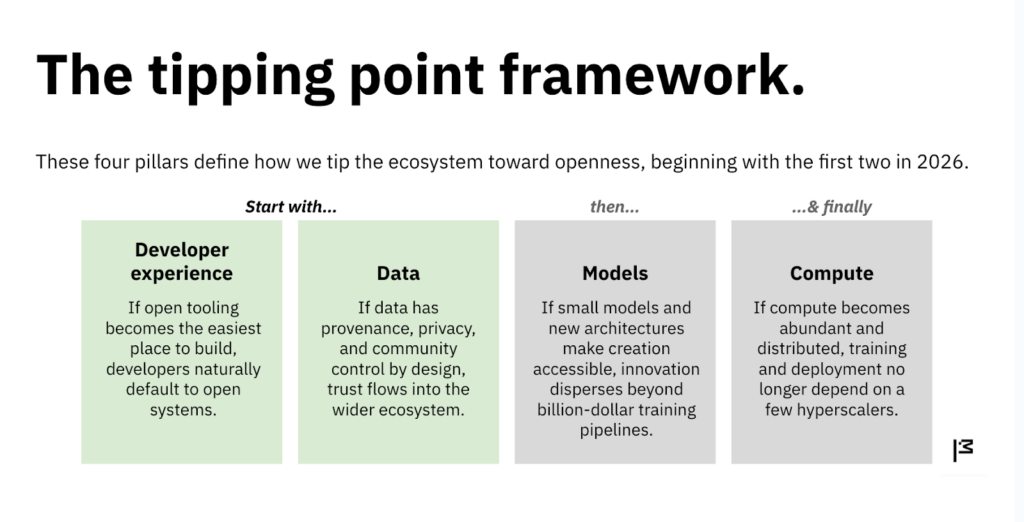
Developer experience is the first. Developers are the architects of the future; their choices regarding defaults, technology stacks, and dependencies shape the norms for everyone. Currently, the quickest path involves closed APIs, which is where much of the development is concentrated. However, developers, like users, prefer to avoid lock-in. Providing open tools that perform as effectively as closed ones will empower them to build the open ecosystem.
Data represents the second tipping point. For a decade, data was often assumed to be freely scrapable—the web treated as a commons for harvesting without consent. This norm is now breaking. Individuals and communities who generate valuable data deserve a say in its usage and a share in the value it creates. A shift towards licensed, provenance-based, and permissioned data is underway. The infrastructure for this transition is still under construction, offering an opportunity to build it correctly.
Models constitute the third area. The prevailing architecture currently favors only the largest laboratories, as they possess the resources to train massive dense transformers. However, innovation is accelerating at the edges with small models, mixtures of experts, domain-specific models, and multilingual models. As these approaches mature, the ability to create and customize intelligence will extend to communities, companies, and countries previously excluded.
Compute remains the fourth critical point. Access to specialized hardware continues to dictate who can train and deploy AI at scale. Expanding access is crucial, through distributed compute, federated approaches, sovereign clouds, and utilizing idle GPUs for productive purposes.
Vision for an Open Stack
Today’s dominant AI platforms construct vertically integrated stacks: closed applications atop closed models, trained on closed data, running on closed compute. Each layer reinforces the next—data enhances models, models improve applications, and applications generate more data exclusively for the platform’s use. This creates a powerful self-reinforcing cycle. If left unchallenged, this could lead to an AI era akin to AOL, but far more centralized, where development occurs within the platform rather than on it.
An alternative path exists. The combination of Linux, Apache, MySQL, and PHP succeeded because it became simpler to use than proprietary alternatives and enabled developers to create innovations that no commercial platform would have prioritized. The modern web owes its existence to that open stack.
AI can potentially follow this same pattern, not with a single stack controlled by one entity, but with multiple stacks shaped by the communities, countries, and companies that utilize them:
- Open developer interfaces at the top. This includes SDKs, guardrails, workflows, and orchestration that avoid vendor lock-in.
- Open data standards underneath. Built-in provenance, consent, and portability ensure transparency regarding training data origin and rights.
- An open model ecosystem below that. This involves smaller, specialized, interchangeable models that can be inspected, customized to specific values, and run where needed.
- Open compute infrastructure at the foundation. Distributed and federated hardware across cloud and edge, rather than being channeled through a few hyperscalers.
Components of this open stack already exist, developed by skilled individuals. The current objective is to bridge the gaps, integrate existing pieces, and make the entire system as user-friendly as its closed counterparts. This is the ongoing work.
The Importance of Open Source
For those familiar with Mozilla, The Manifesto serves as a guiding document. For nearly two decades, it has directed development and methodology, functioning not as an abstract ideal but as a practical tool for daily principled decision-making. Three of its principles are particularly relevant in the age of AI:
- Human agency. In a world increasingly influenced by AI agents, it is paramount that technology empowers individuals to shape their experiences and safeguards privacy.
- Decentralization and open source. An open and accessible internet relies on innovation and broad participation in technology creation and usage. The success of open-source AI, built on transparent community practices, is essential for this.
- Balancing commercial and public benefit. The direction of AI is largely being set by commercial entities. Strong public-benefit contributors are needed to establish balance within the overall ecosystem.
Open-source AI actualizes these principles. It enables plurality—multiple intelligences shaped by diverse communities, rather than a single dominant model. It facilitates sovereignty—owning one’s infrastructure instead of renting it. Furthermore, it ensures the continued existence of public-benefit alternatives alongside commercial offerings.
Focus Areas for 2026
The opportunity to influence these foundational defaults remains, but it is finite. Efforts are concentrated on areas where openness can still redefine norms before they become entrenched.
Making open AI simpler than closed alternatives. Mozilla.ai is developing any-suite, a modular framework designed to integrate the disparate components of the open AI stack—including model routing, evaluation, guardrails, memory, and orchestration—into a coherent system that developers can readily adopt without needing to be infrastructure specialists. The concrete aim is for initiating open AI projects to be as straightforward as making a single API call.
Shifting data economics. The Mozilla Data Collective is establishing a marketplace for data that is properly licensed, clearly sourced, and aligned with community values. This initiative provides developers with access to high-quality training data while ensuring that contributors retain agency and share in the economic value generated.
Learning from practical deployments. Strategy not informed by real-world experience is merely theoretical. Therefore, engagement is being deepened with governments and enterprises adopting sovereign, auditable AI systems. These interactions provide crucial feedback, highlighting where the stack encounters issues and where openness requires reinforcement.
Investing in the ecosystem. Beyond direct development, support is extended to others building in this space. Mozilla Ventures invests in open-source AI companies aligned with these principles, and the Mozilla Foundation funds researchers and projects through targeted grants. The objective is to empower individuals and teams already engaged in this work.
Engaging with the community. The open-source AI ecosystem is vast, making it challenging to discern effective solutions from hype and identify genuine momentum. Efforts are being made to provide value to this community. A newsletter is being launched to track developments in open AI, meetups and hackathons are organized to connect builders, and developer surveys are conducted to understand user needs. Additionally, MozFest will feature a dedicated developer track focused on open-source AI this year. The aim is to help important work in this domain reach its intended audience.
Mozilla operates as part of a broader movement, with no intention of owning or controlling it, but rather to facilitate its success. A growing community believes in defending the open internet and is working to ensure AI develops along a different trajectory than that laid out by the largest platforms. While not all members of this community use identical language or build the same things, a shared purpose is emerging, and Mozilla considers itself a part of this endeavor.
The open web was maintained not by seeking permission, but by creating superior alternatives. A similar approach is being pursued again.
The future of intelligence is being shaped now. The fundamental question is whether individuals will own it or merely rent it.
