

Close Menu
    Latest Post

    Unauthenticated Blind SSRF in Oracle EBS

    January 10, 2026

    Did a clean Windows install? Do these 6 things before anything else

    January 10, 2026

    A Thousand Blows Season 2 Review: A Grittier Return to Victorian London on Disney+

    January 10, 2026
    Facebook X (Twitter) Instagram
    Trending
    • Unauthenticated Blind SSRF in Oracle EBS
    • Did a clean Windows install? Do these 6 things before anything else
    • A Thousand Blows Season 2 Review: A Grittier Return to Victorian London on Disney+
    • Most Parked Domains Now Serving Malicious Content
    • Are Tech Giants Killing Cold Outreach?
    • AWS Introduces Three Well-Architected Lenses for AI at re:Invent 2025
    • CES 2026: Key Innovations from Nvidia, AMD, and Razer’s AI Concepts
    • Six Key Components of UX Strategy
    Facebook X (Twitter) Instagram Pinterest Vimeo
    NodeTodayNodeToday
    • Home
    • AI
    • Dev
    • Guides
    • Products
    • Security
    • Startups
    • Tech
    • Tools
    NodeTodayNodeToday
    Home»Tech»Is ChatGPT’s New Shopping Research Solving a Problem, or Creating One?
    Tech

    Is ChatGPT’s New Shopping Research Solving a Problem, or Creating One?

    Samuel AlejandroBy Samuel AlejandroJanuary 9, 2026No Comments3 Mins Read
    Share Facebook Twitter Pinterest LinkedIn Tumblr Reddit Telegram Email
    src ip9xzf featured
    Share
    Facebook Twitter LinkedIn Pinterest Email

    When OpenAI introduced its new shopping research capabilities, the announcement was met with skepticism. For the past decade, the slow evolution of traditional search engines has been observed. What began as tools for pure information discovery gradually transformed into ecosystems dominated by SEO-optimized content and sponsored results. A concern arose with ChatGPT’s update: Is this the beginning of a similar shift? Is the integrity of the “reasoning engine” being compromised by commercial imperatives?

    After testing the new shopping integration, the results suggest a pivotal moment in the user experience of Generative AI, one that necessitates an open discussion about the desired purpose of these tools.

    The “Vacuum” Paradox

    The defining characteristic of Large Language Models (LLMs) is their ability to handle nuance. Interactions with ChatGPT typically involve an expectation of Socratic dialogue, where the AI asks clarifying questions to narrow down user intent.

    To test this, a simple prompt was entered: “I want to buy a vacuum.”

    A conversational approach was anticipated, with questions about home size, floor type, or budget. Instead, the conversational nuance was replaced by a familiar display: a grid of product photos, names, prices, and direct links to retailers.
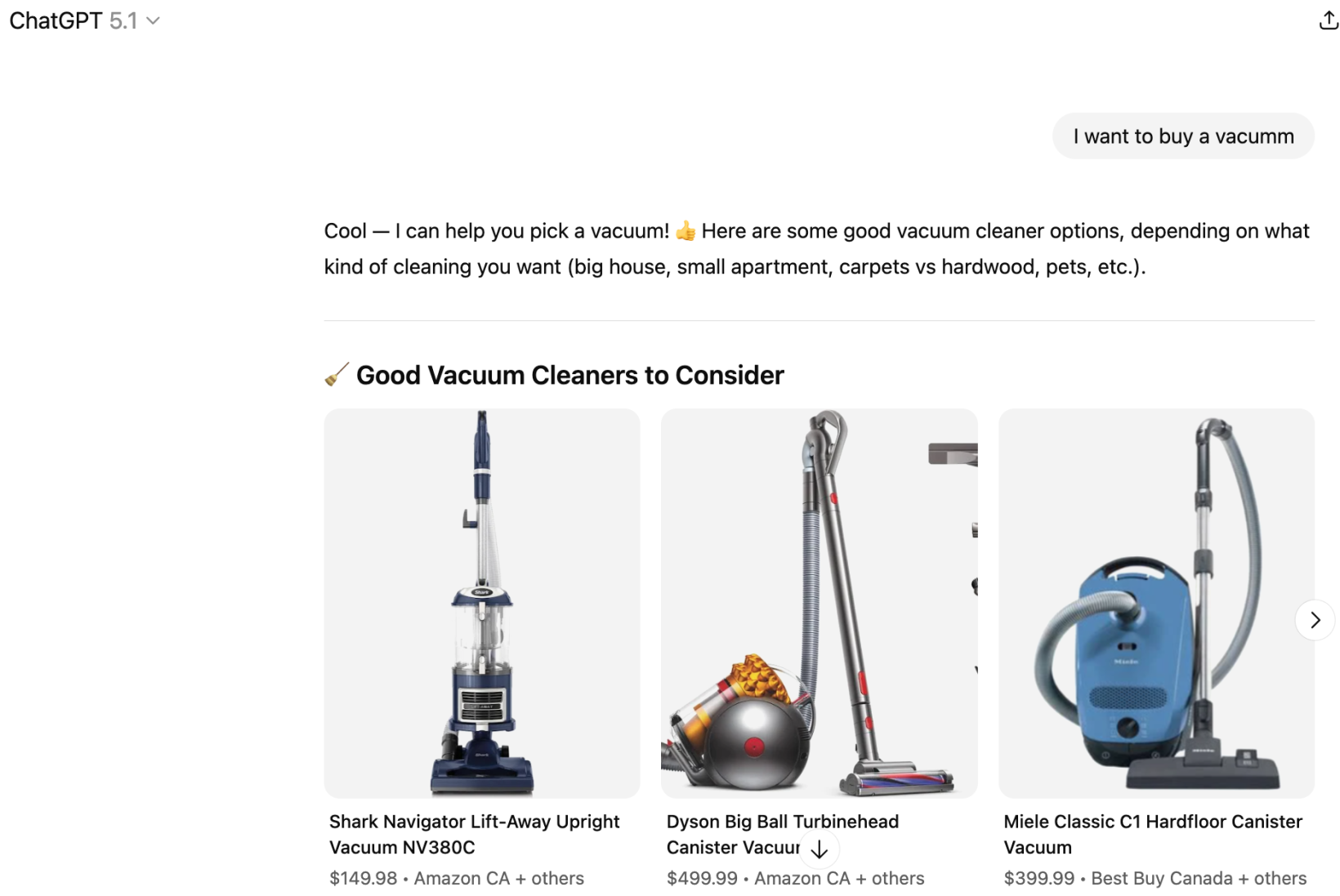
    Image 2

    While efficient, this experience appeared to be a regression. It mirrored the “keyword search” experience of Web 2.0 rather than the “intent-based” promise of GenAI. The prompt was addressed, but the intelligence was diminished.

    When “Research” Becomes a Filter

    Scrolling further, engagement with the new feature occurred via a call to action: “Research the best vacuums.” This is where significant user experience friction became evident. Rather than synthesizing data or comparing technical specifications in a chat format, the tool presented a polling interface designed to filter results.

    Image 3

    The experience is notably time-sensitive; pausing too long causes the screens to skip forward, returning the user to a list of product cards. The interface presents products with a binary choice: “More like this” or “Not interested.” It offers brand names and price tags, but provides virtually no information to assist the user in making an informed choice.
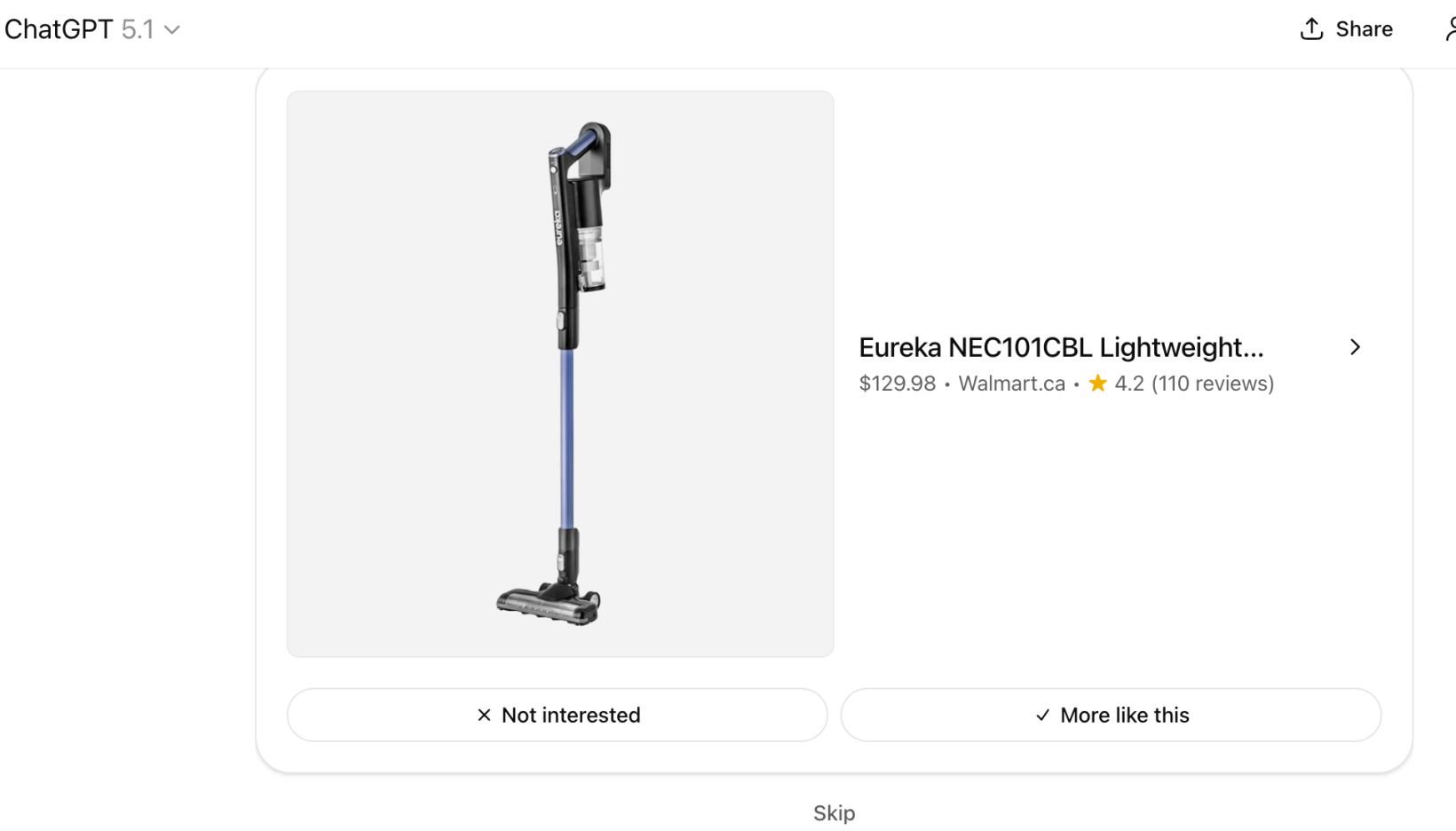
    Image 4

    For a user seeking genuine research, being presented with a list of brands and prices without deep comparative analysis seems like a missed opportunity. This raises a question: If product filtering by price and brand were the goal, would a traditional retailer not suffice? The value proposition of Gen AI should be synthesis, not merely aggregation.

    The Tension Between Reasoning and Revenue

    This update highlights an inevitable tension for major AI companies: balancing user utility with business sustainability. As OpenAI expands, the pressure to demonstrate revenue models to investors is natural. However, prioritizing transactional features before the core product—reasoning and logic—is fully matured carries a risk. By introducing a shopping experience that feels more like a “click-through” engine than a “knowledge” engine, the platform risks blurring its identity.

    Is ChatGPT intended as a research partner that aids thought, or a shopping assistant aiming to expedite checkout?

    A Call for “Smart” Shopping

    A place for shopping within AI exists, but the execution is critical. A truly Generative AI shopping experience should not simply list products; it should understand the user. It should interpret the underlying intent of a prompt, recognizing that a user asking for a vacuum might actually be addressing a problem like pet hair or allergies.

    The current iteration feels more like a beta test of a business model than an evolution of intelligence. Moving forward, the hope is that OpenAI will refine this tool to prioritize the “Chat” aspect over the transaction. The aim is not for it to be just another platform for advertisements. A better decision-making method is required.

    Share. Facebook Twitter Pinterest LinkedIn Tumblr Email
    Previous ArticleHow GitHub Engineers Address Platform Challenges
    Next Article Win Commercial Land in Ham Lake, Minnesota: Fleet Star’s Charitable Sweepstakes
    Samuel Alejandro

    Related Posts

    Tech

    Are Tech Giants Killing Cold Outreach?

    January 10, 2026
    Tools

    AWS Introduces Three Well-Architected Lenses for AI at re:Invent 2025

    January 10, 2026
    AI

    CES 2026: Key Innovations from Nvidia, AMD, and Razer’s AI Concepts

    January 10, 2026
    Add A Comment
    Leave A Reply Cancel Reply

    Latest Post

    ChatGPT Mobile App Surpasses $3 Billion in Consumer Spending

    December 21, 202512 Views

    Automate Your iPhone’s Always-On Display for Better Battery Life and Privacy

    December 21, 202510 Views

    Creator Tayla Cannon Lands $1.1M Investment for Rebuildr PT Software

    December 21, 20259 Views
    Stay In Touch
    • Facebook
    • YouTube
    • TikTok
    • WhatsApp
    • Twitter
    • Instagram
    About

    Welcome to NodeToday, your trusted source for the latest updates in Technology, Artificial Intelligence, and Innovation. We are dedicated to delivering accurate, timely, and insightful content that helps readers stay ahead in a fast-evolving digital world.

    At NodeToday, we cover everything from AI breakthroughs and emerging technologies to product launches, software tools, developer news, and practical guides. Our goal is to simplify complex topics and present them in a clear, engaging, and easy-to-understand way for tech enthusiasts, professionals, and beginners alike.

    Latest Post

    Unauthenticated Blind SSRF in Oracle EBS

    January 10, 20260 Views

    Did a clean Windows install? Do these 6 things before anything else

    January 10, 20260 Views

    A Thousand Blows Season 2 Review: A Grittier Return to Victorian London on Disney+

    January 10, 20260 Views
    Recent Posts
    • Unauthenticated Blind SSRF in Oracle EBS
    • Did a clean Windows install? Do these 6 things before anything else
    • A Thousand Blows Season 2 Review: A Grittier Return to Victorian London on Disney+
    • Most Parked Domains Now Serving Malicious Content
    • Are Tech Giants Killing Cold Outreach?
    Facebook X (Twitter) Instagram Pinterest
    • About Us
    • Contact Us
    • Privacy Policy
    • Terms & Conditions
    • Disclaimer
    • Cookie Policy
    © 2026 NodeToday.

    Type above and press Enter to search. Press Esc to cancel.