


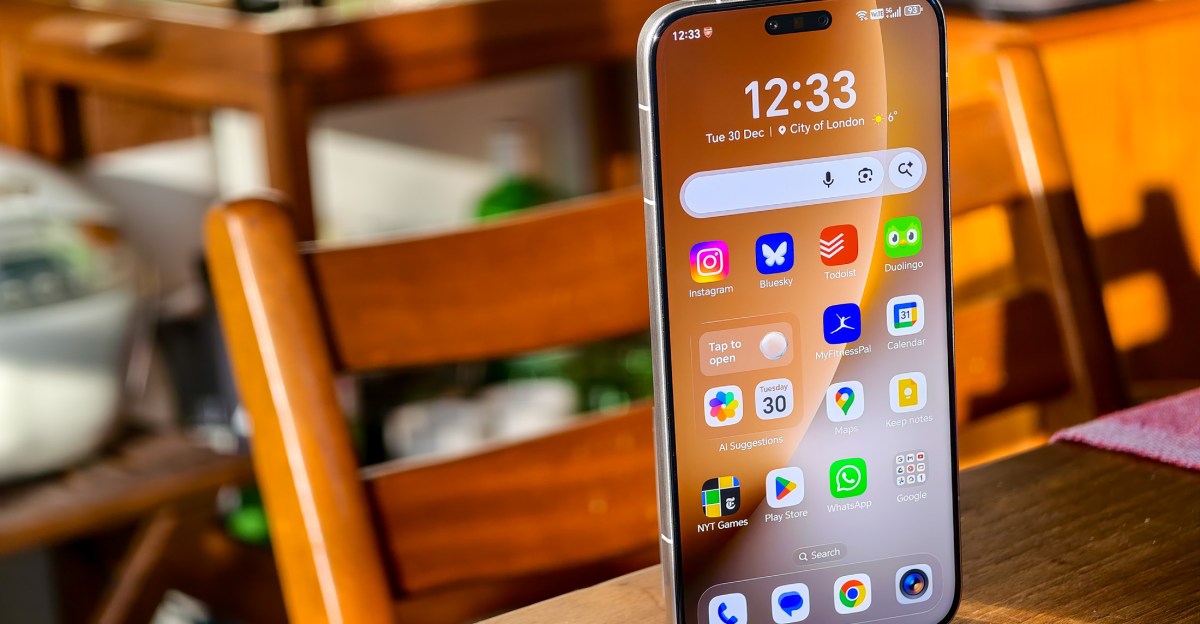


The Honor Magic 8 Pro is now available in Europe, following its Chinese launch months prior.
When evaluating phones, particularly those highlighting their camera capabilities, a key consideration is whether one feels the need for a different device for photography. While some phones might excel in battery life or software smoothness, there are often moments when capturing a portrait or a dimly lit scene makes one wish for a camera with superior performance, like the Vivo X300 Pro.
However, during a month of testing the Honor Magic 8 Pro, such a thought rarely arose.


Honor Magic 8 Pro
The Good
- Fantastic camera system
- Two-day battery life
- Flagship performance
The Bad
- Middling design
- AI button lacks extensive customization
The Magic 8 Pro represents Honor’s newest flagship device, initially launched in China in October and now making its European debut. Priced at £1,099.99 (approximately $1,500), it aims to compete with devices such as the iPhone 17 Pro Max, and Galaxy S25 Ultra, along with other flagships from brands like Xiaomi, Oppo, and Vivo.
Honor has consistently positioned its premium phones as photographic powerhouses, a strategy reminiscent of its former parent company, Huawei. While Honor has produced many phones with good cameras, they haven’t always been considered best-in-class. The Magic 8 Pro, however, comes closer than any previous Honor device and could easily outperform many handsets available in the US market.
The triple rear camera system features a 50-megapixel, f/1.6 main lens. This is complemented by a 50MP, f/2.0 ultrawide lens and a 200MP, f/2.6, 3.7x telephoto lens. The telephoto lens is a crucial battleground in modern phone photography, with manufacturers striving for the sharpest, longest-distance zoom, alongside excellent performance in the 2-4x range, ideal for portraits, pets, or detailed food photography.


Every photo in this gallery was captured using the Magic 8 Pro’s telephoto camera.
The Magic 8 Pro’s telephoto lens incorporates contemporary trends, utilizing a large sensor and a fast aperture. These features are primarily designed to enhance performance in low-light conditions, even with moving subjects and varied light sources. A beneficial side effect is a narrow focal range, which creates a natural depth of field in photos. This helps avoid the flat appearance often seen in smartphone photography, making images from this phone more akin to those from larger cameras.
While these advancements are not exclusive to the Magic 8 Pro—rival flagships from other brands employ similar hardware—the image quality produced is notably impressive. The dynamic range is excellent, colors appear warm and are seldom oversaturated, and noise is minimal. This consistent quality extends across all three rear lenses, though the ultrawide lens exhibits slightly more difficulty in challenging lighting scenarios.


These photos were all taken with the main and ultrawide lenses.
Factors preventing this from being considered the absolute best phone camera include occasional oversharpening in some shots and slightly elevated contrast in others. Capturing fast-moving subjects can be inconsistent, with some excellent results alongside instances of unwanted blur. While a preference for the color tuning of devices like the Vivo X300 Pro exists due to its film-like aesthetic, these are largely matters of personal taste rather than outright technical deficiencies. On purely technical terms, the Magic 8 Pro’s camera performance is comparable to any other leading phone camera available.

The Magic 8 Pro’s cameras are highly capable, with the telephoto lens being a standout feature.

This additional button serves for both camera controls and AI shortcuts.
Honor has not adopted hardware add-ons like the telephoto extenders popular among some Chinese OEMs, but it has included a dedicated camera button. This touch-sensitive side button functions as both a zoom control and a shutter button. It also acts as an “AI Button,” providing a shortcut to Honor’s various AI-powered features, such as photo editing, transcription, and translation. These features largely overlap with those offered by Google Gemini. Customization options for the button are limited, preventing its use for opening apps beyond the camera and AI functionalities.
The phone’s design may not appeal to everyone. The camera island, despite its unique shape, can be perceived as an aesthetic drawback, a common issue across many phones. The back panel has a somewhat plasticky feel, which might be unexpected for a device in this price range. While a case would mitigate this, the look and feel are important at this premium level. MagicOS, Honor’s Android overlay, includes several preinstalled proprietary apps and some less intuitive design choices, though these are generally minor annoyances. Honor is offering seven years of software support in Europe and at least four years elsewhere, with the phone shipping with Android 16.

The Magic 8 Pro’s silicon-carbon battery offers extended endurance compared to many other smartphones.
Beyond its camera, the Magic 8 Pro’s substantial battery is another significant selling point. The global model features a 7,100mAh capacity, while the European version will have a slightly smaller 6,270mAh battery. Although the larger cell did not match the endurance of the recent Oppo Find X9 Pro, it comfortably provides two days of use, eliminating the need for nightly charging. As with other silicon-carbon batteries, there are considerations regarding long-term degradation, but the starting capacity is impressive.
The overall performance is, as expected, premium. The Qualcomm Snapdragon 8 Elite Gen 5 chipset handles all tasks effortlessly, and the 6.71-inch 120Hz OLED display delivers a superb visual experience. The device supports fast 100W wired and 80W wireless charging, boasts IP68 and IP69K ingress protection ratings, and offers up to 16GB RAM and 1TB storage, depending on the market. However, for a current Android flagship, many of these specifications are standard expectations.

The device features a single 50-megapixel selfie camera, accompanied by a depth sensor.
Honor has sometimes been seen as a secondary player in the annual Chinese flagship competition, often providing solid core specifications but lagging in critical areas. The Magic 8 Pro marks the first Honor phone that appears truly competitive at this high level. For European consumers, its appeal is enhanced by the inconsistent and limited international releases of Oppo and Vivo’s latest flagships, and the fact that Xiaomi’s new 17 Pro and 17 Ultra have not yet launched outside China. Depending on the region, this could position the Magic 8 Pro as one of the most powerful phones currently available.
Agree to Continue: Honor Magic 8 Pro
Modern smart devices typically require users to accept numerous terms and conditions, which are rarely read in full. It is impractical to review every single agreement. However, the number of mandatory and optional agreements required to use devices is often noted, as these are contracts most users do not read or negotiate.
To use the Magic 8 Pro, users must agree to:
- Google Terms of Service
- Google Play Terms of Service
- Google Privacy Policy (included in ToS)
- Install apps and updates: “You agree this device may also automatically download and install updates and apps from Google, your carrier, and your device’s manufacturer, possibly using cellular data.”
- Honor End User Software License Agreement
- Honor Basic Service Statement
A range of optional agreements is also available, including:
- Providing anonymous location data for Google’s services
- “Allowing apps and services to scan for Wi-Fi networks and nearby devices at any time, even when Wi-Fi or Bluetooth is off.”
- Sending usage and diagnostic data to Google
- Google Gemini Apps Privacy Notice if opting into Gemini Assistant
- Honor User Experience Improvement Program
- Honor Enhanced Services
Additional features, such as Google Wallet, may necessitate further agreements.
In total, there are six mandatory agreements and at least six optional agreements.
