


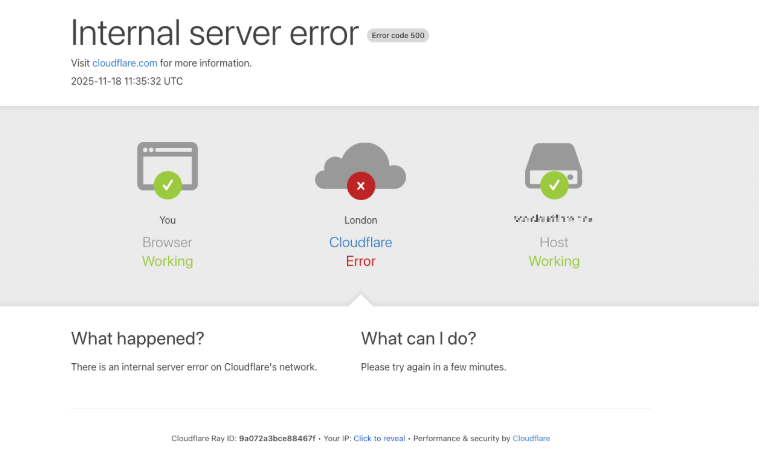
An intermittent outage at Cloudflare recently disrupted numerous prominent websites. While some affected organizations managed to redirect their traffic away from the platform to maintain accessibility, security experts suggest this action might have inadvertently served as an unscheduled network penetration test for those accustomed to Cloudflare’s robust protection against malicious traffic.
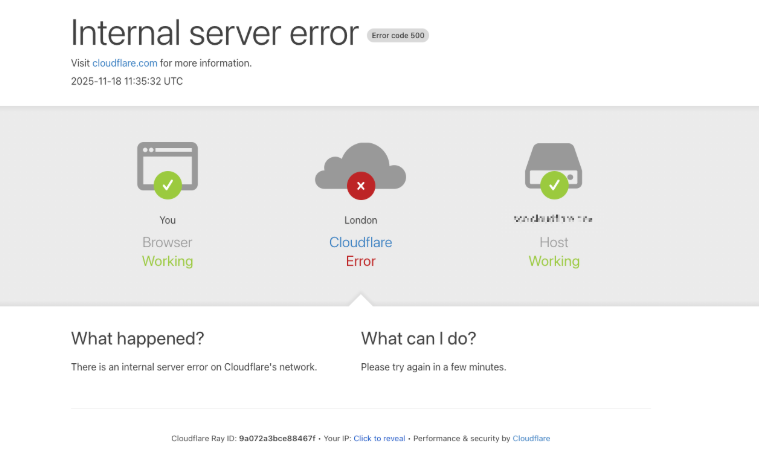
On November 18, around 6:30 EST/11:30 UTC, Cloudflare’s status page reported an “internal service degradation.” Over several hours, Cloudflare services repeatedly failed and recovered. Many websites relying on Cloudflare encountered difficulties migrating away from its services, either due to an inaccessible Cloudflare portal or because they also depended on Cloudflare for their Domain Name System (DNS) services.
Despite these challenges, some customers successfully redirected their domains away from Cloudflare during the incident. According to Aaron Turner, a faculty member at IANS Research, these organizations should meticulously review their web application firewall (WAF) logs from that period.
Turner noted that Cloudflare’s WAF effectively filters malicious traffic, including common application-layer attacks listed in the OWASP Top Ten, such as credential stuffing, cross-site scripting, SQL injection, bot attacks, and API abuse. He suggested the outage presented an opportunity for Cloudflare users to assess the shortcomings of their own application and website defenses when Cloudflare’s protection is absent.
He explained that developers might have become complacent regarding issues like SQL injection, relying on Cloudflare to mitigate such threats at the network edge. Similarly, security quality assurance might have been less rigorous in areas where Cloudflare served as the primary control layer.
Turner mentioned a company he advises experienced a significant surge in log volume during the outage, and efforts are ongoing to distinguish genuinely malicious activity from mere noise.
Turner highlighted an approximate eight-hour period during which several prominent websites bypassed Cloudflare for availability reasons. He pointed out that many organizations depend on Cloudflare for protection against OWASP Top Ten web application vulnerabilities and extensive bot blocking. He urged any organization that made this decision to thoroughly examine any exposed infrastructure for persistent threats, even after Cloudflare protections were reinstated.
He suggested that certain cybercrime groups likely observed when their target online merchants temporarily ceased using Cloudflare’s services during the disruption.
Turner elaborated, imagining an attacker who previously found Cloudflare an impediment. Upon noticing DNS changes indicating a target had removed Cloudflare from their web stack due to the outage, such an attacker would likely initiate a flurry of new attacks, exploiting the absence of the protective layer.
Nicole Scott, a senior product marketing manager at Replica Cyber in McLean, Va., described the outage as “a free tabletop exercise, whether intended or not.”
In a LinkedIn post, Scott characterized the brief outage as a “live stress test” revealing how an organization bypasses its own control plane and how “shadow IT” emerges under pressure. She advised examining not only the traffic received during weakened protections but also internal organizational behavior.
Scott suggested organizations seeking security insights from the Cloudflare outage should consider the following questions:
- What protections were disabled or bypassed (e.g., WAF, bot protections, geo blocks), and for what duration?
- What emergency DNS or routing modifications were implemented, and who authorized them?
- Did personnel resort to personal devices, home Wi-Fi, or unauthorized Software-as-a-Service providers to circumvent the outage?
- Were any new services, tunnels, or vendor accounts established as temporary measures?
- Is there a strategy to revert these changes, or have they become permanent workarounds?
- For future incidents, what is the deliberate fallback plan, as opposed to improvised, decentralized solutions?
Cloudflare’s postmortem report, released Tuesday evening, stated that the disruption was not a result of any cyberattack or malicious activity.
According to Cloudflare CEO Matthew Prince, the outage was caused by a permission change in a database system. This change led the database to generate numerous entries into a “feature file” utilized by their Bot Management system, causing the file to double in size. The oversized feature file was then distributed across Cloudflare’s entire network.
Cloudflare estimates approximately 20 percent of websites use its services. Given that a significant portion of the modern web also heavily relies on a few other major cloud providers like AWS and Azure, even a short outage at any of these platforms can introduce a single point of failure for numerous organizations.
Martin Greenfield, CEO of the IT consultancy Quod Orbis, commented that the Tuesday outage served as a further reminder that many organizations might be overly dependent on a single provider.
Greenfield recommended several practical and necessary solutions: diversifying infrastructure, distributing WAF and DDoS protection across multiple zones, utilizing multi-vendor DNS, segmenting applications to prevent a single provider outage from cascading, and continuously monitoring controls to identify single-vendor dependencies.
