


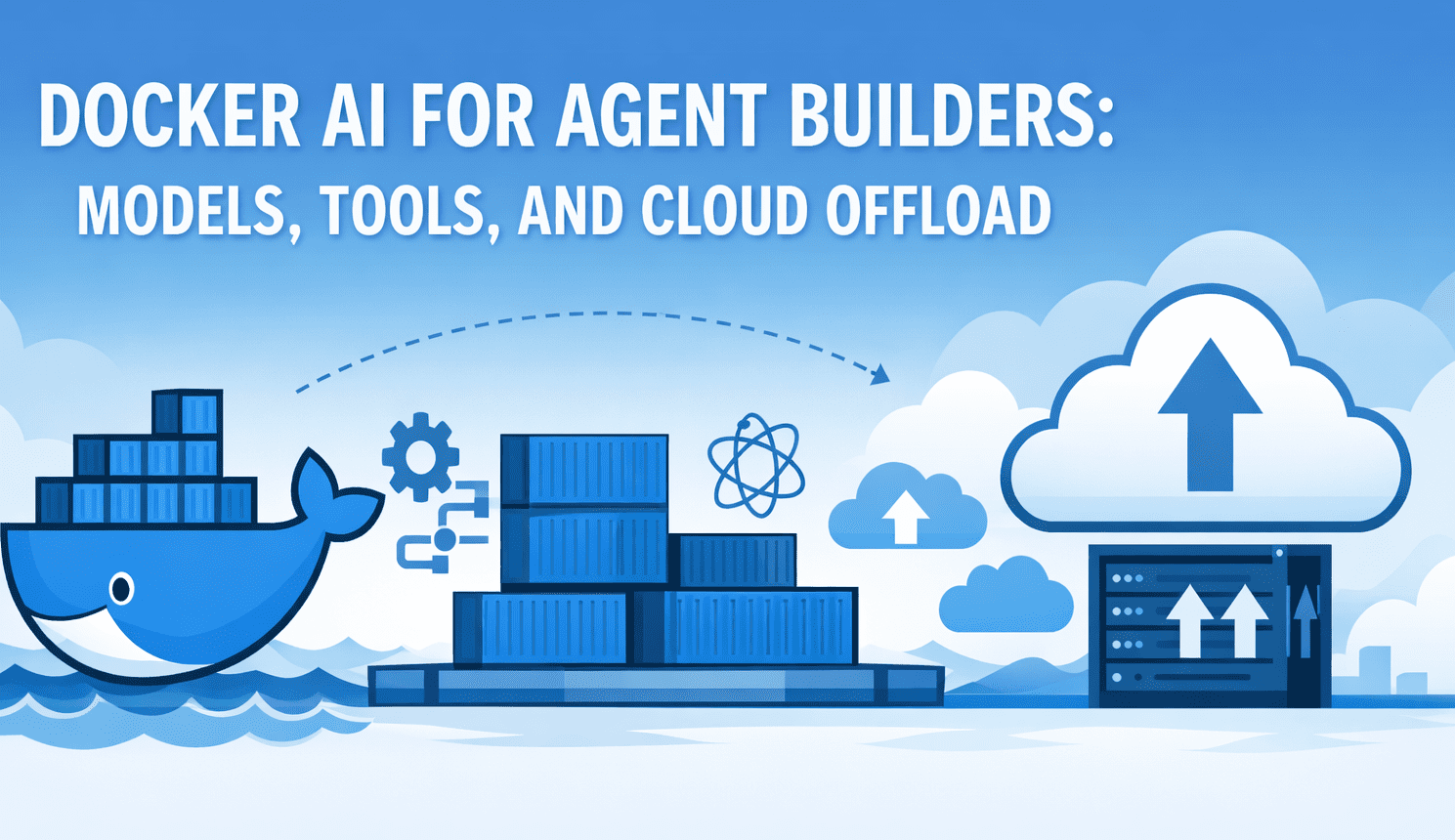



The Value of Docker
Building autonomous AI systems is no longer just about prompting a large language model. Modern agents coordinate multiple models, call external tools, manage memory, and scale across heterogeneous compute environments. Success is determined not just by model quality, but by infrastructure design.
Agentic Docker represents a shift in the approach to that infrastructure. Instead of treating containers as a packaging afterthought, Docker becomes the composable backbone of agent systems. Models, tool servers, GPU resources, and application logic can all be defined declaratively, versioned, and deployed as a unified stack. The result is portable, reproducible AI systems that behave consistently from local development to cloud production.
This article explores five infrastructure patterns that make Docker a powerful foundation for building robust, autonomous AI applications.
1. Docker Model Runner: A Local Gateway
The Docker Model Runner (DMR) is ideal for experiments. Instead of configuring separate inference servers for each model, DMR provides a unified, OpenAI-compatible application programming interface (API) to run models pulled directly from Docker Hub. An agent can be prototyped using a powerful 20B-parameter model locally, then switched to a lighter, faster model for production — all by changing just the model name in the code. It turns large language models (LLMs) into standardized, portable components.
Basic usage:
# Pull a model from Docker Hub
docker model pull ai/smollm2

# Run a one-shot query
docker model run ai/smollm2 "Explain agentic workflows to me."

# Use it via the OpenAI Python SDK
from openai import OpenAI
client = OpenAI(
    base_url="http://model-runner.docker.internal/engines/llama.cpp/v1",
    api_key="not-needed"
)
2. Defining AI Models in Docker Compose
Modern agents sometimes use multiple models, such as one for reasoning and another for embeddings. Docker Compose now allows these models to be defined as top-level services in a compose.yml file, making the entire agent stack — business logic, APIs, and AI models — a single deployable unit.
This helps bring infrastructure-as-code principles to AI. One can version-control the complete agent architecture and spin it up anywhere with a single docker compose up command.
3. Docker Offload: Cloud Power, Local Experience
Training or running large models can strain local hardware. Docker Offload solves this by transparently running specific containers on cloud graphics processing units (GPUs) directly from a local Docker environment.
This enables development and testing of agents with heavyweight models using a cloud-backed container, without learning a new cloud API or managing remote servers. The workflow remains entirely local, but the execution is powerful and scalable.
4. Model Context Protocol Servers: Agent Tools
An agent is only as effective as the tools it can use. The Model Context Protocol (MCP) is an emerging standard for providing tools (e.g. search, databases, or internal APIs) to LLMs. Docker’s ecosystem includes a catalogue of pre-built MCP servers that can be integrated as containers.
Instead of writing custom integrations for every tool, a pre-made MCP server can be used for PostgreSQL, Slack, or Google Search. This allows focus on the agent’s reasoning logic rather than the plumbing.
5. GPU-Optimized Base Images for Custom Work
When fine-tuning a model or running custom inference logic, starting from a well-configured base image is essential. Official images like PyTorch or TensorFlow come with CUDA, cuDNN, and other essentials pre-installed for GPU acceleration. These images provide a stable, performant, and reproducible foundation. They can be extended with custom code and dependencies, ensuring the custom training or inference pipeline runs identically in development and production.
Putting It All Together
The real power lies in composing these elements. Below is a basic docker-compose.yml file that defines an agent application with a local LLM, a tool server, and the ability to offload heavy processing.
services:
  # our custom agent application
  agent-app:
    build: ./app
    depends_on:
      - model-server
      - tools-server
    environment:
      LLM_ENDPOINT: http://model-server:8080
      TOOLS_ENDPOINT: http://tools-server:8081

  # A local LLM service powered by Docker Model Runner
  model-server:
    image: ai/smollm2:latest # Uses a DMR-compatible image
    platform: linux/amd64
    # Deploy configuration could instruct Docker to offload this service
    deploy:
      resources:
        reservations:
          devices:
            - driver: nvidia
              count: all
              capabilities: [gpu]

  # An MCP server providing tools (e.g. web search, calculator)
  tools-server:
    image: mcp/server-search:latest
    environment:
      SEARCH_API_KEY: ${SEARCH_API_KEY}

# Define the LLM model as a top-level resource (requires Docker Compose v2.38+)
models:
  smollm2:
    model: ai/smollm2
    context_size: 4096
This example illustrates how services are linked.
Agentic systems demand more than clever prompts. They require reproducible environments, modular tool integration, scalable compute, and clean separation between components. Docker provides a cohesive way to treat every part of an agent system — from the large language model to the tool server — as a portable, composable unit.
By experimenting locally with Docker Model Runner, defining full stacks with Docker Compose, offloading heavy workloads to cloud GPUs, and integrating tools through standardized servers, a repeatable infrastructure pattern for autonomous AI is established.
Whether building with LangChain or CrewAI, the underlying container strategy remains consistent. When infrastructure becomes declarative and portable, focus can shift from environment friction to designing intelligent behavior.
